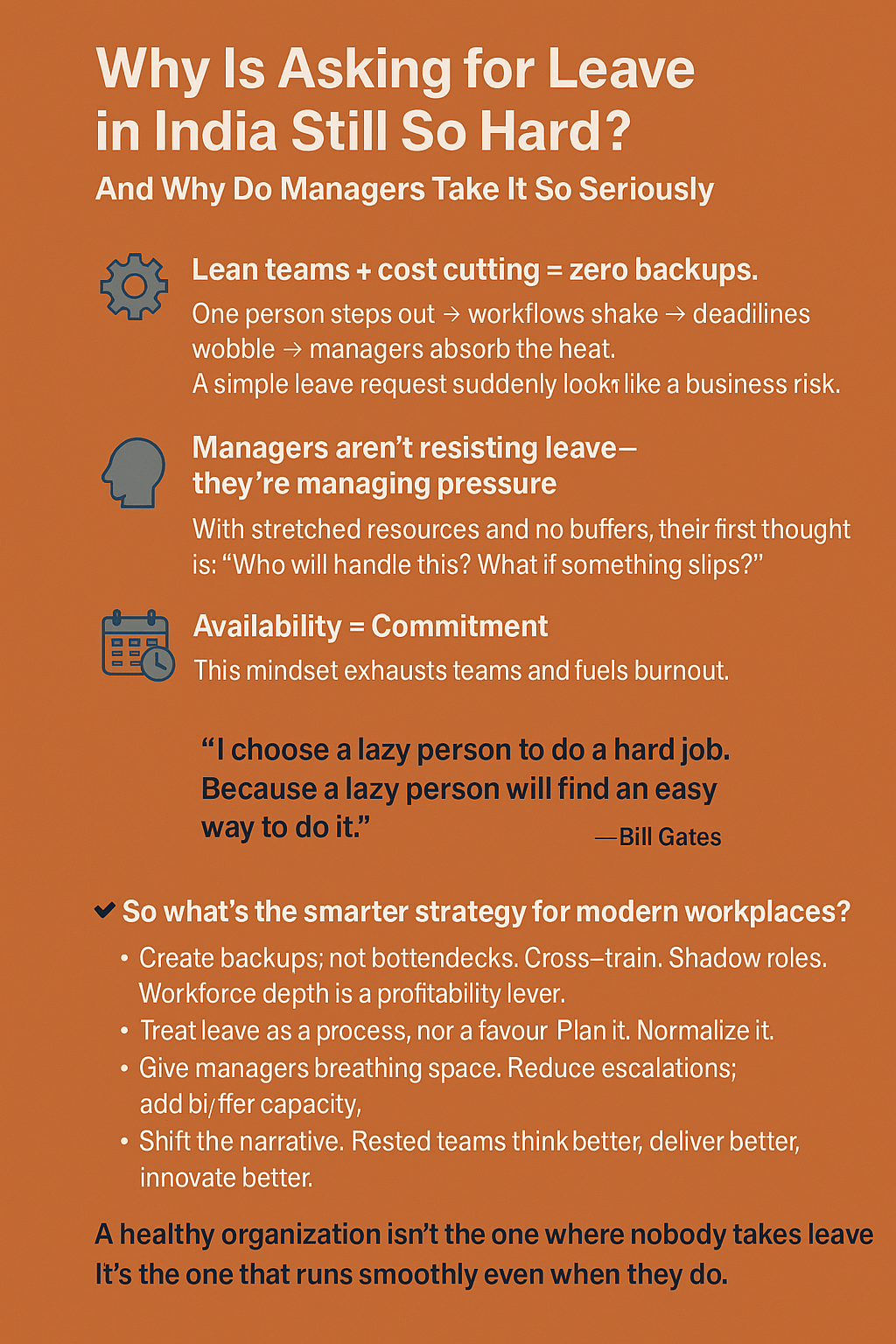
In many Indian workplaces, asking for leave often feels like stepping into a negotiation—sometimes even a confrontation. But the uncomfortable truth is this: the difficulty has less to do with people and more to do with how our work systems are designed.
Let’s unpack the real reasons.
1️⃣ Lean Teams + Cost Cutting = Zero Backups
Over the last decade, organizations have chased efficiency aggressively—small teams, tight budgets, “do more with less” mandates.
So when one employee steps out, it creates:
- workflow disruptions
- deadline pressure
- customer dissatisfaction
- workload spikes for managers
A simple leave request suddenly looks like a business risk, not a personal right.
Peter Drucker once said,
“Efficiency is doing things right; effectiveness is doing the right things.”
But many companies today are “efficient” at the cost of effectiveness and human sustainability.
2️⃣ Managers Aren’t Denying Leave — They’re Managing Invisible Pressure
Most managers operate under intense constraints:
- unrealistic timelines
- insufficient manpower
- constant escalations
- performance pressure from above
So when a leave request arrives, their mental filters ask:
- Who will do this in their absence?
- What if delivery slips?
- Will this become a client escalation?
This isn’t resistance—this is fear of downstream consequences.
As Simon Sinek said:
“A boss has the title. A leader has the people.”
Managers need systems that let them lead, not fear operational breakdowns.
3️⃣ Our Cultural Lens: Availability = Commitment
Indian workplaces still carry a legacy mindset:
- Being always available = loyal
- Saying no = non-cooperative
- Taking leave = lack of seriousness
This belief quietly fuels burnout and guilt-driven working styles.
But as Arianna Huffington rightly said:
“Burnout is not the price you pay for success.”
4️⃣ The Real Cost of Not Taking Leave
When teams avoid breaks because of pressure or guilt:
- innovation slows
- mistakes increase
- engagement drops
- attrition rises
- productivity becomes inconsistent
Companies lose more in the long run by not allowing people to rest.
5️⃣ So What’s the Smarter Strategy for Future-Ready Organizations?
✔ Build Backup Capacity
Create role redundancies, cross-training frameworks, and shadow responsibilities.
A business that depends on “one person per function” is fragile by design.
✔ Normalize Leave as a Process, Not a Problem
Leave management should be predictable, documented, and planned—just like budgets or delivery cycles.
✔ Give Managers Psychological Safety
If managers feel they’ll be penalized for approving leave, they’ll naturally resist it.
✔ Design for Humanity, Not Hyper-Optimization
Humans are not machines.
Systems need buffer capacity, not burnout capacity.
✔ Shift the Mindset
Rested employees outperform exhausted ones—consistently.
As Bill Gates famously said:
“I choose a lazy person to do a hard job. They will find an easy way to do it.”
Rest is not inefficiency. Rest is strategy.
Final Thought
The difficulty of asking for leave in India isn’t a failure of employees or managers—
it’s a failure of organizational design.
A truly healthy workplace isn’t the one where nobody takes leave.
It’s the one that runs smoothly even when they do.
And that’s the real mark of a resilient, modern, and humane organization.