Let me begin with a simple but uncomfortable question.
How many powerful ideas have you had that never translated into action?
Ideas about starting a venture.
Ideas about investing.
Ideas about writing, building, launching, or leading.
If we are honest, most people are not short of ambition. They are short of execution.
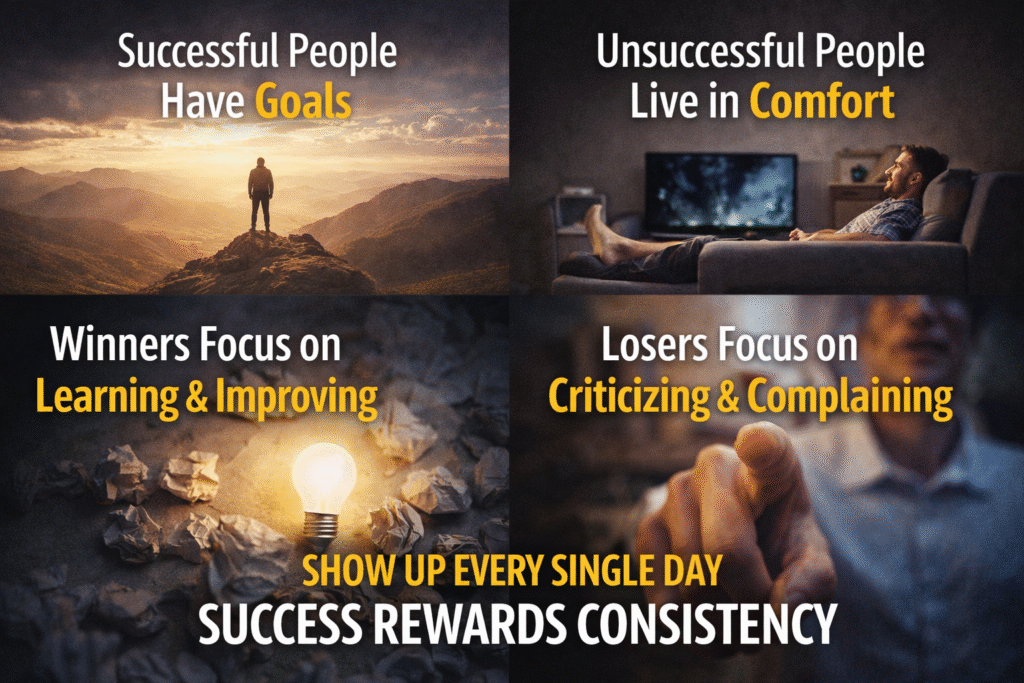
Across decades of observing leaders, founders, and high performers, one pattern stands out with striking clarity. The single biggest difference between successful and unsuccessful people is not intelligence, education, or even opportunity.
It is bias for action.
Successful people act before they feel fully ready. They move with imperfect information. They test, learn, fail, adapt, and keep going.
Unsuccessful people often wait for clarity, certainty, and the “right time.”
But the real world rewards motion, not intention.
Why Action Changes Everything
Action does three things that thinking alone never can:
1. It creates real feedback
Markets respond. Customers react. Data emerges.
2. It builds confidence
Progress reduces fear more effectively than planning.
3. It compounds over time
Small actions accumulate into disproportionate outcomes.
Clarity is rarely found before action. It is discovered through action.
Real World Examples of Bias for Action
Jeff Bezos and the Birth of E-Commerce
When Jeff Bezos founded Amazon in 1994, online commerce was experimental at best.
Internet penetration was low. Consumer trust was weak. Logistics systems were underdeveloped.
He did not wait for ecosystem maturity. He started with books, the most logical entry category, and built systems iteratively.
Warehouse by warehouse.
Category by category.
Market by market.
Execution created infrastructure. Infrastructure created scale.
Today, Amazon is not just an e-commerce company. It is a technology, logistics, and cloud computing powerhouse.
Elon Musk and Industrial-Scale Risk Taking
When Elon Musk launched SpaceX, private space exploration sounded implausible.
The early years were brutal. Rockets exploded. Launches failed. Capital nearly ran out.
Most would have paused or pivoted.
Instead, Musk doubled down on engineering iteration and cost innovation. The breakthrough came with reusable rockets, fundamentally altering launch economics.
Execution turned science fiction into commercial reality.
Dhirubhai Ambani and Industrial India
Dhirubhai Ambani did not begin with factories or capital abundance.
He began as a trader.
While many analyzed India’s potential, he built supply chains, manufacturing capacity, and petrochemical scale.
His philosophy was rooted in decisive movement. Think big, but act immediately.
That execution mindset transformed Reliance Industries into one of the largest conglomerates in Asia.
Narayana Murthy and the IT Services Revolution
When N. R. Narayana Murthy co-founded Infosys in 1981, India was not yet seen as a global technology delivery hub.
Infrastructure was limited. Global trust was low. Foreign contracts were difficult to secure.
Rather than waiting for India’s brand to evolve, Murthy and his team built credibility through governance, delivery excellence, and global engagement.
They created the offshore delivery model before it became industry standard.
Execution did not just build a company. It helped build an entire sector.
Sundar Pichai and Product-Led Leadership
Sundar Pichai’s rise within Alphabet Inc. is deeply rooted in execution.
One of his defining contributions was championing Google Chrome.
At the time, the browser market was already dominated. Building another browser looked redundant.
But Pichai saw speed, simplicity, and ecosystem integration as strategic levers.
He pushed forward.
Chrome launched. Adoption surged. It became the world’s most widely used browser, strengthening Google’s platform advantage.
Execution transformed a product bet into a strategic moat.
The Execution Gap in Everyday Careers
This principle is not limited to billion-dollar founders.
It shows up everywhere.
In corporations:
- Some leaders debate strategy endlessly.
- Others pilot initiatives quickly.
In careers:
- Some professionals wait for perfect roles.
- Others build skills through stretch assignments.
In entrepreneurship:
- Some refine business plans for years.
- Others launch MVPs and learn from markets.
The gap is rarely talent. It is velocity of execution.
Wisdom From Those Who Built Through Action
As Tony Robbins said:
“The path to success is to take massive, determined action.”
Walt Disney echoed this mindset:
“The way to get started is to quit talking and begin doing.”
And Thomas Edison offered a grounded reminder:
“Opportunity is missed by most people because it is dressed in overalls and looks like work.”
Each insight reinforces the same truth. Success favors those who move.
The Compounding Power of Doing
Action creates momentum.
Momentum builds belief.
Belief fuels bigger action.
Over time, this becomes a flywheel.
What begins as small execution turns into:
- Market leadership
- Category creation
- Institutional impact
Success is rarely a single breakthrough moment. It is accumulated execution.
A Reflection Worth Sitting With
Are you waiting to feel ready?
Or will readiness come because you started?
Because in the real world:
Perfection delays progress.
Planning delays learning.
Waiting delays growth.
But action accelerates all three.
The difference between successful people and the rest is not that they have better ideas.
It is that they act on them.