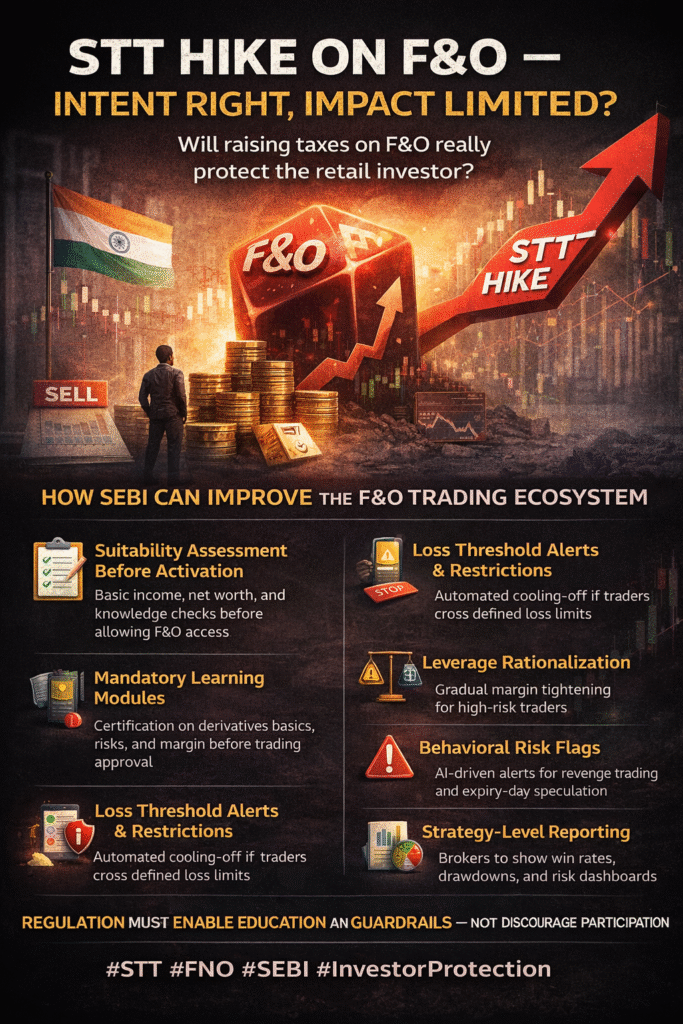
The Government of India recently increased the Securities Transaction Tax (STT) on Futures & Options (F&O) trading, citing a strong investor-protection concern. The rationale shared was direct and emotional — “People are calling us saying they are losing money — we cannot sit and watch.”
There is no doubt that the concern is real.
Over the last few years, retail participation in derivatives has grown at an unprecedented pace. Easy account opening, low brokerage, mobile trading apps, and social media–driven “quick profit” narratives have attracted millions of first-time traders into F&O.
However, data consistently shows that a large percentage of retail traders incur net losses in derivatives trading.
This brings us to the critical question:
Will increasing STT reduce losses or stop excessive F&O trading?
The answer, realistically, is — No.
Why STT Increase Alone May Not Work
F&O trading behavior is not primarily driven by transaction costs. It is driven by:
- Leverage (ability to control large value with small capital)
- Liquidity and quick entry/exit
- Short-term profit expectations
- Psychological triggers like overconfidence and revenge trading
When transaction taxes increase:
- Serious traders absorb the cost as a business expense
- Speculative traders try to recover costs through higher risk trades
- Overtrading may actually increase
- Net profitability reduces, but participation rarely falls sharply
In simple terms, taxation can slow activity — but it does not correct behavior.
The Real Issue: Behavioral & Structural Gaps
Retail losses in F&O are less about market manipulation and more about:
- Lack of derivatives knowledge
- Misunderstanding of leverage risk
- Blind option buying
- Expiry-day speculation
- No stop-loss discipline
- Trading with borrowed or essential funds
Therefore, if the intent is genuine investor protection, the intervention must move beyond taxation into process and participation reform.
A Practical Alternative: Cooling-Off Mechanism
A notable suggestion from industry leaders has been the idea of a temporary trading ban (for example, 3 months) for consistent loss-makers.
Why this could work better:
- Forces traders to pause and reflect
- Breaks addiction-like trading cycles
- Prevents rapid capital erosion
- Encourages learning before re-entry
Behavioral finance research globally shows that forced cooling periods reduce compulsive risk-taking.
How SEBI Can Strengthen the F&O Trading Ecosystem
If the regulatory objective is long-term retail protection, the following structural reforms can create deeper impact:
1. Suitability Assessment Before F&O Activation
Before granting F&O access, brokers could evaluate:
- Income levels
- Net worth
- Trading experience
- Risk understanding
This ensures derivatives are not treated as entry-level products.
2. Mandatory Learning & Certification
A short but compulsory derivatives certification covering:
- Futures vs Options mechanics
- Leverage risk
- Time decay
- Margin obligations
- Loss scenarios
Trading without understanding derivatives is like driving without brakes.
3. Loss Threshold Alerts & Temporary Restrictions
Automated systems can track trader performance and trigger:
- Alerts after defined drawdowns
- Trading limits after repeated losses
- Temporary cooling bans
This introduces risk guardrails without banning participation.
4. Leverage Rationalization
High leverage amplifies both gains and losses.
SEBI could consider:
- Gradual margin tightening for high-risk traders
- Lower leverage for new participants
- Dynamic exposure limits based on trading history
5. AI-Driven Behavioral Risk Flags
Technology can identify harmful trading patterns such as:
- Revenge trading after losses
- Excessive intraday churn
- Expiry-day gambling
- Sudden spike in position sizing
Real-time alerts can nudge traders toward discipline.
6. Strategy-Level Performance Dashboards
Brokers can provide analytics like:
- Win/loss ratio
- Average holding period
- Drawdown history
- Strategy profitability
Visibility drives accountability.
7. Phased Access to Complex Products
Instead of open access:
- Start with hedged strategies
- Allow spreads before naked selling
- Unlock complex trades gradually
This mirrors global best practices.
Taxation vs Education: What Protects More?
| Approach | Impact on Loss Reduction | Behavioral Change |
|---|---|---|
| Higher STT | Low–Moderate | Minimal |
| Education & Certification | High | Strong |
| Loss Restrictions | High | Strong |
| Cooling-Off Periods | High | Strong |
| Leverage Controls | Very High | Structural |
The conclusion is clear:
Investor protection improves more through guardrails than through taxation.
The Way Forward
India’s derivatives market is among the fastest growing globally. Retail participation is a positive sign of financial inclusion — but unmanaged participation creates systemic and personal financial risks.
The regulatory approach should aim to:
- Enable informed participation
- Build knowledge before access
- Introduce behavioral safeguards
- Reduce compulsive speculation
- Protect capital without discouraging markets
Because the real risk in F&O is not volatility —
It is unprepared participation.
For more such insights and in-depth perspectives on markets, regulation, and investor behavior, visit:
www.ratinmathur.com