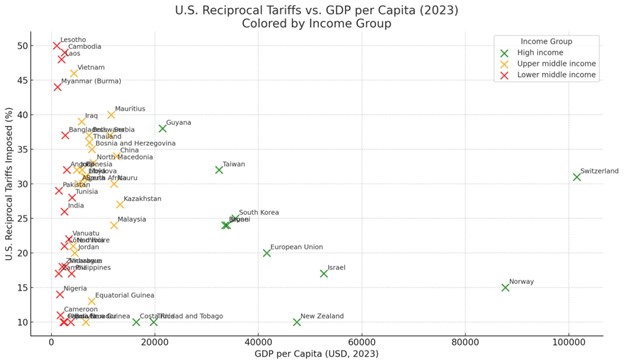
Despite being the world’s largest economy — both in GDP and per capita terms — the U.S. to impose reciprocal tariffs, even on low- and middle-income countries (LMICs) with far lower economic capacity.
But here’s the real question: Should the U.S. apply the same tariff logic to a $2,000-per-capita economy as it does to a $50,000 one?
🔍 Why does the U.S. impose tariffs on poorer countries?
Even Low Middle Income Countries (LMICs) aren’t spared — and it’s often due to:
🔄 Reciprocity – Retaliating against high tariffs on U.S. goods
📉 Trade deficit control – Reducing reliance on imports
🗳️ Domestic pressure – Protecting U.S. jobs and industries
🧩 Negotiation leverage – Forcing trade reforms abroad
🎯 Does it work?
✅ Short-term gains
📌 Temporary relief for domestic industries
📌 Leverage in trade talks
📌 Appears “strong” politically
❌ Long-term damage
📌 Penalizes LMIC exporters who depend on U.S. markets
📌 Disrupts supply chains and inflates domestic prices
📌 Damages diplomatic trust and soft power
📌 Encourages retaliation against U.S. exports (e.g., agriculture, manufacturing)
📉 Tariffs are a tax — and Americans pay the price:
📌 Consumers face higher prices
📌 Global firms operating in the U.S. absorb higher input costs
📌 Inflation rises due to costlier imports
📌 And exports shrink if partners hit back
🔍 A 2019 Fed-Princeton study found that U.S. consumers and firms bore nearly 100% of tariff costs during the China trade war.
🤝 Diplomatic Fallout? Absolutely.
Tariffs on LMICs may be viewed as punishment for underdevelopment — hurting alliances and trust in systems like the WTO. It creates the perception that U.S. trade policy is transactional, not transformational.
🧠 What’s the smarter strategy?
Instead of blanket reciprocity, consider:
✅ Calibrated tariffs based on economic strength
✅ Support for fair trade without punishing vulnerability
✅ Win-win frameworks that promote long-term stability
✅ Non-tariff measures to address disputes (e.g., standards, partnerships, aid-for-trade)
📊 Bottom line: Tariffs may seem tough — but they often backfire.
They raise prices at home, hurt global partnerships, and create long-term risks for U.S. leadership.
💬 What’s your take — Are reciprocal tariffs on developing nations fair, or is it time for a smarter, more inclusive trade strategy?