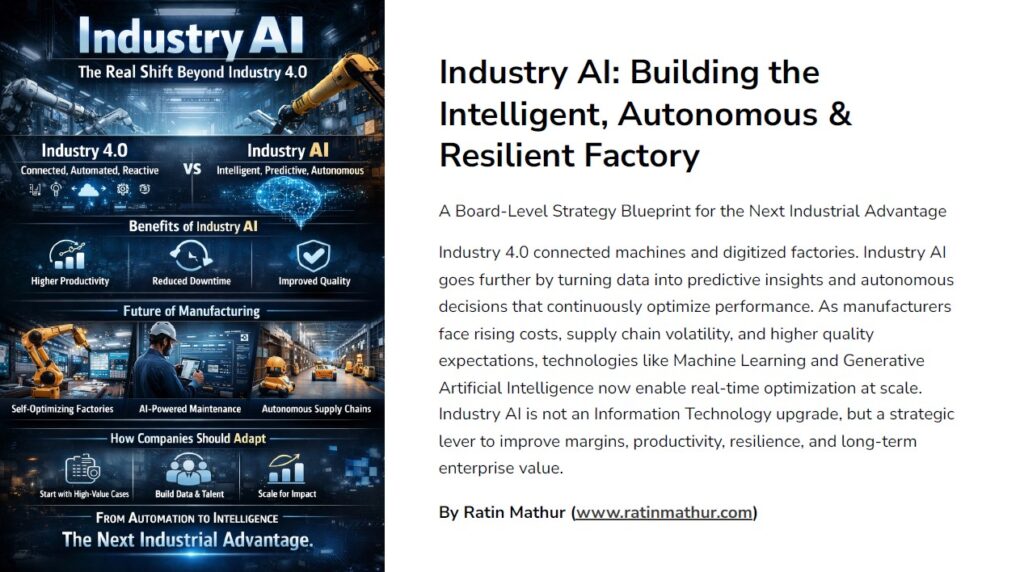
Introduction: Manufacturing Is Entering Its Intelligence Era
Manufacturing has always evolved through waves of transformation. Mechanization defined the first industrial revolution. Electrification enabled mass production. Automation and computers brought precision and scale. Industry 4.0 introduced connectivity through the Internet of Things, cloud computing, robotics, and digital twins.
Today, we stand at the next inflection point: Industry AI.
Industry 4.0 connected machines and created visibility across operations. Industry AI converts that data into intelligence, autonomy, and continuous optimization. This shift is not about incremental efficiency. It represents a fundamental transformation in how manufacturing decisions are made, how factories operate, and how competitive advantage is built.
The manufacturers that embrace Industry AI strategically will not simply reduce costs. They will redesign their operating models, improve resilience, accelerate innovation, and build structural margin advantage.
Industry 4.0 vs Industry AI: Understanding the Difference
To understand Industry AI, it is essential to clarify what it is not.
Industry 4.0 focused on connectivity and digitization. Sensors were installed on machines. Data was transmitted to cloud platforms. Enterprise Resource Planning systems were integrated. Robotics automated repetitive tasks. Digital twins replicated physical assets in virtual form.
These developments created transparency. Leaders could see what was happening in their factories in real time.
However, most decisions remained human driven. Optimization still required manual analysis. Forecasts relied on historical trends. Maintenance was scheduled based on rules or thresholds. Quality inspection often involved sampling rather than full automation.
Industry AI changes this dynamic.
Industry AI uses Machine Learning, Deep Learning, Computer Vision, Reinforcement Learning, and Generative Artificial Intelligence to:
- Predict failures before they occur
- Optimize production schedules dynamically
- Detect microscopic defects instantly
- Simulate thousands of supply chain scenarios
- Accelerate product design cycles
In short, Industry 4.0 created data visibility. Industry AI creates autonomous intelligence.
The difference is profound. One connects systems. The other continuously improves them.
The Five Core Value Pools of Industry AI
Artificial Intelligence in manufacturing creates value across five major domains. Each offers different economic potential and implementation complexity.
1. Smart Operations Optimization
At the heart of manufacturing lies production optimization. Traditional production planning relies on fixed schedules and manual adjustments. Unexpected events such as machine breakdowns, material delays, or demand shifts disrupt plans.
Industry AI introduces dynamic optimization. Machine Learning algorithms analyze real time production data, demand forecasts, and capacity constraints to adjust schedules continuously.
Reinforcement Learning systems learn which production configurations yield the best outcomes over time. Digital twins simulate thousands of potential scenarios before physical changes are made.
Impact typically includes:
- 5% to 15% throughput improvement
- 20% to 30% scrap reduction
- Higher asset utilization
- Lower energy consumption
In advanced cases, factories move toward self optimizing production lines where parameters are adjusted automatically without manual intervention.
2. Predictive and Prescriptive Maintenance
Unplanned downtime remains one of the most expensive operational risks in manufacturing. Traditional preventive maintenance relies on fixed schedules, often leading to unnecessary servicing or unexpected breakdowns.
Industry AI uses sensor data, vibration analysis, temperature monitoring, and historical failure patterns to predict equipment failure before it occurs.
Prescriptive maintenance goes further. It not only predicts failure but recommends the optimal time and method for intervention, balancing cost, risk, and operational impact.
Organizations deploying AI driven maintenance commonly report:
- 30% to 50% reduction in unplanned downtime
- 10% to 20% maintenance cost savings
- Improved Overall Equipment Effectiveness
- Reduced spare parts inventory
Beyond cost savings, predictive maintenance increases reliability, which strengthens customer trust and delivery performance.
3. AI-Driven Quality and Zero-Defect Manufacturing
Quality expectations have tightened dramatically. Customers demand near zero defects, while regulatory requirements have intensified in sectors such as automotive, aerospace, and pharmaceuticals.
Artificial Intelligence powered Computer Vision systems can inspect 100% of production output in real time. They detect microscopic cracks, alignment issues, surface imperfections, and assembly deviations with far greater accuracy than human inspection.
Machine Learning models can also identify root causes of recurring defects by analyzing process variables and correlating them with quality outcomes.
The results are significant:
- Up to 90% defect detection accuracy
- Reduction in inspection labor costs
- Lower warranty and recall exposure
- Stronger brand reputation
As these systems mature, quality control transitions from reactive defect correction to proactive defect prevention.
4. Autonomous Supply Chains
Recent global disruptions exposed vulnerabilities in traditional supply chains. Static forecasting models and linear planning systems proved insufficient in volatile environments.
Industry AI transforms supply chain management by:
- Improving demand forecasting accuracy using Machine Learning
- Optimizing inventory levels dynamically
- Modeling supplier risk exposure
- Simulating geopolitical and logistics disruptions
Artificial Intelligence based control towers integrate internal and external data sources to provide real time decision support.
Organizations that deploy AI in supply chains often achieve:
- 15% to 25% inventory reduction
- 20% to 30% forecast accuracy improvement
- Lower working capital requirements
- Greater resilience during disruptions
Autonomous supply chains are not only more efficient. They are strategically more robust.
5. AI-Accelerated Engineering and Product Development
Innovation speed is becoming a competitive differentiator. Traditional product development cycles are time consuming and resource intensive.
Generative Artificial Intelligence and advanced simulation models enable engineers to explore thousands of design alternatives rapidly. AI systems can propose lightweight structures, optimize material selection, and predict performance outcomes before physical prototypes are built.
This leads to:
- 30% to 50% reduction in design cycle time
- Lower material usage
- Faster time to market
- Greater customization capability
In the future, engineers will collaborate with AI copilots that assist in design decisions, documentation, and compliance checks.
Quantifying the Financial Impact
Industry AI is not a technology experiment. It is a financial transformation lever.
When implemented at scale, Artificial Intelligence in manufacturing can drive:
- 3% to 8% margin expansion
- 10% to 20% reduction in operating costs
- 20% to 40% productivity improvement
- 15% to 25% reduction in inventory
- Significant reduction in capital tied up in buffer stock
Importantly, these gains compound over time. As AI systems learn and improve, performance continues to enhance beyond initial implementation.
The impact becomes visible at the Earnings Before Interest and Taxes level, making Industry AI a board level strategic priority rather than an operational initiative.
Sustainability and Energy Optimization
Sustainability is no longer optional. Manufacturers face regulatory requirements, investor scrutiny, and consumer expectations related to environmental performance.
Artificial Intelligence enables:
- Real time energy optimization
- Carbon emission tracking
- Waste reduction through yield improvement
- Predictive environmental compliance
Machine Learning models can optimize energy usage during peak load periods, reducing both cost and emissions. Process optimization reduces raw material waste, contributing to circular economy goals.
Industry AI therefore aligns financial performance with Environmental, Social, and Governance objectives.
Risks and Implementation Challenges
Despite its promise, Industry AI implementation is not straightforward. Key challenges include:
Data quality issues. Poorly structured or siloed data undermines model accuracy.
Cybersecurity risk. Increased connectivity expands the attack surface for cyber threats.
Talent shortages. Skilled professionals who understand both operations and Artificial Intelligence are scarce.
Change resistance. Plant operators may distrust algorithmic decisions.
Pilot paralysis. Many organizations run multiple small pilots without scaling successful solutions.
Overcoming these challenges requires strong governance, leadership commitment, and a structured roadmap.
A Strategic Implementation Roadmap
To capture value effectively, manufacturers should adopt a phased approach.
First, identify high Return on Investment use cases such as predictive maintenance or AI driven quality control. These provide measurable impact and quick wins.
Second, build a scalable data architecture. Standardize data collection, ensure interoperability, and invest in cloud infrastructure.
Third, create cross functional teams combining operations leaders, data scientists, and Information Technology experts.
Fourth, move beyond pilots. Define clear performance thresholds that trigger enterprise wide scaling.
Fifth, embed Artificial Intelligence into daily workflows. AI must become part of the operating system, not an external tool.
Governance structures should ensure accountability, cybersecurity oversight, and ethical compliance.
The Future of the Autonomous Factory
Over the next decade, Industry AI will reshape manufacturing fundamentally.
Factories will self optimize continuously based on demand signals and operational constraints. Maintenance will become largely prescriptive. Supply chains will simulate disruptions before they occur. Engineers will collaborate with Artificial Intelligence to accelerate innovation.
Human roles will evolve from manual intervention to oversight, exception management, and strategic decision making.
The competitive landscape will shift from scale advantage to intelligence density. The organizations that learn faster and adapt quicker will dominate.
Leadership Imperative: Act with Strategic Intent
Industry AI is not an Information Technology upgrade. It is a strategic operating model transformation.
Leaders must:
- Tie Artificial Intelligence investments directly to financial metrics
- Prioritize scalable high impact use cases
- Invest in data infrastructure and talent
- Establish board level governance
- Revisit Artificial Intelligence strategy annually
The window for advantage is limited. As Artificial Intelligence adoption accelerates, performance gaps between leaders and laggards will widen structurally.
Conclusion: From Automation to Intelligence
Manufacturing is moving from automation to intelligence.
Industry 4.0 connected the factory. Industry AI makes it self learning, adaptive, and autonomous.
The organizations that embrace this shift will not only reduce costs. They will redefine productivity, resilience, sustainability, and innovation speed. They will build structural advantage that compounds over time.
Industry AI represents the next industrial revolution. The question is no longer whether to adopt it. The real question is how quickly and strategically it can be scaled.
The future of manufacturing belongs to intelligent enterprises.
References
- McKinsey & Company — The Next Normal in Manufacturing
https://www.mckinsey.com/capabilities/operations/our-insights - Boston Consulting Group — AI in Industrial Operations
https://www.bcg.com/publications/ai-industrial-operations - World Economic Forum — Fourth Industrial Revolution Reports
https://www.weforum.org/agenda/archive/fourth-industrial-revolution - Deloitte — AI in Manufacturing Study
https://www2.deloitte.com/global/en/pages/manufacturing/articles/ai-in-manufacturing.html - PwC — Industry 4.0 and Digital Manufacturing
https://www.pwc.com/gx/en/industries/industrial-manufacturing/industry-4-0.html - MIT Sloan Management Review — Artificial Intelligence in Operations
https://sloanreview.mit.edu/tag/artificial-intelligence - Siemens — Digital Enterprise and Industrial AI
https://www.siemens.com/global/en/company/topic-areas/digital-enterprise.html - World Economic Forum — Global Lighthouse Network
https://www.weforum.org/projects/global-lighthouse-network - Accenture — AI in Industrial Manufacturing
https://www.accenture.com/us-en/industries/industrial-equipment - Gartner — Artificial Intelligence in Manufacturing Research
https://www.gartner.com/en/industries/manufacturing