Executive Summary
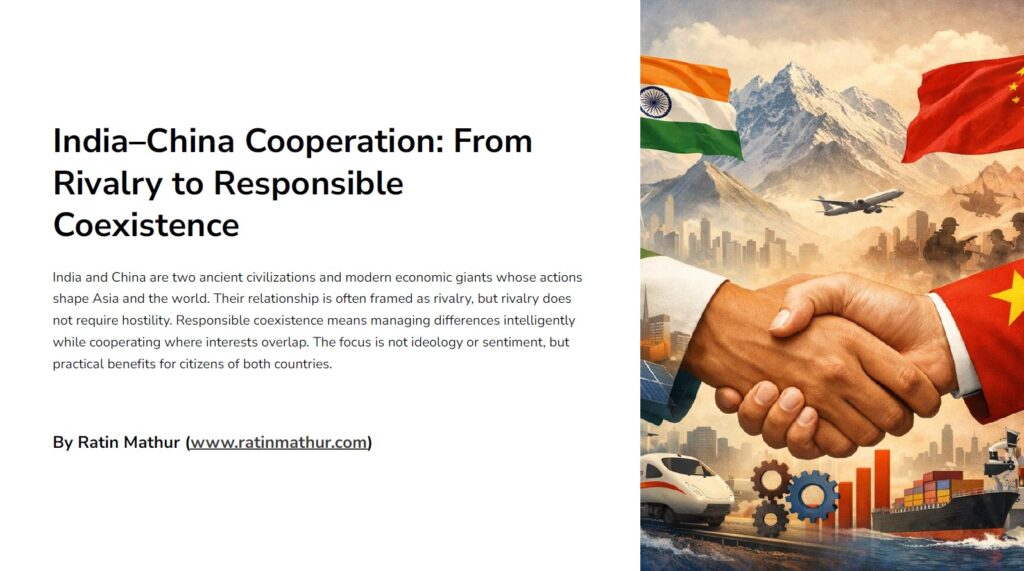
India and China are two of the world’s oldest civilizations and most influential contemporary powers. Together, they account for over one-third of the global population and play a decisive role in shaping Asia’s economic, geopolitical, and environmental future. While their relationship is often characterized by rivalry and mistrust, long-term confrontation carries significant costs for both nations and their people.
This report presents a pragmatic, citizen-centric framework for how India and China can manage their differences, pursue selective cooperation, and reduce systemic risks without compromising core national interests. The emphasis is not on resolving all disputes, but on preventing disagreements from escalating into instability and ensuring that competition remains predictable, bounded, and constructive.
1. Why India–China Cooperation Matters
India and China are not natural allies, but they are unavoidable neighbors and systemic stakeholders. The quality of their relationship directly affects:
- Regional peace and security in Asia
- Global supply chains, trade flows, and investment confidence
- Climate change mitigation and disaster resilience
- The economic well-being of billions of people
In an era of global fragmentation, sustained hostility between Asia’s two largest powers would weaken regional growth and increase global volatility. Conversely, managed coexistence creates stability that benefits not only both nations but the wider international system.
2. The Tangible Benefits of Cooperation
2.1 Economic Stability and Growth
Stable relations reduce uncertainty for businesses, manufacturers, and investors. Cooperation in critical supply chains such as pharmaceuticals, renewable energy components, and electronics lowers production costs and shields consumers from inflationary shocks.
2.2 Reduced Human and Military Costs
De-escalation along the border minimizes the risk of accidental conflict, loss of life, and prolonged military deployments. Resources saved from reduced tensions can be redirected toward education, healthcare, and infrastructure.
2.3 Climate and Disaster Resilience
India and China share ecological systems, particularly in the Himalayan region. Data sharing and scientific cooperation can significantly reduce the impact of floods, droughts, and extreme weather events on millions of people.
2.4 Regional and Global Stability
A stable India–China relationship strengthens Asia’s growth outlook, reassures neighboring countries, and improves the effectiveness of multilateral institutions addressing global challenges.
3. The Core Challenges That Cannot Be Ignored
3.1 Unresolved Border Disputes
The absence of a mutually agreed boundary has led to repeated stand-offs. Tactical incidents can escalate quickly due to misperception and heightened alertness.
3.2 Strategic Mistrust
Past confrontations have hardened public opinion and institutional attitudes on both sides. This trust deficit complicates even non-security cooperation.
3.3 Economic Asymmetry
Large trade imbalances and dependency in critical sectors generate political anxiety and fears of strategic vulnerability.
3.4 Domestic Politics and Nationalism
Public sentiment, media narratives, and political incentives often reward hardline positions, limiting diplomatic flexibility.
4. A Pragmatic Framework for Moving Forward
Rather than seeking sweeping agreements, progress is more realistic through a phased and functional approach.
Phase 1: Stabilize
- Strengthen confidence-building measures along the border
- Establish reliable military and diplomatic communication channels
- Introduce clear protocols for incident management and de-escalation
The goal is to prevent crises, not resolve sovereignty disputes.
Phase 2: Manage Economic Frictions
- Identify critical supply chains and ensure continuity through predictable rules
- Promote sector-specific cooperation where mutual dependence already exists
- Use transparent, rule-based trade remedies instead of ad-hoc restrictions
This phase reduces economic shocks and domestic backlash.
Phase 3: Institutionalize Cooperation
- Embed collaboration in climate science, water management, and public health
- Leverage multilateral platforms to reduce bilateral pressure
- Expand people-to-people exchanges in education, research, and business
Institutions make cooperation durable beyond political cycles.
5. Making Cooperation Sustainable
The most durable form of stability emerges when disruption becomes costly for all sides. Shared economic projects, joint public-goods delivery, and visible citizen benefits create domestic constituencies that favor restraint over escalation.
Cooperation does not require trust at the outset. It builds trust through repeated, verifiable outcomes.
6. Key Insight for Leaders and Policymakers
India and China do not need to agree on borders, ideology, or historical narratives to act responsibly. Strategic maturity lies in separating areas of disagreement from areas of mutual interest and ensuring that competition does not become conflict.
Responsible coexistence is not a concession. It is a calculated investment in long-term national strength and citizen well-being.
Conclusion
The future of Asia, and to a significant extent the global order, will be shaped by how India and China manage their relationship. Permanent confrontation imposes high and recurring costs, while pragmatic cooperation delivers stability, resilience, and shared prosperity.
The choice before both nations is not between rivalry and friendship, but between unmanaged tension and strategic coexistence. For the sake of their people and the wider world, the latter is the wiser path.
References
- Acharya, A. (2014). The end of American world order. Polity Press.
- Bajpai, K. P., & Mattoo, A. (2016). India and China: Cooperation and conflict. Oxford University Press.
- Ministry of External Affairs, Government of India. (2020). Agreements and confidence-building measures between India and China. https://mea.gov.in
- Garver, J. W. (2016). China’s quest: The history of the foreign relations of the People’s Republic of China. Oxford University Press.
- World Bank. (2023). World development indicators. https://www.worldbank.org
- International Monetary Fund. (2024). World economic outlook. https://www.imf.org
- Council on Foreign Relations. (2023). China–India relations. https://www.cfr.org
- Kissinger, H. (2014). World order. Penguin Press.
- United Nations Environment Programme. (2022). Climate risk and transboundary cooperation in Asia. https://www.unep.org
- Asian Development Bank. (2023). Asian economic integration report. https://www.adb.org
- Tellis, A. J. (2020). Troubles, they come in battalions: The future of Sino-Indian relations. Carnegie Endowment for International Peace.
- World Health Organization. (2022). Pandemic preparedness and cross-border cooperation. https://www.who.int
- National Bureau of Asian Research. (2021). Managing strategic competition in Asia. https://www.nbr.org
- Organisation for Economic Co-operation and Development. (2023). Global value chains and resilience. https://www.oecd.org
- Shambaugh, D. (2020). China and the world. Oxford University Press.