Introduction: The End of a Simple Debate
For decades, globalization was not just a strategy. It was the default path to growth. Organizations expanded across borders, optimized supply chains for cost efficiency, and leveraged global talent to drive scale. Localization, in contrast, was often seen as a tactical adjustment, something companies adopted only when required by regulation or cultural nuance.
However, the past few years have fundamentally challenged this worldview. The COVID-19 pandemic, geopolitical tensions, trade wars, and supply chain disruptions have exposed the vulnerabilities of overly globalized systems. At the same time, purely localized models have revealed their own limitations in terms of scalability, innovation, and competitiveness.
This has led to a critical strategic question. In times of uncertainty, which model truly delivers sustainable advantage? The answer is not found at either extreme. It lies in understanding the evolving dynamics of globalization and localization, and in building a hybrid model that prioritizes resilience alongside efficiency.
The Rise of Globalization: Efficiency as a Strategic Imperative
Globalization emerged as a powerful force driven by liberalized trade policies, technological advancement, and the pursuit of cost optimization. Organizations fragmented their value chains across geographies to take advantage of comparative advantages.
This approach delivered undeniable benefits. Companies achieved economies of scale, reduced production costs, and accessed new consumer markets. Innovation accelerated as ideas and talent flowed across borders. Global supply chains became finely tuned systems designed for maximum efficiency.
Industries such as electronics, automotive, pharmaceuticals, and consumer goods became deeply interconnected. A single product could involve components from multiple countries, assembled in another, and sold globally.
However, this efficiency came with an implicit assumption. Stability. Global systems were designed for a predictable world, where trade flows remained uninterrupted and geopolitical risks were manageable.
The Fragility of Hyper-Globalization
The events of recent years have exposed the structural weaknesses of hyper-globalization. When the pandemic disrupted manufacturing hubs, supply chains collapsed. When geopolitical tensions escalated, trade routes and partnerships became uncertain.
The core issue was not globalization itself, but overdependence on concentrated nodes within the global network. Many organizations relied heavily on single countries or regions for critical components, creating systemic risk.
Key vulnerabilities included:
- Over-centralized manufacturing in specific geographies
- Lack of supply chain visibility beyond Tier 1 suppliers
- Minimal buffer inventory due to just-in-time models
- Limited flexibility in supplier switching
- Exposure to regulatory and geopolitical shocks
The result was clear. Efficiency without resilience leads to fragility. Organizations that had optimized for cost alone found themselves unable to respond effectively to disruptions.
Localization: The Shift Toward Control and Agility
In response to these disruptions, many organizations began exploring localization strategies. Governments also played a role by encouraging domestic production, particularly in critical sectors such as healthcare, semiconductors, and energy.
Localization offers several strategic advantages. It brings production closer to demand, reduces dependency on global logistics, and enhances responsiveness to local market conditions. It also helps organizations navigate regulatory environments more effectively.
From a risk perspective, localization improves control. Companies gain greater visibility over operations and reduce exposure to external shocks.
However, localization is not a universal solution. It often comes with higher costs, reduced economies of scale, and potential duplication of infrastructure. It can also limit access to global innovation ecosystems and specialized capabilities.
In many cases, organizations that moved too aggressively toward localization found themselves trading resilience for inefficiency.
The False Dichotomy: Why the Debate is Misleading
The framing of globalization versus localization as an either-or decision is fundamentally flawed. Both models offer distinct advantages, and both have inherent limitations.
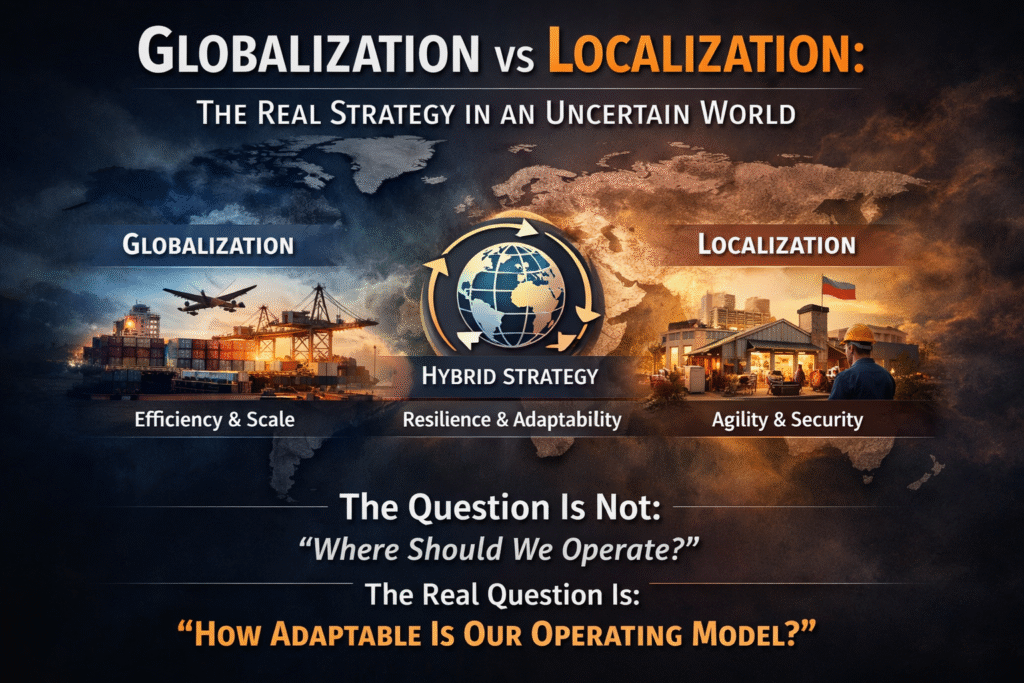
Globalization enables scale, efficiency, and access. Localization provides agility, control, and resilience. The strategic challenge is not choosing between them, but integrating them effectively.
Organizations that treat this as a binary decision risk overcorrecting. Moving entirely away from globalization can erode competitiveness, while clinging to old global models can increase vulnerability.
The real opportunity lies in designing systems that combine the strengths of both approaches while mitigating their weaknesses.
The Emergence of the Hybrid Model
The most forward-looking organizations are adopting a hybrid approach that blends global reach with local resilience. This model is not a compromise. It is a deliberate design strategy aimed at optimizing both performance and risk management.
Instead of relying on a single global network, companies are building diversified and modular systems. They are rethinking supply chains, operational structures, and market strategies to ensure flexibility and adaptability.
Key elements of this hybrid model include:
- Multi-country sourcing to reduce dependency on any single region
- Regional supply chain hubs that balance efficiency and proximity
- Strategic redundancy in critical components and suppliers
- Digital tools that provide end-to-end supply chain visibility
- Localized production for high-risk or high-demand markets
This approach allows organizations to maintain global advantages while building resilience against disruptions.
Sectoral Insights: How Industries Are Adapting
Different industries are responding to this shift in distinct ways, depending on their risk profiles, cost structures, and regulatory environments.
In the automotive sector, companies are diversifying supplier bases and investing in regional manufacturing hubs. Semiconductor shortages have accelerated efforts to localize critical chip production in multiple regions.
In pharmaceuticals, the focus has shifted toward ensuring domestic manufacturing capabilities for essential drugs while maintaining global research and development networks.
In consumer goods, organizations are leveraging localized distribution and manufacturing to respond quickly to changing demand patterns, while still benefiting from global sourcing.
Technology companies are adopting a distributed model, where innovation remains global but data storage and compliance are increasingly localized due to regulatory requirements.
These examples highlight a common theme. The future is not less global. It is differently global.
The Role of Digital Transformation
Digitalization is a critical enabler of the hybrid model. Without advanced data and analytics capabilities, managing complex, multi-layered systems becomes extremely challenging.
Technologies such as artificial intelligence, blockchain, and advanced analytics are transforming supply chain management. They provide real-time visibility, predictive insights, and enhanced decision-making capabilities.
Digital platforms enable organizations to monitor risks, simulate scenarios, and respond proactively to disruptions. They also facilitate collaboration across geographies, ensuring that global and local operations remain aligned.
In essence, digital transformation bridges the gap between globalization and localization, enabling organizations to operate seamlessly across both dimensions.
Strategic Implications for Leaders
For business leaders, the shift toward a hybrid model requires a fundamental rethinking of strategy. Traditional metrics focused solely on cost and efficiency are no longer sufficient.
Resilience must be integrated into strategic decision-making. This involves evaluating trade-offs between cost, risk, speed, and flexibility.
Key considerations include:
- How diversified is the supply chain?
- What is the organization’s exposure to geopolitical risks?
- How quickly can operations adapt to disruptions?
- Are there sufficient buffers and redundancies in critical areas?
- How effectively is data being leveraged for decision-making?
Leaders must also foster a culture of agility and continuous learning. In an uncertain world, the ability to adapt quickly is more valuable than the ability to optimize perfectly.
Conclusion: From Efficiency to Resilience
The globalization versus localization debate is no longer about choosing one over the other. It is about redefining how organizations operate in a world characterized by uncertainty and disruption.
Efficiency remains important, but it is no longer the sole objective. Resilience, adaptability, and strategic flexibility have emerged as equally critical priorities.
The organizations that will succeed are those that can operate globally while responding locally. They will design systems that are not only efficient but also robust and adaptable.
The question for leaders is not where to operate. It is how to build an operating model that can thrive under any conditions.
Final Thought
In a world where disruption is the norm, resilience is not a defensive strategy. It is a source of competitive advantage.