Artificial Intelligence is no longer a futuristic capability. It is fast becoming the core engine of competitive advantage. As organizations move from digital-first to AI-first, the traditional technology leadership structure is undergoing a fundamental shift.
For decades, the Chief Technology Officer (CTO) has been the apex technology authority. But AI has expanded the mandate of technology from running systems to creating intelligence, predicting outcomes, and generating revenue.
This evolution has led to the emergence of a new C-suite role: the Chief Artificial Intelligence Officer (CAIO).
Many organizations are now debating whether AI should sit under the CTO or whether a separate CAIO role is essential. The answer depends on AI maturity, strategic ambition, and long-term value creation goals.
1. The Foundational Mandate Difference
CTO: Builder and Guardian of Technology Infrastructure
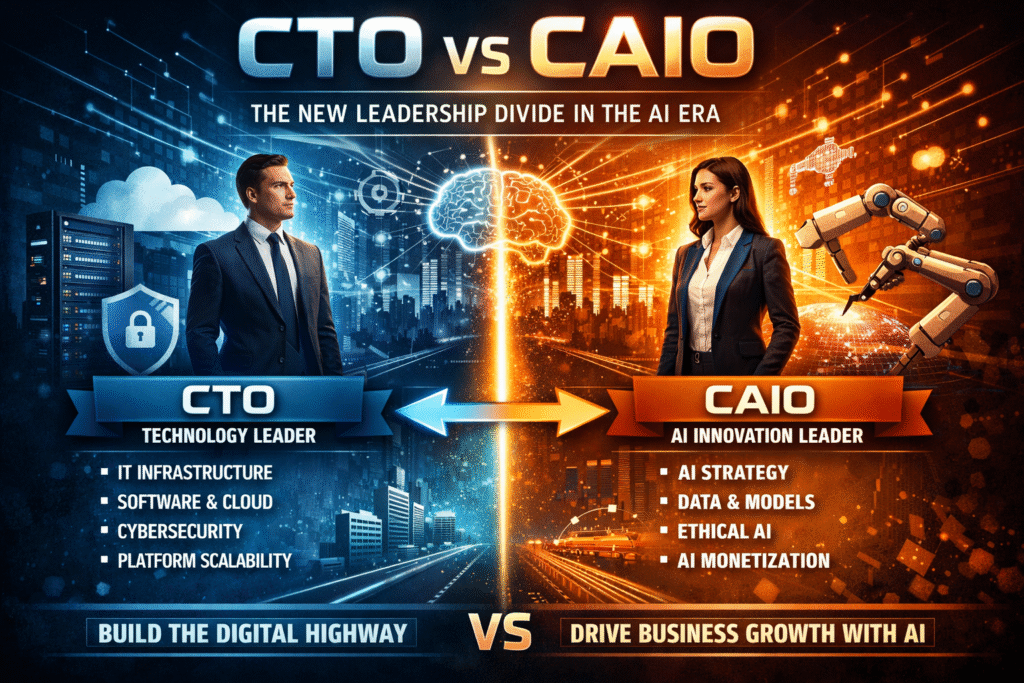
The CTO is responsible for designing, implementing, and scaling the enterprise technology ecosystem.
Core responsibilities include:
• IT infrastructure and cloud architecture
• Enterprise software platforms
• Cybersecurity and risk management
• Systems integration
• Engineering and product development
• Network reliability and uptime
• Digital transformation execution
In essence, the CTO ensures that technology platforms are secure, scalable, resilient, and cost efficient.
They build the digital highways on which the organization operates.
CAIO: Architect of Enterprise Intelligence
The CAIO, on the other hand, is responsible for transforming data and AI capabilities into business value.
Core responsibilities include:
• Enterprise AI vision and roadmap
• AI use case identification and prioritization
• Data strategy and governance alignment
• Machine learning model lifecycle management
• Responsible and ethical AI frameworks
• AI risk, bias, and compliance oversight
• AI-driven product innovation
• Monetization of AI capabilities
If the CTO builds the highway, the CAIO decides where intelligence should drive growth.
2. Why AI Initially Sat Under the CTO
In early adoption stages, AI was viewed as an extension of analytics and automation.
Common early use cases included:
• Process automation
• Chatbots for customer service
• Predictive maintenance in manufacturing
• Fraud detection in banking
• Demand forecasting in retail
These initiatives required:
• Data infrastructure
• Cloud computing
• Integration with enterprise systems
Since these capabilities fell within the CTO’s domain, AI leadership naturally resided there.
This model worked when AI was:
• Experimental
• Departmental
• Efficiency focused
• Technology driven
However, as AI matured, its impact expanded beyond IT.
3. The Inflection Point: When AI Becomes Strategic
Organizations begin to separate CTO and CAIO roles when AI becomes central to:
• Revenue generation
• Product differentiation
• Customer experience transformation
• Decision automation
• Business model reinvention
At this stage, AI leadership requires:
• Business strategy alignment
• Cross-functional orchestration
• Governance and ethics frameworks
• Investment prioritization
• Value measurement
This goes beyond traditional CTO bandwidth.
4. Real-World Leadership Structures
Model 1: CTO-Led AI Structure
Common in traditional industries and mid-maturity organizations.
Examples of adoption
Manufacturing companies deploying predictive maintenance AI within plant operations often keep AI under the CTO because:
• AI is operational efficiency focused
• Use cases are plant specific
• Integration with IoT infrastructure is critical
Regional banks using AI for fraud detection also follow this structure because:
• AI is risk mitigation oriented
• Technology integration dominates effort
Long-term benefits
• Lower cost of leadership expansion
• Centralized governance
• Faster infrastructure alignment
Limitations
• AI innovation remains IT driven
• Business units lack ownership
• Monetization opportunities are underexplored
Model 2: Chief Data and AI Under Technology
Some organizations introduce a Chief Data Officer or Head of AI reporting to the CTO.
Examples
Large retailers building recommendation engines and customer analytics platforms often adopt this interim model.
Here:
• Data engineering sits within technology
• AI pilots expand across marketing and supply chain
• Governance begins forming
Benefits
• Strong data foundation
• Gradual AI scaling
• Controlled investment expansion
Limitations
• AI strategy remains technology centric
• Cross-business scaling is slower
Model 3: Independent CAIO Role
This structure is emerging rapidly in AI-mature enterprises.
Global examples of adoption patterns
Technology companies building AI-native products have established dedicated AI leadership.
Financial institutions deploying enterprise risk AI platforms, algorithmic trading models, and customer intelligence engines are also moving toward CAIO roles.
Healthcare organizations leveraging AI for diagnostics, drug discovery, and clinical decision support require independent AI governance due to regulatory sensitivity.
Why separation works here
• AI drives core revenue
• Ethical risk is high
• Data ecosystems are complex
• Models impact real-world outcomes
5. Strategic Benefits of Separating CTO and CAIO
1. Clear Accountability
CTO accountability: Technology performance
CAIO accountability: AI-driven business outcomes
This eliminates ownership ambiguity.
2. Faster Enterprise AI Adoption
A CAIO drives cross-functional AI deployment across:
• Sales
• Marketing
• Operations
• Finance
• Supply chain
• HR
This accelerates enterprise transformation.
3. Stronger Responsible AI Governance
Dedicated AI leadership ensures:
• Bias monitoring
• Ethical model design
• Regulatory compliance
• Explainability frameworks
Critical in regulated sectors like banking and healthcare.
4. Enhanced Monetization
CAIO-led organizations are more effective at:
• AI-powered product creation
• Data monetization
• Subscription intelligence platforms
• AI-as-a-service offerings
This shifts AI from cost center to profit center.
5. CTO Focus Optimization
Separating roles frees the CTO to focus on:
• Cloud modernization
• Cybersecurity resilience
• Platform engineering
• DevSecOps maturity
• Enterprise architecture
This strengthens digital backbone stability.
6. Long-Term Enterprise Value Creation
Organizations that separate CTO and CAIO roles early gain structural advantages.
Competitive differentiation
AI-led personalization, pricing, and product innovation become defensible capabilities.
Speed to innovation
Dedicated AI leadership accelerates experimentation-to-scale cycles.
Talent magnetism
Top AI talent prefers organizations where AI has board-level representation.
Investor confidence
Clear AI governance enhances valuation narratives, especially in tech-driven sectors.
7. Qualification and Capability Differences
CTO Profile
Typical background includes:
• Computer science or engineering foundation
• Enterprise architecture expertise
• Cloud and distributed systems leadership
• Cybersecurity governance
• Large-scale platform delivery
Experience focus:
• Reliability
• Scalability
• Performance
• Cost optimization
CAIO Profile
Typical background includes:
• AI and machine learning expertise
• Data science leadership
• Advanced analytics strategy
• AI product development
• Algorithm commercialization
Experience focus:
• Value creation
• Decision intelligence
• Business model innovation
• AI ethics and governance
Many CAIOs also possess hybrid credentials spanning technology and business strategy.
8. Operating Model Interaction
High-performing enterprises define clear collaboration mechanisms.
CTO responsibilities
• Data platforms
• Compute infrastructure
• Model deployment environments
• Security layers
CAIO responsibilities
• Model design
• Use case strategy
• Business alignment
• AI ROI measurement
This partnership ensures scalable and responsible AI deployment.
9. Industry-Wise Adoption Trajectory
Banking and Financial Services
Moving fastest due to:
• Risk analytics
• Fraud detection
• Algorithmic trading
• Credit scoring
Dedicated CAIO roles are rising to manage regulatory exposure.
Healthcare
AI use in diagnostics and drug discovery is accelerating CAIO adoption due to ethical implications.
Retail and E-commerce
Personalization engines and demand intelligence are pushing AI into revenue ownership, justifying separation.
Manufacturing
Currently CTO-led but shifting as AI integrates into autonomous operations and supply chain optimization.
Technology and SaaS
Already AI-native. Many have distinct AI leadership structures driving product innovation.
10. The Future Outlook
Over the next decade, three structural shifts are likely:
- CAIO becomes as mainstream as CFO
- AI governance boards emerge
- AI P&L accountability formalizes
Organizations that delay leadership restructuring risk:
• Fragmented AI investments
• Ethical exposure
• Slower innovation
• Lost competitive advantage
Closing Perspective
The evolution from digital enterprise to AI enterprise demands leadership reinvention.
The CTO builds and scales the technology backbone.
The CAIO transforms intelligence into enterprise value.
Together, they form the dual engine powering the AI-first organization.
Forward-looking companies are not asking whether to separate the roles.
They are asking how fast they can do it to stay competitive in an intelligence-driven economy.