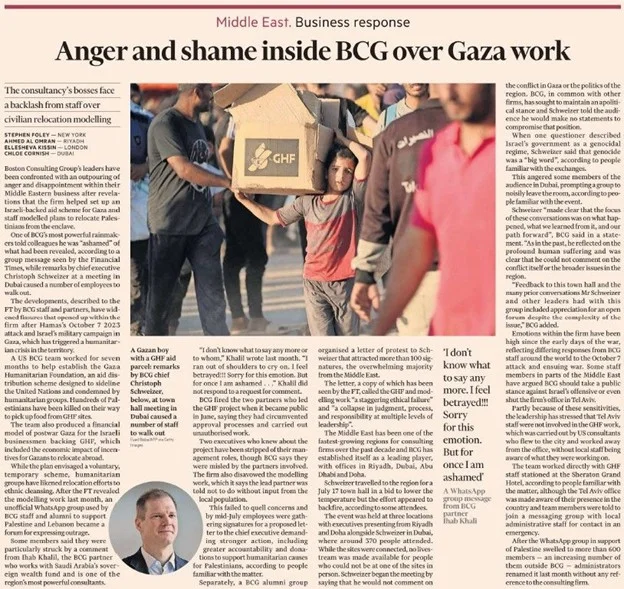
Context: 𝘛𝘩𝘦 𝘍𝘪𝘯𝘢𝘯𝘤𝘪𝘢𝘭 𝘛𝘪𝘮𝘦𝘴 reports internal anger at Boston Consulting Group (BCG) over work linked to an Israeli-backed aid scheme for Gaza and alleged modelling related to relocating Palestinians. Beyond the specifics, the industry question is bigger.
𝗖𝗼𝗿𝗲 𝗽𝗿𝗶𝗻𝗰𝗶𝗽𝗹𝗲:
- Consulting is leverage. Advice does not sit on a slide; it shapes real decisions. “Neutral problem-solving” can become policy-shaping the moment civilians are affected.
𝗜𝘀 𝗶𝘁 𝗶𝗻𝗵𝗲𝗿𝗲𝗻𝘁𝗹𝘆 𝗯𝗮𝗱?:
- Not always. Work that clearly protects life and dignity; supply chains for food, water, medicine can be positive when done with neutral, legitimate partners.
- Often risky. Projects that plan or enable population movement in a live conflict cross ethical red lines and risk normalizing harm.
𝗔 𝘀𝗶𝗺𝗽𝗹𝗲 𝗱𝗲𝗰𝗶𝘀𝗶𝗼𝗻 𝘁𝗲𝘀𝘁 𝗳𝗼𝗿 𝗹𝗲𝗮𝗱𝗲𝗿𝘀
- Mandate & Legitimacy: Who requested the work—recognized humanitarian bodies or a conflict party?
- Proximity to Harm: Could our analysis materially enable violations of International Humanitarian Law (IHL)? If “maybe,” decline.
- Beneficiary Primacy: Does the work measurably improve civilian safety and dignity now—not just optics for the sponsor?
- Transparency & Contestability: Would we be comfortable disclosing scope to staff and to outside experts for challenge?
- Employee Agency: Guaranteed opt-out without penalty; independent ethics review with veto power.
- Misuse Risk: Could the output be weaponized by one side? If yes, re-scope through a neutral channel or walk away.
𝗧𝗵𝗶𝘀 𝗶𝘀 𝗯𝗼𝗮𝗿𝗱-𝗹𝗲𝘃𝗲𝗹 𝗿𝗶𝘀𝗸, 𝗻𝗼𝘁 𝗮 𝗣𝘂𝗯𝗹𝗶𝗰 𝗥𝗲𝗹𝗮𝘁𝗶𝗼𝗻𝘀 𝗶𝘀𝘀𝘂𝗲
- Legal exposure: Potential breaches of International Humanitarian Law.
- Talent & culture: Moral injury, internal backlash, attrition.
- Client mix & revenue: Boycotts, countersanctions, unstable accounts.
- Brand equity: Trust takes years to build and days to lose.
𝗪𝗵𝗮𝘁 “𝗴𝗼𝗼𝗱” 𝗹𝗼𝗼𝗸𝘀 𝗹𝗶𝗸𝗲
- Public client-selection standards: no work that facilitates displacement, targeting of civilians, or collective punishment.
- A red-team ethics council with external human-rights expertise and veto power.
- Partner accountability for scope; employee conscience clauses written into contracts.
- When in doubt, route through neutral coordinators (for example, the United Nations or a reputable Non-Governmental Organization).
𝗕𝗼𝘁𝘁𝗼𝗺 𝗹𝗶𝗻𝗲
- It is not automatically wrong for firms to engage in social crises. But if the brief can plausibly aid civilian harm or forced movement, it is not a consulting problem—it is a moral line.
- Real leadership means building the guardrails now—before a slide deck becomes a real-world tragedy.