Abstract
Corporate history demonstrates that the world’s most valuable organizations rarely become industry leaders by accident. They achieve sustained leadership through deliberate strategic choices regarding where to invest capital, develop capabilities, assume risks, and create competitive differentiation. Among these decisions, none has generated greater debate in boardrooms than whether long-term growth should be driven primarily through internal innovation or accelerated through mergers and acquisitions. This question has become even more significant as artificial intelligence, digital transformation, geopolitical uncertainty, climate transition, demographic shifts, and technological convergence redefine the rules of competition across industries.
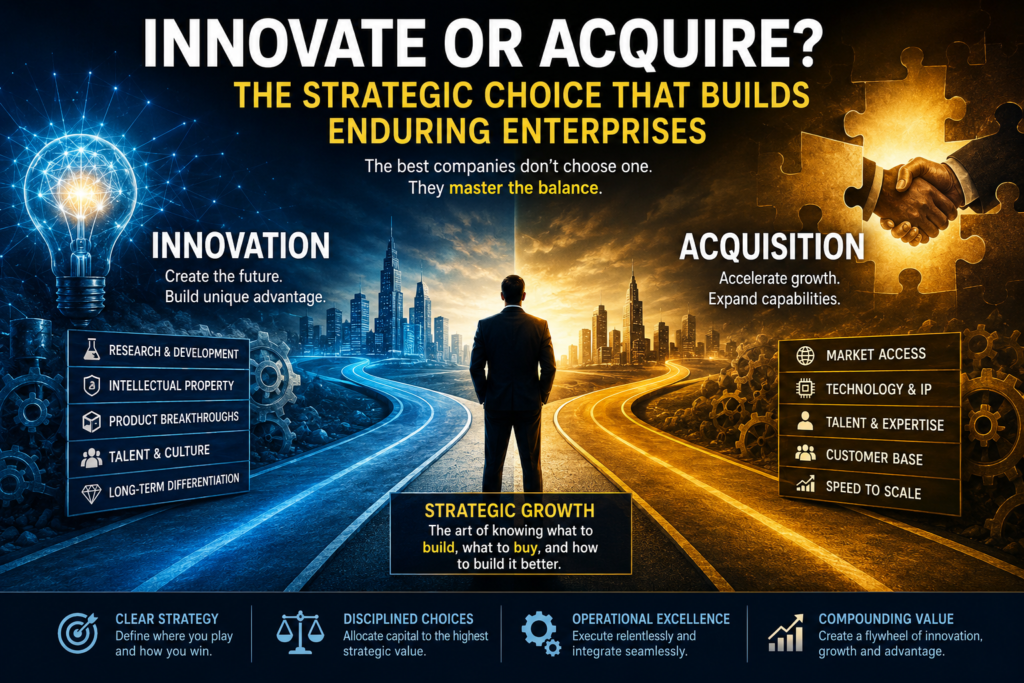
Traditional strategic thinking frequently positions innovation and acquisitions as competing alternatives. Organizations are encouraged either to build new technologies internally through research and development or to purchase innovation by acquiring startups, technologies, patents, customers, and market share. Such binary thinking no longer reflects the complexity of modern competition. Companies that dominate global markets today have demonstrated that sustainable leadership emerges not from choosing between innovation and acquisitions, but from mastering the strategic balance between both approaches while maintaining exceptional capital allocation discipline.
This paper argues that innovation creates sustainable competitive advantage, whereas acquisitions create strategic acceleration. Sustainable value creation occurs when organizations understand which capabilities should be invented, which should be acquired, which should be partnered, and which should be continuously reinvented. Through analysis of leading global organizations including Apple, NVIDIA, Microsoft, Amazon, Alphabet, Berkshire Hathaway, Pfizer, Toyota, and Disney, this paper develops an integrated strategic framework explaining how corporate leaders should evaluate growth decisions in increasingly uncertain environments.
The paper further introduces five original strategic frameworks designed for boards of directors, chief executive officers, strategy leaders, and investors to evaluate long-term growth decisions. These frameworks collectively establish a comprehensive methodology for determining whether innovation, acquisitions, partnerships, or hybrid growth models create the highest sustainable shareholder value.
Introduction
History remembers organizations not merely because they became successful but because they fundamentally changed the trajectory of industries. Some companies introduced products that customers never imagined possible. Others assembled business empires through disciplined acquisitions that reshaped entire sectors. A smaller group accomplished both simultaneously, redefining competitive advantage for generations.
The modern corporate environment has significantly complicated strategic decision-making. Product life cycles continue to shorten while technological disruption accelerates across every industry. Artificial intelligence is transforming product development, manufacturing, healthcare, financial services, education, logistics, retail, and professional services at unprecedented speed. Customers demand continuous innovation while investors simultaneously expect predictable financial performance and superior capital returns. Governments increasingly regulate technology platforms, cross-border acquisitions, intellectual property, and competition. Under these conditions, traditional growth models require fundamental reassessment.
The question confronting today’s executive leadership is no longer whether growth should occur. Growth remains essential for organizational survival. The more important question concerns the mechanism through which growth should occur. Should organizations allocate billions toward research laboratories, engineering talent, product development, digital transformation, and intellectual property creation, accepting years of uncertainty before commercial returns emerge? Alternatively, should they accelerate expansion through acquisitions that provide immediate access to customers, technologies, manufacturing capacity, talent, and geographic markets?
The answer cannot be generalized across industries because growth strategies are influenced by technological maturity, market structure, competitive intensity, capital availability, regulatory complexity, organizational capability, and innovation velocity. Pharmaceutical companies depend heavily upon scientific discoveries protected by patents. Consumer technology firms frequently combine internal research with targeted acquisitions. Industrial manufacturing organizations often pursue operational innovation while acquiring complementary capabilities. Financial institutions consolidate markets through acquisitions while simultaneously investing in digital innovation.
Consequently, sustainable strategic leadership requires a more sophisticated perspective than the traditional innovation-versus-acquisition debate. The organizations most admired for long-term performance have demonstrated an exceptional ability to determine precisely when to invent, when to acquire, when to collaborate, and when to transform existing business models.
This paper develops that perspective through strategic analysis supported by corporate evidence, economic reasoning, and governance principles.
The Evolution of Corporate Growth Thinking
For much of the twentieth century, competitive advantage was primarily associated with manufacturing excellence, scale economies, product quality, distribution networks, and operational efficiency. Research and development served as important differentiators, but industries generally evolved at a pace that allowed organizations decades to capitalize upon innovations.
Globalization fundamentally altered this equation. Competitive barriers declined while information moved almost instantaneously across borders. Digital technologies reduced product development cycles and increased customer expectations regarding innovation. Companies could no longer rely exclusively upon historical market positions because emerging competitors rapidly commercialized disruptive technologies.
The twenty-first century introduced another transformation. Data became a strategic asset. Software evolved from supporting business operations to defining business models. Artificial intelligence further accelerated this evolution by enabling organizations to automate decisions, personalize customer experiences, optimize supply chains, improve product design, and generate entirely new sources of revenue.
Growth consequently evolved from a linear process into a multidimensional strategic capability requiring simultaneous investment across research, digital technologies, acquisitions, partnerships, ecosystems, intellectual property, and organizational learning.
Table 1 illustrates the progression of corporate growth priorities across different economic periods.
| Economic Era | Primary Growth Driver | Strategic Focus | Representative Companies |
| Industrial Economy | Manufacturing Scale | Operational Excellence | Ford, General Motors, Caterpillar |
| Globalization Era | Geographic Expansion | Market Penetration | Unilever, Nestlé, Toyota |
| Digital Economy | Technology Innovation | Platform Development | Apple, Amazon, Alphabet |
| AI Economy | Intelligent Ecosystems | Innovation, Data and Strategic Acquisitions | NVIDIA, Microsoft, Amazon, Alphabet |
The progression demonstrates that corporate growth has become increasingly knowledge-intensive. Tangible assets such as factories remain valuable, yet intangible assets including software, patents, algorithms, brands, engineering talent, customer data, and organizational knowledge increasingly determine enterprise valuation. Consequently, boards and executive teams must evaluate investment opportunities not solely through financial metrics but also through capability creation.
The Strategic Growth Equation™
One of the principal findings emerging from this analysis is that sustainable enterprise growth cannot be explained through revenue expansion alone. Organizations frequently increase revenue while simultaneously destroying shareholder value because growth lacks strategic quality.
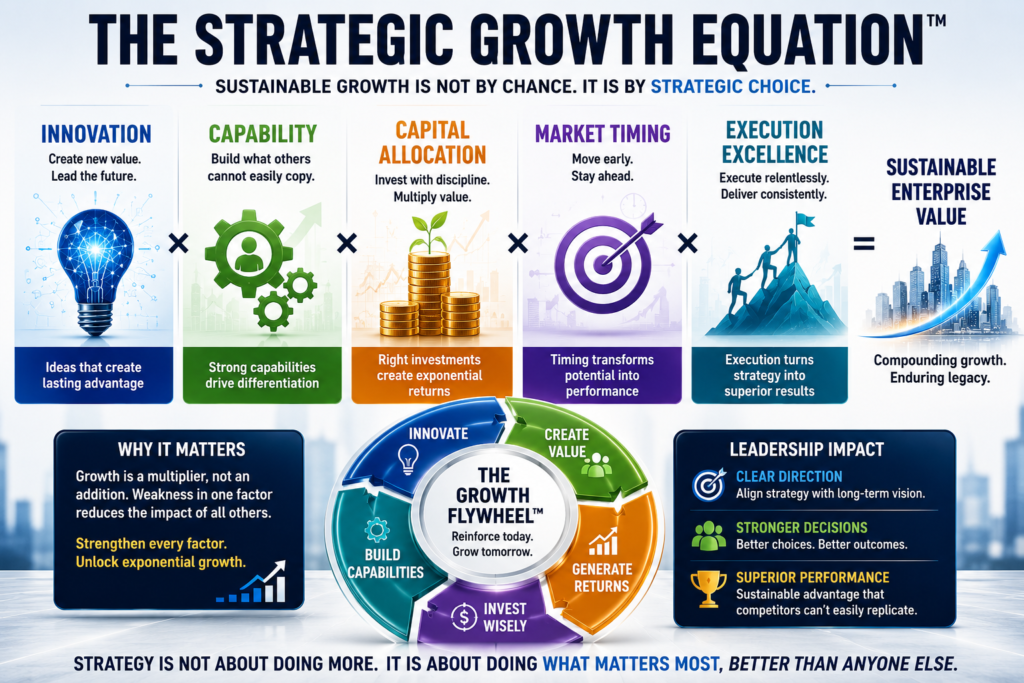
To address this limitation, this paper introduces the Strategic Growth Equation™, a board-level framework for evaluating sustainable corporate expansion.
The Strategic Growth Equation™ proposes that long-term enterprise value results from the interaction of five mutually reinforcing dimensions rather than isolated financial performance.
Strategic Growth = Innovation × Capability × Capital Allocation × Market Timing × Execution Excellence
Unlike additive models, the multiplicative nature of this equation implies that weakness in any single dimension materially reduces long-term value creation. Exceptional innovation produces limited results without disciplined execution. Superior execution cannot compensate for poor capital allocation. Market timing amplifies or diminishes otherwise excellent strategic decisions. Sustainable competitive advantage therefore emerges only when organizations strengthen every component simultaneously.
This framework provides boards with a practical lens through which major investment decisions may be evaluated before significant capital commitments are approved.
The Innovation Capital Multiplier™ Framework
Innovation should not be measured exclusively by research expenditure or patent counts. Many organizations invest heavily in research while generating limited commercial outcomes. Conversely, relatively modest innovation investments occasionally produce extraordinary shareholder returns.
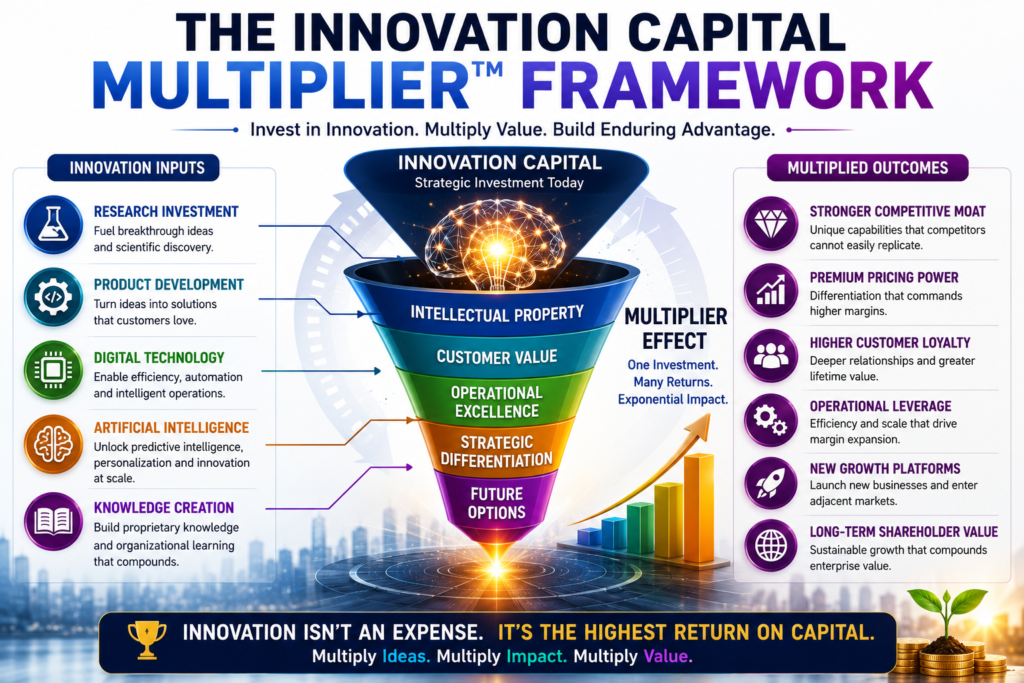
The Innovation Capital Multiplier™ Framework argues that organizations should evaluate innovation according to its ability to multiply strategic capital rather than merely consume financial capital.
Table 2 illustrates the concept.
| Innovation Input | Strategic Multiplier | Enterprise Outcome |
| Research Investment | Intellectual Property | Competitive Protection |
| Product Development | Customer Value | Premium Pricing |
| Digital Technology | Productivity | Margin Expansion |
| Artificial Intelligence | Decision Intelligence | Organizational Agility |
| Knowledge Creation | Capability Development | Long-Term Resilience |
Organizations demonstrating high innovation multipliers consistently outperform competitors because each innovation generates multiple secondary benefits including stronger brands, pricing power, operational efficiencies, customer loyalty, ecosystem expansion, and future innovation opportunities.
Apple’s semiconductor strategy provides an excellent illustration. Developing Apple Silicon did not merely reduce dependence upon external suppliers. It enhanced product performance, improved energy efficiency, strengthened ecosystem integration, increased profit margins, differentiated customer experiences, and established a technological platform supporting future innovations across multiple product categories. One strategic innovation therefore multiplied enterprise value across numerous dimensions.
The Strategic Acquisition Value Matrix™ Framework
Acquisitions frequently fail because organizations evaluate targets primarily through financial metrics while underestimating strategic compatibility.
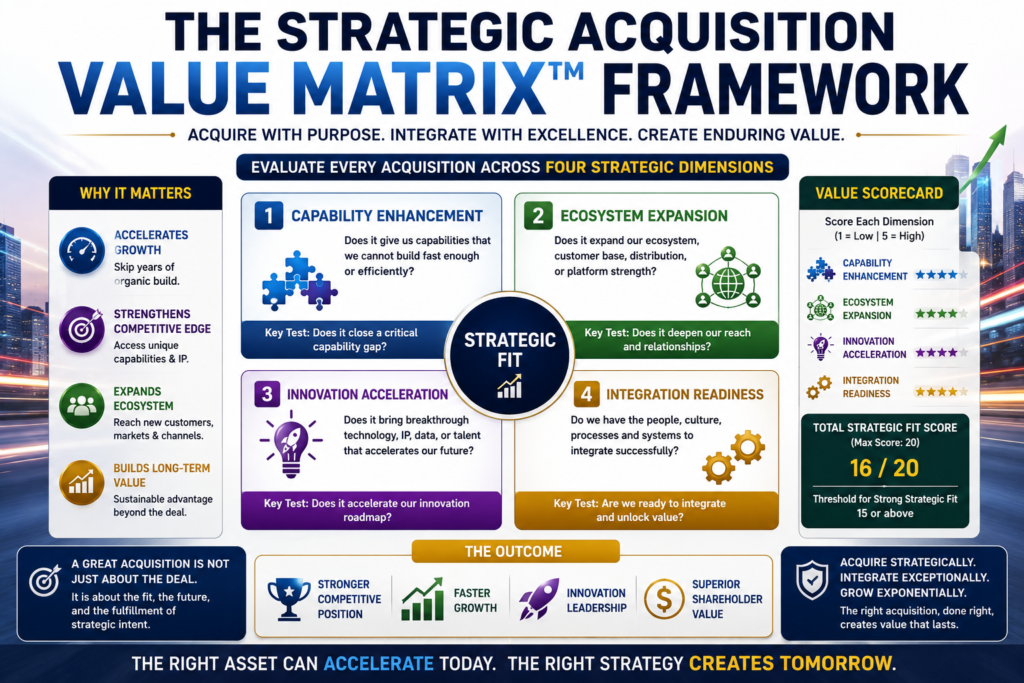
The Strategic Acquisition Value Matrix™ proposes that every acquisition should be evaluated across four interconnected dimensions before financial valuation becomes the dominant consideration.
The first dimension evaluates capability enhancement by determining whether the acquisition creates competencies unavailable internally. The second dimension assesses ecosystem expansion by examining how the acquired business strengthens customer relationships, distribution, platforms, or network effects. The third dimension measures innovation acceleration by identifying technologies, patents, engineering talent, or data assets capable of expanding future competitive advantage. The final dimension evaluates integration readiness because even strategically attractive acquisitions fail when organizations lack integration capabilities.
Google’s acquisition of Android illustrates the framework effectively. Android significantly expanded Google’s ecosystem beyond desktop search into mobile computing. It accelerated innovation through an open-source operating system, increased advertising opportunities, strengthened developer relationships, and positioned Google at the center of the global smartphone ecosystem. The acquisition generated strategic value substantially exceeding its original purchase price because all four dimensions aligned simultaneously.
In contrast, numerous failed acquisitions demonstrated attractive financial projections while neglecting cultural compatibility, technological integration, leadership continuity, and organizational execution.
The Competitive Moat Reinforcement™ Framework
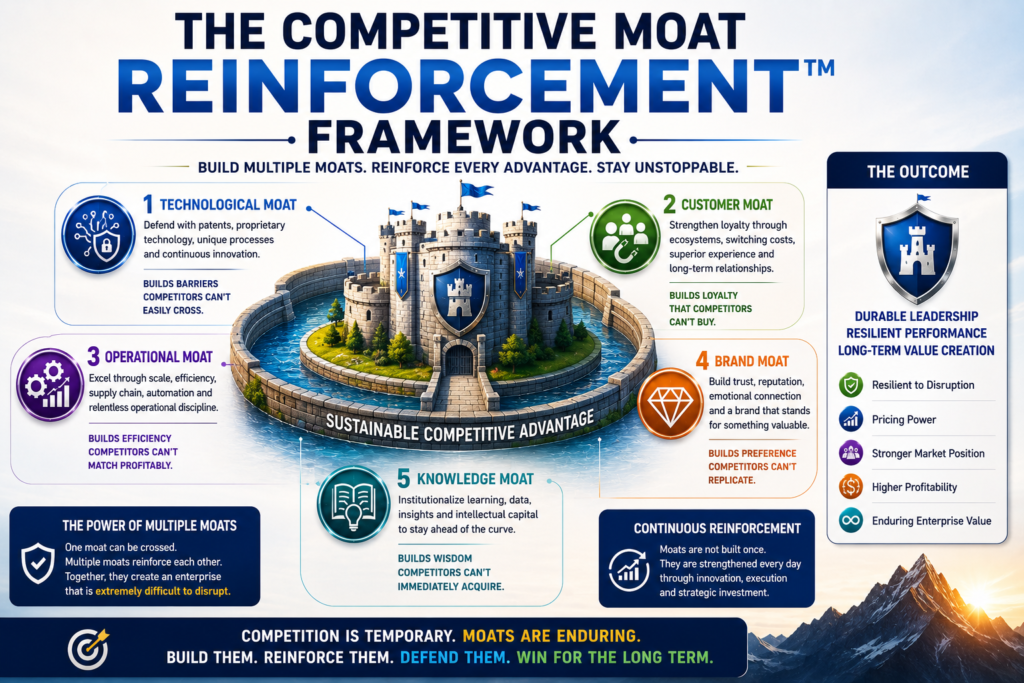
Competitive advantage deteriorates continuously unless organizations intentionally reinforce it. This paper therefore introduces the Competitive Moat Reinforcement™ Framework, which proposes that sustainable market leadership depends upon strengthening five categories of strategic protection simultaneously.
Technological moats emerge through patents, proprietary algorithms, manufacturing processes, and research capabilities. Customer moats develop through ecosystems, subscriptions, switching costs, and long-term relationships. Operational moats arise from supply chain excellence, manufacturing efficiency, automation, and quality systems. Brand moats are strengthened through trust, reputation, customer experience, and premium positioning. Knowledge moats expand through organizational learning, leadership capability, and continuous innovation.
Organizations possessing multiple reinforcing moats become increasingly difficult to disrupt because competitors must simultaneously overcome technological, operational, financial, customer, and organizational barriers rather than merely introducing superior products.
NVIDIA represents perhaps the strongest contemporary example. Its leadership extends beyond semiconductor design into software platforms, developer communities, networking technologies, artificial intelligence frameworks, research partnerships, and ecosystem integration. These interconnected advantages reinforce one another, creating extraordinary resilience against competitive threats.
The Adaptive Enterprise Cycle™ Framework
The final decades of the twentieth century rewarded efficiency. The coming decades will reward adaptability.
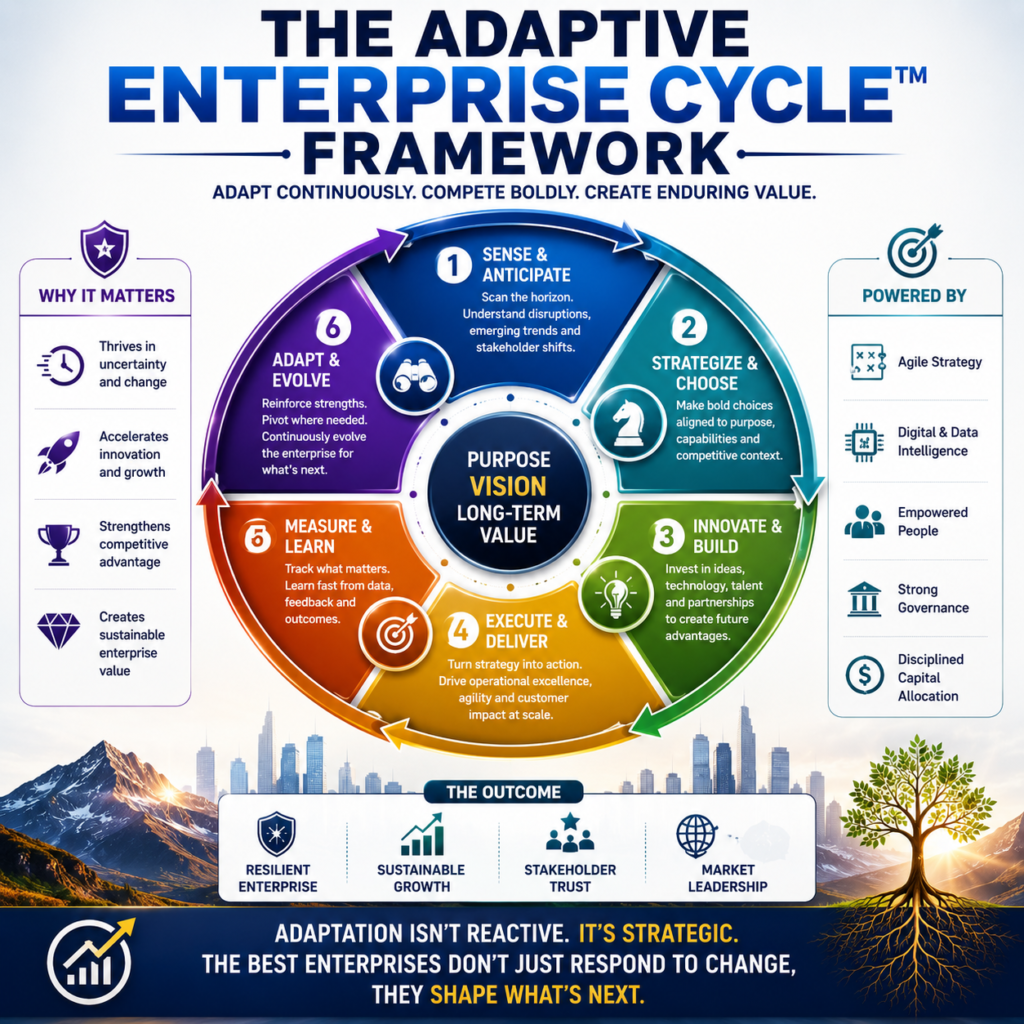
The Adaptive Enterprise Cycle™ Framework argues that organizations progress continuously through four strategic stages comprising Discovery, Scaling, Reinvention, and Renewal.
Discovery focuses upon identifying emerging technologies, unmet customer needs, and disruptive opportunities. Scaling transforms validated innovations into commercially successful business models supported by operational excellence. Reinvention occurs as technological shifts require organizations to redefine products, capabilities, and business models before competitors force change. Renewal institutionalizes organizational learning, ensuring the enterprise continuously regenerates innovation capability rather than relying upon isolated successes.
Amazon exemplifies this cycle through repeated reinvention. Beginning as an online bookstore, the company expanded into digital retail, cloud computing, logistics, artificial intelligence, robotics, entertainment, healthcare, and autonomous mobility. Rather than protecting existing business models, Amazon repeatedly reinvested in future opportunities, ensuring continuous organizational renewal while competitors remained focused upon optimizing mature businesses.
The Adaptive Enterprise Cycle™ therefore transforms innovation from an occasional corporate initiative into a permanent organizational capability embedded within strategic decision-making and governance.
The five frameworks introduced in this paper collectively establish an integrated methodology through which boards, executive leadership teams, investors, and strategy professionals can evaluate corporate growth decisions in an increasingly uncertain business environment. Rather than asking whether innovation or acquisitions represent superior strategies, these frameworks encourage organizations to determine which combination creates the greatest sustainable enterprise value under specific competitive conditions.
Innovation as the Architecture of Long-Term Competitive Advantage
Innovation has traditionally been viewed as the responsibility of research laboratories and engineering teams. In reality, innovation is a strategic capability that permeates every function of an enterprise. Organizations that consistently outperform competitors recognize innovation not as a department but as an organizational philosophy influencing capital allocation, talent development, customer engagement, manufacturing, digital transformation, and corporate governance.
Joseph Schumpeter’s theory of “creative destruction” remains remarkably relevant in today’s business environment. Industries are rarely transformed by organizations that merely optimize existing products. Instead, transformative companies create new value propositions that render previous technologies, business models, or customer experiences obsolete. Artificial intelligence is accelerating this phenomenon by shortening innovation cycles and lowering barriers to experimentation while simultaneously increasing the premium placed upon differentiated intellectual property.
The strategic importance of innovation extends beyond revenue generation. Every successful innovation strengthens multiple organizational capabilities simultaneously. A new product may improve brand perception, increase pricing power, generate proprietary intellectual property, attract engineering talent, expand customer loyalty, improve manufacturing efficiency, and establish new ecosystem relationships. These reinforcing effects explain why innovation compounds enterprise value over extended periods.
Apple illustrates this principle exceptionally well. Since the introduction of the Macintosh, the company has consistently focused on integrating hardware, software, semiconductor engineering, industrial design, and services into a unified customer experience. The development of Apple Silicon was not simply a technological upgrade. It fundamentally altered the company’s cost structure, supply chain flexibility, product performance, battery efficiency, and software optimization while creating additional competitive barriers. What initially appeared to be a semiconductor decision ultimately strengthened nearly every strategic dimension of Apple’s ecosystem.
NVIDIA provides another compelling example of innovation as a long-term strategic investment. During the 1990s and early 2000s, the company’s investment in graphics processing units appeared highly specialized. However, its long-term commitment to GPU architecture, CUDA software, developer tools, networking technologies, and artificial intelligence infrastructure positioned the company to become the foundational technology provider for the generative AI revolution. The extraordinary increase in NVIDIA’s enterprise value was not the consequence of a single breakthrough but rather decades of disciplined innovation investments that reinforced one another.
The pharmaceutical industry further demonstrates why innovation remains indispensable despite its inherent uncertainty. Developing a successful therapeutic drug frequently requires more than a decade of scientific research, extensive clinical trials, substantial regulatory scrutiny, and billions of dollars in cumulative investment. Yet a successful breakthrough can fundamentally transform both patient outcomes and corporate performance. Novo Nordisk’s leadership in obesity and diabetes treatments exemplifies how sustained scientific innovation can redefine an entire therapeutic category while creating durable shareholder value.
Table 3 compares the strategic outcomes generated through innovation-led organizations across multiple dimensions.
| Strategic Dimension | Innovation-Led Enterprise | Long-Term Strategic Outcome |
| Intellectual Property | Continuous creation of proprietary assets | Sustainable competitive advantage |
| Product Portfolio | Regular introduction of differentiated offerings | Premium market positioning |
| Customer Loyalty | Strong ecosystem relationships | Higher lifetime customer value |
| Talent Attraction | Magnet for high-performing professionals | Stronger organizational capability |
| Financial Performance | Gradual but compounding returns | Superior long-term enterprise valuation |
| Market Influence | Industry leadership | Ability to shape future standards |
Innovation also creates optionality, a concept frequently underestimated in corporate strategy. Organizations possessing strong innovation capabilities are better positioned to respond to emerging technologies because they continuously develop new competencies. This flexibility becomes invaluable during periods of disruption when industries undergo structural transformation. Companies lacking innovation capabilities often become dependent upon expensive acquisitions simply to remain competitive.
The economic significance of innovation is further supported by capital market behavior. Investors consistently assign premium valuation multiples to organizations perceived as innovation leaders because markets anticipate future growth rather than merely evaluating current earnings. This explains why companies investing aggressively in research and development frequently command higher enterprise valuations despite short-term reductions in reported profitability.
The Economics of Strategic Acquisitions
Acquisitions represent one of the most powerful strategic instruments available to corporate leadership. Properly executed, acquisitions accelerate market access, diversify capabilities, strengthen customer relationships, eliminate competitive threats, and compress years of internal development into a single strategic transaction. Improperly executed, they destroy shareholder value, weaken organizational culture, increase debt burdens, and divert management attention from core strategic priorities.
The appeal of acquisitions lies primarily in speed. Developing breakthrough technologies internally often requires significant investment, uncertain outcomes, and extended commercialization timelines. Acquiring an established business provides immediate access to technologies, engineering talent, intellectual property, customer relationships, distribution networks, manufacturing capabilities, regulatory approvals, and geographic presence.
Google’s acquisition of Android in 2005 remains one of the most strategically significant transactions in technology history. At the time, the smartphone market was fragmented, and Google’s dominance in desktop search did not guarantee future relevance in mobile computing. Rather than attempting to develop an entirely new mobile operating system internally, Google acquired Android and transformed it into the world’s most widely adopted smartphone operating system. The acquisition protected Google’s advertising ecosystem, expanded developer relationships, strengthened cloud services, and ensured continued relevance as computing shifted from desktop devices to mobile platforms.
Similarly, YouTube enabled Google to dominate online video without building a competing platform from the ground up. LinkedIn enabled Microsoft to integrate professional networking with enterprise productivity software. GitHub strengthened Microsoft’s relationship with global software developers while supporting its broader cloud computing strategy.
Amazon’s acquisition of Whole Foods represented a different form of strategic logic. Rather than acquiring technology, Amazon obtained physical retail infrastructure, supply chain capabilities, premium customer relationships, and valuable data regarding consumer purchasing behavior. The acquisition accelerated Amazon’s expansion into omnichannel retail while complementing its digital commerce ecosystem.
Acquisitions are particularly valuable when industries undergo rapid technological convergence. Artificial intelligence provides a contemporary example. Established organizations increasingly acquire AI startups because access to specialized engineering talent, proprietary algorithms, domain expertise, and unique datasets frequently creates greater strategic value than attempting to develop equivalent capabilities independently.
However, acquisition success depends upon considerably more than identifying attractive targets.
Research conducted over several decades consistently demonstrates that a substantial proportion of acquisitions fail to generate anticipated shareholder value. While precise estimates vary across industries and methodologies, many post-merger analyses conclude that integration challenges, cultural incompatibility, unrealistic synergy assumptions, leadership turnover, and inadequate execution significantly reduce expected returns.
Table 4 summarizes the principal strategic advantages and risks associated with acquisition-led growth.
| Strategic Dimension | Potential Advantage | Principal Risk |
| Market Entry | Immediate customer access | Overpayment for mature markets |
| Technology | Rapid capability acquisition | Technology integration challenges |
| Geographic Expansion | Established local presence | Regulatory complexity |
| Talent Acquisition | Access to specialized expertise | Post-acquisition employee attrition |
| Competitive Position | Increased market share | Antitrust intervention |
| Financial Performance | Revenue acceleration | Synergies not fully realized |
Perhaps the most overlooked aspect of acquisitions concerns organizational attention. Every major acquisition consumes substantial executive bandwidth. Leadership teams must integrate technologies, align organizational cultures, consolidate operations, communicate with stakeholders, retain key talent, and maintain customer confidence while continuing to operate the existing business. Organizations pursuing multiple acquisitions simultaneously frequently underestimate the cumulative managerial complexity involved.
Consequently, acquisition capability should itself be considered a strategic competency. Cisco Systems provides one of the strongest examples of this principle. Over several decades, Cisco developed repeatable processes for identifying acquisition targets, integrating technologies, retaining engineering talent, and incorporating acquired innovations into its broader networking portfolio. The company’s success resulted not merely from acquiring attractive businesses but from institutionalizing acquisition integration as a core organizational capability.
Why Innovation and Acquisitions Should Not Be Viewed as Opposing Strategies
The most enduring misconception within corporate strategy is the assumption that organizations must choose between innovation and acquisitions. Historical evidence suggests precisely the opposite.
Nearly every high-performing global enterprise combines internal innovation with carefully selected acquisitions according to strategic priorities. The distinction lies not in whether acquisitions occur but in what purpose they serve.
Innovation creates the organization’s strategic identity. Acquisitions strengthen that identity by accelerating capabilities that complement existing strengths rather than replacing them.
Microsoft illustrates this integrated approach effectively. The company continues investing billions of dollars annually in cloud computing, cybersecurity, artificial intelligence, developer platforms, enterprise productivity software, and infrastructure research. Simultaneously, acquisitions including LinkedIn, GitHub, Nuance Communications, and Activision Blizzard strengthened complementary ecosystems supporting Microsoft’s long-term strategic vision. None of these acquisitions replaced Microsoft’s innovation capability. Instead, they expanded the environments within which Microsoft’s internally developed technologies could create greater value.
Disney demonstrates a similar philosophy through content rather than technology. Internal creative excellence remains central to Disney’s identity. Nevertheless, acquisitions including Pixar, Marvel, and Lucasfilm dramatically expanded storytelling capabilities, intellectual property portfolios, merchandising opportunities, and streaming content libraries. Each acquisition strengthened Disney’s existing competitive advantages rather than diverting the organization from its strategic direction.
These examples reinforce an essential governance principle. Organizations should never acquire businesses simply because acquisition opportunities appear financially attractive. Every acquisition should reinforce an already well-defined strategic vision. When acquisitions become substitutes for innovation, organizations gradually lose the capability to generate proprietary competitive advantages independently.
The distinction between strategic acceleration and strategic substitution ultimately determines whether acquisitions create sustainable enterprise value or merely temporary revenue growth.
Comparative Analysis of Global Growth Models
No single growth strategy has consistently dominated every industry. The organizations that have created exceptional shareholder value over multiple decades have distinguished themselves not by choosing innovation over acquisitions, but by mastering the discipline of strategic capital allocation. They understand which capabilities must be developed internally, which can be acquired externally, and which should be cultivated through strategic partnerships.
A comparative assessment of leading global corporations reveals distinct patterns in growth philosophy.
| Company | Primary Growth Engine | Role of Acquisitions | Strategic Observation |
| Apple | Internal innovation | Capability enhancement | Innovation defines identity; acquisitions strengthen technology capabilities. |
| NVIDIA | Research and engineering | Highly selective | Proprietary technology creates enduring competitive advantage. |
| Microsoft | Balanced innovation and acquisitions | Ecosystem expansion | Acquisitions reinforce internally developed platforms. |
| Alphabet | Innovation supported by acquisitions | Platform acceleration | Acquisitions extend technological leadership into adjacent markets. |
| Amazon | Continuous reinvention | Strategic expansion | Innovation remains core while acquisitions accelerate diversification. |
| Berkshire Hathaway | Capital allocation | Primary growth mechanism | Acquisition excellence becomes the competitive advantage itself. |
| Toyota | Manufacturing innovation | Limited | Operational excellence drives sustainable leadership. |
| Pfizer | Scientific innovation | Pipeline enhancement | Acquisitions complement long-term research capability. |
| Cisco | Acquisition integration | Primary strategic capability | Institutionalized integration drives long-term success. |
| Tesla | Internal engineering | Minimal | Vertical integration strengthens technological differentiation. |
These organizations differ significantly in industry, geography, and business model, yet they share one defining characteristic. Every major investment decision reinforces an overarching strategic architecture rather than pursuing isolated opportunities.
This observation leads to another important conclusion. Sustainable growth rarely emerges from opportunistic decision-making. Instead, it results from disciplined strategic consistency maintained over many years.
The Enterprise Value Flywheel™ Framework
One of the most significant findings emerging from this research is that exceptional companies create self-reinforcing cycles of value creation rather than isolated competitive advantages.
To explain this phenomenon, this paper introduces the Enterprise Value Flywheel™ Framework.
The framework proposes that sustainable enterprise value evolves through a continuous cycle in which innovation strengthens customer value, customer value generates financial performance, financial performance enables greater investment in capability development, capability development enhances organizational resilience, and resilience creates additional opportunities for innovation.
The sequence operates as follows:
Innovation → Customer Value → Financial Performance → Strategic Investment → Capability Development → Competitive Advantage → Innovation
Unlike conventional growth models that emphasize quarterly financial performance, the Enterprise Value Flywheel™ demonstrates that financial success is an outcome rather than the origin of sustainable growth.
Amazon provides perhaps the clearest illustration of this framework. Early investments in customer experience generated stronger customer loyalty. Growing customer loyalty increased transaction volume and operating cash flow. Increased financial resources enabled investment in logistics, cloud computing, artificial intelligence, robotics, and digital infrastructure. These investments further enhanced customer value, creating an accelerating cycle that competitors continue attempting to replicate.
Apple follows a similar pattern. Superior product innovation strengthens ecosystem loyalty. Strong ecosystem loyalty supports premium pricing and recurring services revenue. Higher profitability finances additional investments in silicon engineering, software development, health technologies, and artificial intelligence. These investments generate future innovations that reinforce the ecosystem once again.
Organizations that successfully establish such flywheels become progressively more difficult to compete against because each strategic success increases the probability of future success.
Lessons from Major Acquisition Failures
While successful acquisitions frequently receive significant attention, failed acquisitions often provide equally valuable strategic insights.
The merger between AOL and Time Warner remains one of the most widely studied examples of strategic misalignment. Although the transaction promised synergies between digital media and traditional content, the organizations possessed fundamentally different cultures, operating models, leadership expectations, and strategic priorities. Integration challenges rapidly overwhelmed anticipated benefits, ultimately destroying hundreds of billions of dollars in shareholder value.
The merger between Daimler-Benz and Chrysler demonstrated similar problems. Financial logic appeared compelling, yet differences in engineering philosophy, management culture, organizational identity, and market positioning prevented meaningful integration. Rather than creating a globally dominant automotive organization, the merger generated years of operational conflict before eventual separation.
Hewlett-Packard’s acquisition of Autonomy further illustrates the risks associated with inadequate strategic due diligence. Expectations regarding software growth, valuation assumptions, accounting practices, and integration planning proved overly optimistic, leading to substantial financial write-downs and significant reputational damage.
Table 5 summarizes the recurring causes of acquisition failure.
| Primary Cause | Strategic Consequence |
| Cultural incompatibility | Loss of talent and declining productivity |
| Weak integration planning | Operational disruption |
| Unrealistic synergy assumptions | Lower financial returns |
| Leadership instability | Strategic uncertainty |
| Excessive acquisition premiums | Shareholder value destruction |
| Poor strategic alignment | Long-term competitive weakness |
An important pattern emerges from these failures. Financial analysis alone rarely explains acquisition outcomes. Leadership quality, organizational culture, execution capability, governance discipline, and strategic clarity often determine whether acquisitions create or destroy value.
The Board Capital Allocation Compass™ Framework
Perhaps the most critical responsibility of any board of directors is determining how scarce capital should be allocated.
Should additional resources fund research laboratories?
Should management pursue acquisitions?
Should investments focus upon digital transformation?
Should excess capital be returned to shareholders?
Should the organization expand internationally?
To support these decisions, this paper introduces the Board Capital Allocation Compass™, a governance framework designed to guide long-term investment priorities.
The framework evaluates every strategic investment across four dimensions.
The first dimension examines whether the investment strengthens long-term competitive differentiation.
The second evaluates whether the investment enhances organizational capability rather than merely increasing short-term revenue.
The third measures strategic resilience by assessing the organization’s ability to withstand technological disruption, competitive pressure, and economic uncertainty.
The fourth evaluates financial sustainability, ensuring that investments strengthen long-term enterprise value without compromising balance-sheet strength.
Organizations achieving consistently superior returns rarely optimize only one of these dimensions. Instead, they pursue investments creating balanced improvements across all four.
Berkshire Hathaway exemplifies this philosophy. Warren Buffett’s investment decisions historically emphasized durable competitive advantages, disciplined valuation, capable management teams, and predictable cash generation rather than short-term market enthusiasm. Although Berkshire’s growth model differs substantially from technology companies, its capital allocation discipline represents one of the strongest competitive advantages in modern corporate history.
The Board Capital Allocation Compass therefore shifts attention away from isolated investment opportunities toward portfolio-level strategic optimization.
Artificial Intelligence and the Next Era of Corporate Growth
Artificial intelligence represents more than another technological advancement. It fundamentally alters how organizations innovate, compete, acquire capabilities, and allocate capital.
Historically, innovation cycles were constrained by human experimentation, engineering resources, and computational limitations. AI significantly reduces these constraints by accelerating scientific discovery, software development, product design, manufacturing optimization, customer personalization, and strategic decision-making.
Consequently, organizations increasingly face simultaneous opportunities to innovate internally while acquiring specialized AI capabilities externally.
This convergence creates an entirely new strategic environment.
Technology companies now compete not only for customers but also for foundational AI models, semiconductor capacity, engineering talent, proprietary datasets, cloud infrastructure, cybersecurity expertise, and domain-specific applications.
The strategic implication is profound.
Future market leaders will not necessarily be those investing the most in artificial intelligence.
They will be organizations possessing the greatest capability to integrate AI across products, operations, governance, decision-making, customer experience, and organizational learning.
Artificial intelligence therefore strengthens the central argument of this paper.
Competitive advantage will increasingly depend upon organizational capability rather than isolated technological assets.
Innovation and acquisitions will remain important, but their value will increasingly depend upon how effectively organizations integrate them into coherent strategic systems.
Conclusion
The central question examined throughout this paper was deceptively simple.
Should organizations build the future through innovation or buy the future through acquisitions?
Historical evidence suggests that this question is incomplete.
Innovation and acquisitions are not competing philosophies. They represent complementary strategic instruments serving fundamentally different purposes.
Innovation creates originality.
Innovation develops intellectual property.
Innovation builds organizational capability.
Innovation strengthens long-term competitive differentiation.
Acquisitions create speed.
Acquisitions expand ecosystems.
Acquisitions accelerate market entry.
Acquisitions compress time.
Organizations relying exclusively upon innovation frequently struggle with commercialization speed, capital intensity, and market timing.
Organizations relying exclusively upon acquisitions gradually lose their ability to create proprietary competitive advantages and become dependent upon increasingly expensive external opportunities.
The world’s highest-performing enterprises consistently demonstrate a different philosophy.
They innovate relentlessly where differentiation matters.
They acquire selectively where acceleration matters.
They partner strategically where collaboration creates greater value than ownership.
Most importantly, they allocate capital with extraordinary discipline.
The five strategic frameworks introduced in this paper collectively provide an integrated decision-making architecture capable of guiding executive leadership and boards through increasingly complex growth decisions.
The Strategic Growth Equation™ explains that sustainable growth results from the interaction of innovation, capability, execution, market timing, and capital allocation.
The Innovation Capital Multiplier™ Framework demonstrates that successful innovation compounds enterprise value across multiple dimensions simultaneously.
The Strategic Acquisition Value Matrix™ establishes a disciplined methodology for evaluating acquisition opportunities beyond financial valuation.
The Competitive Moat Reinforcement™ Framework illustrates how enduring market leadership emerges through interconnected technological, operational, customer, knowledge, and brand advantages.
Finally, the Enterprise Value Flywheel™ Framework explains why exceptional organizations generate accelerating rather than linear growth by continuously reinvesting competitive success into future capability development.
Taken together, these frameworks reinforce a broader strategic principle.
The future will not belong to organizations that innovate the fastest.
Nor will it belong to organizations acquiring the most companies.
The future will belong to organizations possessing the strategic wisdom to determine what must be invented, what should be acquired, what can be partnered, and what requires continuous reinvention.
In an economy increasingly shaped by artificial intelligence, digital ecosystems, geopolitical uncertainty, sustainability expectations, and relentless technological disruption, this capability will become the defining characteristic separating enduring institutions from temporary market leaders.
References
- Barney, J. B. (1991). Firm Resources and Sustained Competitive Advantage. Journal of Management, 17(1), 99–120. https://doi.org/10.1177/014920639101700108
- Christensen, C. M. (1997). The Innovator’s Dilemma. Harvard Business School Press. https://www.hbs.edu/faculty/Pages/item.aspx?num=46
- Porter, M. E. (1985). Competitive Advantage: Creating and Sustaining Superior Performance. Free Press. https://books.google.com/books?id=7UUbAQAAMAAJ
- Porter, M. E. (1996). What Is Strategy? Harvard Business Review, 74(6), 61–78. https://hbr.org/1996/11/what-is-strategy
- Schumpeter, J. A. (1942). Capitalism, Socialism and Democracy. Harper & Brothers. https://archive.org/details/capitalismsocial00schu
- Teece, D. J. (2018). Business Models and Dynamic Capabilities. Long Range Planning, 51(1), 40–49. https://doi.org/10.1016/j.lrp.2017.06.007
- Pisano, G. P. (2019). The Hard Truth About Innovative Cultures. Harvard Business Review. https://hbr.org/2019/01/the-hard-truth-about-innovative-cultures
- McKinsey & Company. (2024). The State of Organizations. https://www.mckinsey.com/capabilities/people-and-organizational-performance/our-insights/the-state-of-organizations
- PwC. (2025). Global CEO Survey. https://www.pwc.com/gx/en/ceo-survey.html
- Boston Consulting Group. (2024). Most Innovative Companies Report. https://www.bcg.com/publications/most-innovative-companies
- KPMG. (2024). Global M&A Trends Report. https://kpmg.com
- Deloitte. (2025). Global M&A Trends Survey. https://www.deloitte.com
Disclaimer
This article is intended solely for educational, research, strategic planning, and thought leadership purposes. The proprietary strategic frameworks presented herein, namely the Strategic Growth Equation™, Innovation Capital Multiplier™ Framework, Strategic Acquisition Value Matrix™, Competitive Moat Reinforcement™ Framework, Enterprise Value Flywheel™ Framework, and Board Capital Allocation Compass™ Framework, are original conceptual frameworks developed for strategic analysis and executive decision-making. The views expressed are those of the author and are based on publicly available information, academic literature, industry research, and strategic interpretation. Company examples are discussed exclusively for educational analysis and do not imply endorsement, criticism, or investment advice. Readers should conduct independent due diligence before making strategic, financial, legal, or investment decisions.