Abstract
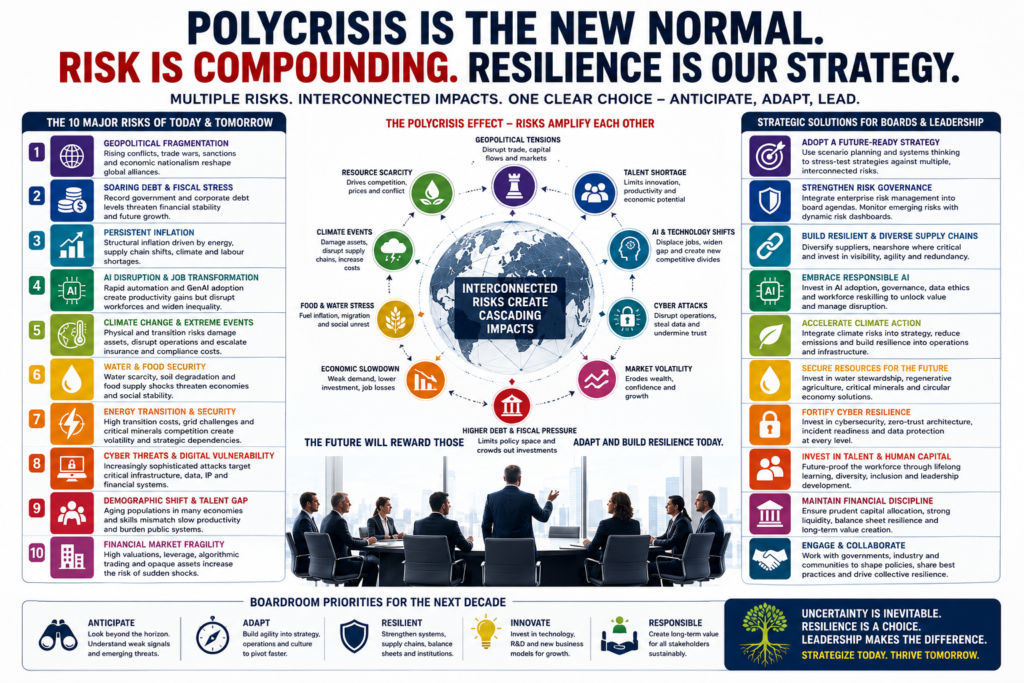
The global economy is entering a transformational period that differs fundamentally from any previous era of economic uncertainty. Unlike earlier crises that emerged from a single catalyst such as the Global Financial Crisis of 2008 or the COVID-19 pandemic, the current environment is characterized by the simultaneous convergence of geopolitical fragmentation, technological disruption, climate instability, demographic transitions, fiscal imbalances, cybersecurity threats, and structural changes in global trade. These interconnected risks have created what economists increasingly describe as a “polycrisis,” where multiple shocks interact and amplify one another, producing cascading effects across financial markets, supply chains, governments, businesses, and societies.
This article presents a strategic assessment of the emerging global economic landscape through the lens of risk interdependence rather than isolated events. It argues that the dominant challenge facing policymakers, corporate leaders, investors, and institutions is no longer forecasting the next recession but understanding the structural transformation underway in the global economic system. The article further examines how globalization is gradually giving way to strategic regionalization, how artificial intelligence is redefining productivity and employment, why sovereign debt has become one of the most underestimated systemic risks, and how geopolitical competition is reshaping investment decisions worldwide. The analysis concludes that resilience, adaptability, technological capability, and strategic foresight will become the principal determinants of sustainable economic success over the coming decade.
Introduction
Throughout modern economic history, global crises have generally emerged from identifiable causes. The Asian Financial Crisis originated from currency instability, the Dot-com Bubble reflected excessive technology valuations, the Global Financial Crisis resulted from systemic weaknesses in financial institutions, and the COVID-19 pandemic represented an unprecedented public health emergency that evolved into a worldwide economic disruption. Each crisis had a primary trigger that policymakers could identify, analyze, and eventually address through targeted interventions.
The economic risks confronting the world today are fundamentally different. There is no single catalyst driving uncertainty. Instead, multiple structural forces are simultaneously reshaping the global economy while interacting in increasingly complex ways. Rising geopolitical tensions influence energy markets, energy volatility contributes to inflation, inflation alters monetary policy, higher interest rates increase sovereign debt burdens, fiscal constraints reduce investments in infrastructure and climate adaptation, while technological disruption accelerates labour market transformation. These risks reinforce one another, creating feedback loops that conventional economic models struggle to capture.
Consequently, governments, multinational corporations, financial institutions, and investors are operating in an environment where uncertainty itself has become structural rather than cyclical. Long-term planning increasingly requires scenario-based thinking instead of reliance on historical trends.
This article examines the principal risks currently confronting the global economy and explores how these forces are likely to reshape international business, trade, investment, and economic development over the next decade.
The End of the Hyper-Globalization Era
For nearly four decades, globalization served as the principal engine of worldwide economic expansion. Manufacturing shifted toward regions offering lower labour costs, multinational corporations optimized global supply chains, cross-border investments expanded rapidly, and technological innovation enabled unprecedented economic integration. Consumers benefited from lower prices, businesses achieved higher operational efficiency, and developing economies experienced significant industrial growth.
However, the assumptions supporting hyper-globalization have begun to weaken significantly.
Recent geopolitical developments have highlighted the vulnerabilities associated with excessive dependence on globally dispersed production networks. Trade disputes among major economies, export restrictions on advanced technologies, strategic competition over semiconductors, disruptions in maritime transportation, and regional conflicts have collectively altered corporate perceptions regarding supply chain efficiency.
Efficiency is no longer the sole objective of global business strategy.
Resilience has emerged as an equally important strategic priority.
Organizations increasingly recognize that minimizing production costs provides limited value if critical components cannot be delivered during periods of geopolitical instability or logistical disruption. Consequently, firms are redesigning supply chains by diversifying suppliers, regionalizing manufacturing operations, and reducing dependence on single-country production hubs.
The transformation represents one of the most significant structural shifts in international commerce since the establishment of the World Trade Organization.
Table presents the evolving characteristics of the global economic system.
| Dimension | Hyper-Globalization Era | Emerging Global Economic Order |
| Primary Objective | Cost Efficiency | Strategic Resilience |
| Supply Chain Model | Global Optimization | Regional Diversification |
| Trade Philosophy | Open Global Markets | Strategic Economic Partnerships |
| Manufacturing Strategy | Concentration | Multi-country Distribution |
| Technology Sharing | Broad International Collaboration | Strategic Technology Protection |
| Investment Focus | Lowest Cost Locations | Geopolitical Risk Assessment |
| Competitive Advantage | Scale and Efficiency | Flexibility and Adaptability |
This transition is expected to increase production costs across many industries while simultaneously improving resilience against future disruptions. Consequently, inflationary pressures that once appeared temporary may become embedded within the global economic structure.
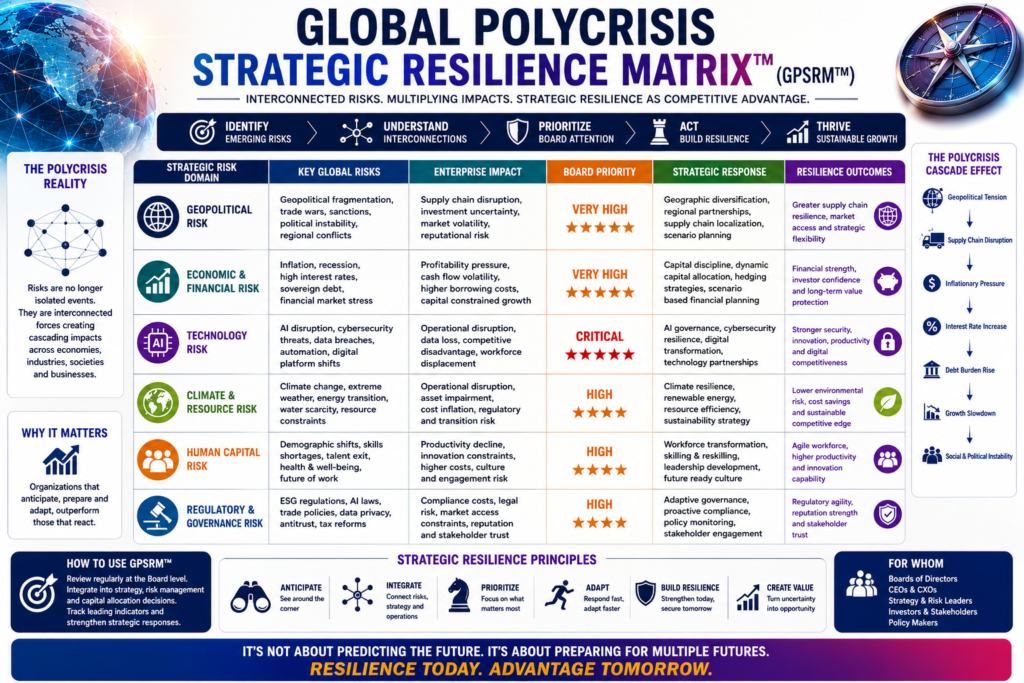
Global Polycrisis Strategic Resilience Matrix™ (GPSRM™)
The GPSRM™ is a strategic management framework designed to help Boards of Directors, CEOs, CXOs, policymakers, and enterprise leaders understand that today’s global risks are no longer isolated events. Instead, they are interconnected forces that simultaneously influence business performance, financial stability, operational resilience, and long-term competitiveness. The framework shifts organizations from traditional Enterprise Risk Management (ERM), where risks are assessed individually, to an integrated strategic resilience model where interconnected risks are evaluated collectively.
The framework recognizes that modern organizations operate in an environment where geopolitical tensions influence supply chains, supply chain disruptions fuel inflation, inflation affects monetary policy, higher interest rates increase sovereign debt burdens, technological disruption transforms labour markets, climate change impacts food and water security, and cyber threats expose critical digital infrastructure. These relationships create cascading effects that cannot be effectively managed through conventional risk registers or periodic risk reviews.
The objective of GPSRM™ is to enable leadership teams to identify emerging global risks, understand their enterprise-wide implications, prioritize Board attention, and define strategic responses before risks evolve into organizational crises. Rather than focusing solely on risk mitigation, the framework promotes resilience, adaptability, and strategic preparedness as core competitive advantages.
Framework Structure
| Strategic Risk Domain | Primary Global Risk | Enterprise Impact | Board Priority | Strategic Response |
| Geopolitical Risk | Trade conflicts, geopolitical fragmentation, sanctions | Supply chain disruption, investment uncertainty | Very High | Geographic diversification, regional partnerships |
| Economic & Financial Risk | Inflation, recession, sovereign debt, interest rates | Profitability, liquidity, capital allocation | Very High | Financial discipline, capital optimization, scenario planning |
| Technology Risk | Artificial Intelligence, cybersecurity, digital disruption | Workforce transformation, operational risk | Critical | AI governance, cybersecurity, digital transformation |
| Climate & Resource Risk | Climate change, energy transition, water scarcity | Operational continuity, cost inflation | High | Climate resilience, resource optimization, sustainability |
| Human Capital Risk | Demographic shifts, skills shortages | Productivity, innovation capability | High | Workforce reskilling, leadership development |
| Regulatory & Governance Risk | ESG regulations, AI governance, trade policies | Compliance, reputation, investor confidence | High | Adaptive governance, policy monitoring |
Strategic Interpretation
The framework demonstrates that organizational resilience cannot be achieved by managing risks independently. Every risk category influences multiple business functions simultaneously and therefore requires coordinated governance, integrated decision-making, and long-term strategic investment.
Organizations that successfully implement GPSRM™ are better positioned to anticipate disruptions, strengthen enterprise resilience, improve capital allocation decisions, enhance Board oversight, and develop sustainable competitive advantage in an increasingly uncertain global economy.
Geopolitical Fragmentation as an Economic Variable
For decades, geopolitical events were frequently viewed as external variables influencing financial markets only during periods of military conflict or diplomatic crises. Today, geopolitics has become one of the primary determinants of investment allocation, industrial policy, technology development, and corporate strategy.
Economic decisions increasingly reflect national security considerations.
Governments worldwide are introducing industrial policies aimed at protecting strategic sectors including semiconductors, artificial intelligence, telecommunications, pharmaceuticals, critical minerals, renewable energy technologies, and defense manufacturing. Export controls, investment screening mechanisms, sanctions, and technology restrictions have become common instruments of economic policy.
The emerging global economy is gradually organizing itself around multiple economic blocs rather than a single integrated marketplace.
This fragmentation creates both opportunities and risks.
Countries capable of serving as trusted manufacturing partners may attract significant foreign investment, while nations dependent upon politically sensitive supply chains may experience declining competitiveness. Businesses must therefore evaluate geopolitical stability alongside traditional financial metrics when making long-term investment decisions.
The strategic implications extend beyond multinational corporations.
Financial markets increasingly incorporate geopolitical risk premiums into asset pricing, sovereign borrowing costs, commodity markets, and currency valuations.
Consequently, political decisions now possess immediate and measurable economic consequences.
The Growing Threat of Sovereign Debt
One of the most underestimated risks confronting the global economy is the unprecedented expansion of sovereign debt.
During the past two decades, governments substantially increased borrowing to address financial crises, economic recessions, infrastructure development, demographic pressures, pandemic-related expenditures, and national security requirements. While low interest rates previously reduced borrowing costs, the current monetary environment has fundamentally altered fiscal sustainability.
Higher interest rates increase the cost of servicing existing debt while simultaneously limiting governments’ capacity to finance future investments.
Table illustrates the evolving characteristics of sovereign debt risk.
| Debt Driver | Short-Term Benefit | Long-Term Risk |
| Fiscal Stimulus | Supports Economic Growth | Persistent Budget Deficits |
| Infrastructure Investment | Productivity Enhancement | Rising Debt Burden |
| Social Welfare Expansion | Political Stability | Structural Fiscal Pressure |
| Pandemic Spending | Economic Stabilization | Increased Borrowing Requirements |
| Defense Expenditure | National Security | Reduced Fiscal Flexibility |
| Higher Interest Rates | Inflation Control | Escalating Debt Servicing Costs |
The consequences extend beyond government finances.
As public debt expands, sovereign borrowing increasingly competes with private investment for available capital. Businesses face higher financing costs, infrastructure investment slows, innovation funding declines, and economic growth weakens over time.
Emerging economies face particularly significant challenges because many rely upon foreign currency borrowing. Currency depreciation can rapidly increase repayment obligations, creating financial instability even when domestic economic conditions remain relatively stable.
The interaction between fiscal deficits, monetary tightening, and slower economic growth represents one of the most important structural risks likely to influence the global economy throughout the coming decade.
Inflation Has Become Structural Rather Than Temporary
One of the defining assumptions following the COVID-19 pandemic was that inflation would gradually return to pre-pandemic levels once supply chains normalized. While inflation has moderated in several economies, the underlying drivers have fundamentally changed.
The global economy is no longer experiencing purely demand-driven inflation.
Instead, inflation increasingly originates from structural supply-side constraints.
Energy market volatility, geopolitical conflicts, climate-related disruptions, labour shortages, demographic aging, higher logistics costs, industrial reshoring, and supply chain diversification collectively increase production expenses across numerous industries.
Unlike cyclical inflation, structural inflation cannot be eliminated solely through higher interest rates.
Central banks face increasingly difficult policy choices.
Aggressive monetary tightening reduces inflationary pressures but simultaneously slows investment, housing activity, employment growth, and business expansion. Conversely, premature interest rate reductions may reignite inflation, undermining long-term economic stability.
This policy dilemma explains why many central banks have adopted a “higher for longer” interest rate strategy.
Persistent inflation also alters corporate behavior.
Businesses increasingly prioritize pricing power, operational efficiency, automation, and supply chain resilience to protect profit margins. Consumers adjust spending habits, investors seek inflation-resistant assets, and governments face mounting pressure to expand fiscal support despite already elevated debt levels.
Inflation has therefore evolved from a temporary macroeconomic disturbance into a structural characteristic of the emerging global economy.
China’s Structural Economic Transformation
For more than thirty years, China served as the principal engine of global manufacturing expansion and international trade growth. Rapid industrialization, infrastructure investment, export competitiveness, and urbanization transformed the country into the world’s second-largest economy.
Today, however, China’s economic model is undergoing significant structural adjustment.
Several long-term challenges have emerged simultaneously.
The real estate sector, which previously represented a major source of investment and household wealth, has experienced prolonged weakness. Local government financing pressures have intensified, consumer confidence has softened, demographic aging is accelerating, and export growth faces increasing geopolitical constraints.
These developments do not necessarily imply economic collapse.
Rather, they suggest a transition toward slower, more sustainable growth.
Nevertheless, the implications for the global economy remain substantial.
Commodity-exporting nations may experience weaker demand for industrial metals and construction materials. Multinational corporations may accelerate supply chain diversification toward India, Vietnam, Indonesia, Mexico, and other emerging manufacturing destinations. Financial markets may reassess long-term growth expectations across Asia.
The strategic importance of China’s transition extends well beyond national borders because the country’s economic performance influences global trade volumes, commodity prices, manufacturing investment, logistics networks, and international capital flows.
The world is therefore entering an era in which multiple regional growth engines rather than a single dominant manufacturing economy will determine global economic expansion.
Artificial Intelligence and the Productivity Paradox
Artificial Intelligence (AI) represents the most transformative technological development since the Industrial Revolution. Unlike previous technological innovations that primarily enhanced physical productivity, AI possesses the capability to augment or replace cognitive functions that have traditionally been performed by highly skilled professionals. Consequently, AI is expected to influence virtually every sector of the global economy, including manufacturing, financial services, healthcare, education, consulting, logistics, engineering, legal services, marketing, and scientific research.
The economic potential of AI is extraordinary. Organizations that successfully integrate AI into their business processes are expected to achieve substantial improvements in productivity, operational efficiency, decision-making accuracy, customer engagement, and innovation. AI-enabled predictive analytics, intelligent automation, digital twins, autonomous systems, and generative AI models are already transforming how businesses operate and compete.
However, the same technology that generates unprecedented productivity gains also introduces significant structural risks.
Historically, technological revolutions displaced routine manual labour while simultaneously creating new categories of employment. Artificial Intelligence differs because it increasingly automates knowledge-intensive work that has traditionally been considered immune to technological substitution. Financial analysts, software developers, accountants, legal professionals, market researchers, customer support specialists, content creators, consultants, and even medical practitioners are beginning to experience significant changes in their professional responsibilities.
The resulting labour market transition is unlikely to occur uniformly across industries or regions.
Advanced economies possessing stronger educational systems, higher digital infrastructure, and greater investment capacity are likely to capture a disproportionate share of AI-driven productivity gains, while developing economies dependent upon labour-intensive services may experience greater employment disruption before realizing comparable economic benefits.
Another emerging concern involves market concentration.
The development of frontier AI models requires enormous computational resources, advanced semiconductor infrastructure, proprietary datasets, and highly specialized talent. These barriers increasingly favour a relatively small number of technology companies capable of financing large-scale AI research and deployment. Such concentration may reduce competitive intensity while simultaneously increasing systemic dependence upon a limited number of global technology providers.
Table summarizes the strategic opportunities and associated risks presented by Artificial Intelligence.
| AI Dimension | Strategic Opportunity | Emerging Risk |
| Productivity | Higher operational efficiency | Unequal productivity distribution |
| Labour Markets | Creation of new high-value occupations | Displacement of knowledge workers |
| Innovation | Accelerated research and development | Technology concentration |
| Decision Making | Improved predictive analytics | Algorithmic bias and governance concerns |
| Global Competition | Enhanced national competitiveness | Widening technological inequality |
| Business Operations | Intelligent automation | Cybersecurity vulnerabilities |
Artificial Intelligence should therefore be viewed neither as an unqualified opportunity nor as an inevitable threat. Rather, it represents a structural transformation requiring significant adaptation by governments, educational institutions, businesses, and individuals.
Climate Change as an Economic Risk
For many years, climate change was primarily discussed within environmental policy circles. That distinction no longer exists.
Climate change has evolved into one of the most important macroeconomic variables influencing investment decisions, financial stability, insurance markets, food production, infrastructure development, labour productivity, migration, and public finance.
Extreme weather events are becoming more frequent and more costly.
Floods disrupt manufacturing operations, droughts reduce agricultural output, wildfires destroy infrastructure, hurricanes interrupt logistics networks, and prolonged heatwaves reduce labour productivity across construction, mining, transportation, and industrial sectors.
The cumulative economic costs extend far beyond immediate disaster recovery.
Insurance companies face rapidly increasing claims, governments allocate larger portions of public expenditure toward reconstruction, investors reassess climate-related financial risks, and businesses encounter growing uncertainty regarding long-term asset values.
Climate change also introduces significant transition risks.
Governments worldwide are implementing stricter emissions regulations, carbon pricing mechanisms, sustainability disclosure requirements, and renewable energy incentives. Organizations unable to adapt to these evolving regulatory environments may experience declining competitiveness, stranded assets, and increasing financing costs.
Table illustrates the multidimensional economic consequences of climate change.
| Climate Factor | Direct Economic Impact | Strategic Consequence |
| Rising Temperatures | Reduced labour productivity | Lower economic output |
| Extreme Weather | Infrastructure destruction | Increased reconstruction spending |
| Water Scarcity | Agricultural losses | Food inflation |
| Sea-Level Rise | Coastal asset exposure | Relocation costs |
| Carbon Regulation | Compliance expenditure | Industrial transformation |
| Insurance Losses | Higher premiums | Financial market repricing |
The economic implications of climate change extend across every major industry.
Agriculture confronts unpredictable growing conditions. Manufacturing faces water availability challenges. Energy systems require extensive modernization. Transportation infrastructure must become increasingly resilient to extreme weather events. Financial institutions are incorporating climate risk into lending decisions and investment portfolios.
Consequently, climate resilience is becoming an essential component of long-term economic competitiveness rather than merely an environmental objective.
Energy Security and the New Strategic Competition
Energy has historically been one of the principal determinants of economic prosperity.
Industrial revolutions, transportation systems, manufacturing capacity, digital infrastructure, and national security all depend upon reliable and affordable energy supplies.
The global transition toward renewable energy represents one of the most significant structural changes occurring within the international economy.
However, energy transition itself introduces substantial economic uncertainty.
Renewable energy systems require extensive investments in transmission networks, battery storage technologies, smart grids, critical minerals, hydrogen infrastructure, and advanced manufacturing capabilities. These investments involve considerable capital expenditure while existing fossil fuel infrastructure continues to satisfy a substantial proportion of global energy demand.
The transition therefore creates a complex period during which legacy energy systems and emerging technologies must coexist.
Geopolitical competition further complicates this transformation.
Control over lithium, cobalt, nickel, graphite, copper, and rare earth elements increasingly resembles historical competition surrounding oil and natural gas. Nations possessing abundant reserves of strategic minerals are likely to gain significant geopolitical influence as demand for electric vehicles, renewable energy systems, advanced electronics, and defense technologies continues expanding.
Energy security consequently extends beyond fuel availability.
It now encompasses technological capability, resource access, manufacturing capacity, grid resilience, and strategic industrial policy.
Countries that successfully integrate these dimensions are expected to emerge as leaders within the evolving global energy economy.
Demographic Transformation and Economic Growth
Demographic trends represent one of the most predictable yet frequently underestimated drivers of long-term economic performance.
Population dynamics influence labour markets, consumer demand, public finances, healthcare expenditure, housing markets, education systems, and productivity growth.
Many advanced economies are entering prolonged periods of demographic decline.
Fertility rates continue falling below replacement levels, life expectancy continues increasing, and workforce participation gradually decreases as populations age.
Japan, South Korea, Germany, Italy, and increasingly China illustrate this structural transition.
An aging population produces several interconnected economic consequences.
Labour shortages reduce productive capacity, pension obligations increase government expenditure, healthcare systems experience mounting financial pressure, consumer spending patterns shift toward services rather than durable goods, and innovation may gradually slow as younger entrepreneurial populations decline.
Conversely, several emerging economies continue benefiting from relatively youthful populations.
India, Indonesia, Vietnam, and parts of Africa possess significant demographic potential.
Nevertheless, favourable demographics alone do not guarantee economic prosperity.
Without adequate investments in education, healthcare, infrastructure, digital connectivity, industrial development, and employment generation, demographic advantages may evolve into social and economic challenges.
The quality of human capital increasingly matters more than the quantity of labour.
Knowledge, adaptability, digital literacy, and continuous skill development are becoming the primary determinants of national competitiveness within the emerging global economy.
Water Scarcity and Food Security
Water has traditionally been treated as an environmental resource.
Increasingly, it must also be viewed as a strategic economic asset.
Agriculture, manufacturing, semiconductor fabrication, mining, power generation, pharmaceuticals, and urban development all depend upon reliable freshwater supplies.
Climate variability, population growth, industrial expansion, groundwater depletion, and changing precipitation patterns are placing unprecedented pressure on water resources across many regions of the world.
Water scarcity directly influences agricultural productivity.
Lower crop yields contribute to food inflation, reduced export capacity, rural income volatility, and increased dependence upon international food markets.
Countries experiencing severe water stress may also encounter rising geopolitical tensions regarding shared river systems and cross-border resource management.
Food security has consequently emerged as both an economic and national security concern.
Global agricultural systems face simultaneous pressures arising from climate change, fertilizer costs, energy prices, transportation disruptions, soil degradation, biodiversity loss, and changing dietary patterns associated with rising incomes.
These interconnected pressures suggest that food price volatility may become a persistent characteristic of global commodity markets rather than an occasional cyclical phenomenon.
For businesses operating within agriculture, food processing, retail, logistics, and consumer goods, resource efficiency and climate adaptation are becoming central components of long-term competitive strategy rather than peripheral sustainability initiatives.
Cybersecurity and the Digital Economy
Economic activity has become increasingly digital.
Financial transactions, industrial operations, healthcare systems, telecommunications, transportation networks, supply chains, cloud computing, and government services depend upon interconnected digital infrastructure.
While digitalization has generated remarkable productivity improvements, it has simultaneously expanded the global cyber threat landscape.
Cyberattacks are evolving in sophistication, scale, and strategic significance.
State-sponsored cyber operations, ransomware attacks, intellectual property theft, financial fraud, supply chain infiltration, and attacks on critical infrastructure have become major sources of economic risk.
Unlike traditional military conflicts, cyber warfare can disrupt economic systems without physical destruction.
Financial markets, payment systems, electricity networks, hospitals, ports, manufacturing facilities, and telecommunications infrastructure may all become targets during periods of geopolitical tension.
The resulting economic consequences extend beyond immediate financial losses.
Reputational damage, regulatory penalties, operational disruption, legal liabilities, customer attrition, and declining investor confidence may collectively exceed the direct costs of cyber incidents.
Cyber resilience is therefore evolving into a strategic board-level priority.
Organizations increasingly recognize that cybersecurity represents not merely an information technology function but a fundamental component of enterprise risk management, business continuity, and long-term value creation.
Financial Market Fragility in an Era of Systemic Uncertainty
Financial markets have always reflected the underlying health of the global economy. However, the structure of financial markets has undergone profound transformation during the past two decades. The expansion of passive investment vehicles, algorithmic trading, private credit markets, leveraged financial products, and interconnected global capital flows has increased both market efficiency and systemic vulnerability.
Modern financial systems are increasingly influenced by speed rather than stability.
Artificial intelligence-driven trading algorithms execute transactions within milliseconds, global information spreads instantaneously, and investor sentiment can shift dramatically following geopolitical developments, policy announcements, or technological disruptions. While these innovations have improved market liquidity under normal conditions, they may amplify volatility during periods of uncertainty.
Another emerging concern involves the rapid expansion of private credit markets. As traditional banking regulations have become more stringent following the Global Financial Crisis, non-bank financial institutions have assumed a larger role in corporate lending. Although private credit has improved access to financing for many businesses, it has also created new areas of systemic risk that remain less transparent than conventional banking systems.
Simultaneously, historically elevated asset valuations across equity markets, commercial real estate, technology sectors, and private investments increase sensitivity to interest rate movements and economic slowdowns.
Financial stability over the coming decade will therefore depend not only on monetary policy but also on regulatory oversight, institutional resilience, market transparency, and investor confidence.
Table summarizes the principal structural vulnerabilities within the modern financial system.
| Financial Risk | Current Trend | Potential Economic Consequence |
| High Sovereign Debt | Increasing | Fiscal instability |
| Elevated Asset Valuations | Moderate to High | Market corrections |
| Private Credit Expansion | Rapid Growth | Liquidity stress |
| Algorithmic Trading | Widespread | Increased market volatility |
| Global Capital Mobility | Highly Integrated | Faster financial contagion |
| Currency Volatility | Rising | Investment uncertainty |
These developments suggest that future financial crises may emerge from multiple interconnected vulnerabilities rather than from a single identifiable institution or asset class.
The Rise of Strategic Regionalization
Globalization is not disappearing.
It is evolving.
The emerging economic model is increasingly characterized by regionalization, strategic alliances, and selective globalization rather than unrestricted international integration.
Corporations are redesigning supply chains around geopolitical resilience rather than lowest-cost production. Governments are strengthening domestic manufacturing capabilities in strategically important industries. International trade agreements increasingly reflect geopolitical priorities alongside commercial interests.
The concept of “friend-shoring” has gained significant strategic importance, encouraging businesses to expand operations within politically aligned economies. Similarly, “China Plus One” manufacturing strategies are accelerating investment across India, Vietnam, Indonesia, Mexico, and several Eastern European economies.
This structural transformation has important implications for international competitiveness.
Countries capable of combining political stability, skilled labour, infrastructure quality, digital connectivity, regulatory transparency, and manufacturing capability are likely to emerge as preferred destinations for long-term foreign direct investment.
Regionalization does not eliminate globalization.
Instead, it creates multiple interconnected regional economic ecosystems with greater emphasis on resilience, trust, strategic cooperation, and supply chain security.
The Future of Global Economic Leadership
The coming decade is unlikely to produce a single dominant economic power comparable to previous historical periods.
Instead, global leadership is expected to become increasingly distributed across multiple regions possessing distinct comparative advantages.
The United States is likely to maintain leadership in frontier technologies, artificial intelligence, financial markets, higher education, and innovation ecosystems.
China will continue representing one of the world’s largest manufacturing economies while pursuing greater technological self-sufficiency and domestic consumption.
The European Union is expected to remain influential in sustainability regulation, advanced manufacturing, climate policy, and industrial standards despite demographic and energy-related challenges.
India possesses an unprecedented opportunity to emerge as one of the defining growth engines of the twenty-first century.
Its demographic profile, expanding digital infrastructure, growing domestic market, rapidly developing Global Capability Centres (GCCs), improving manufacturing ecosystem, entrepreneurial culture, and geopolitical positioning provide significant long-term competitive advantages.
However, realizing this opportunity will require sustained investments in education, logistics, urban infrastructure, research and development, judicial efficiency, healthcare, water management, and workforce skills.
Economic leadership during the coming decade will increasingly depend upon adaptability rather than size alone.
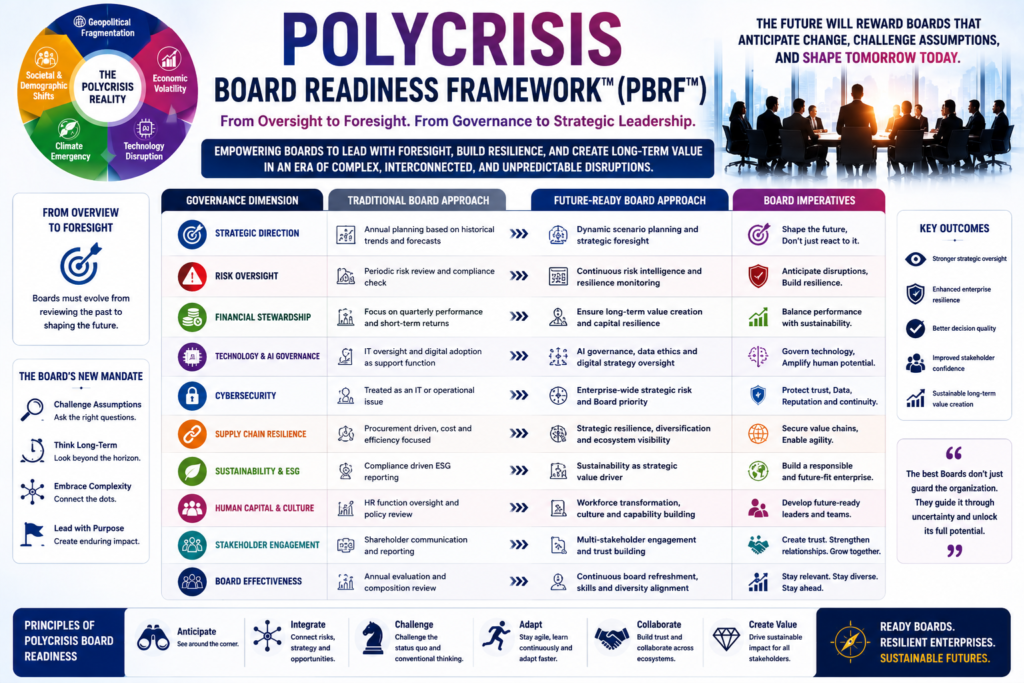
Polycrisis Board Readiness Framework™ (PBRF™)
The PBRF™ is a Board-centric governance framework that redefines the evolving role of Boards of Directors in an era of continuous disruption. The framework recognizes that corporate governance has entered a new phase where traditional responsibilities such as financial oversight, compliance monitoring, and shareholder reporting are no longer sufficient to address the complexity of the modern business environment.
The accelerating convergence of geopolitical instability, artificial intelligence, cybersecurity threats, climate change, demographic transitions, and regulatory evolution requires Boards to move beyond retrospective governance toward anticipatory strategic leadership. Future-ready Boards must continuously evaluate emerging risks, challenge strategic assumptions, oversee enterprise resilience, and guide organizations through uncertain and rapidly changing environments.
PBRF™ provides a structured roadmap for transforming governance from compliance-focused oversight into strategic foresight. It encourages Boards to integrate scenario planning, enterprise resilience, digital governance, and long-term value creation into every major strategic decision.
Framework Structure
| Governance Dimension | Traditional Board Approach | Future-Ready Board Approach |
| Strategic Planning | Annual planning cycle | Continuous scenario planning |
| Risk Oversight | Periodic enterprise risk review | Real-time enterprise resilience monitoring |
| Financial Oversight | Quarterly financial performance | Long-term capital resilience and sustainability |
| Technology Governance | IT oversight | Artificial Intelligence governance and digital strategy |
| Cybersecurity | Operational responsibility | Enterprise strategic risk oversight |
| Supply Chain | Procurement management | Strategic resilience and diversification |
| Sustainability | Regulatory compliance | Long-term competitive differentiation |
| Human Capital | Human resource review | Workforce transformation and future capability building |
Strategic Interpretation
The framework emphasizes that future Boards will increasingly be evaluated by their ability to anticipate disruption rather than simply monitor performance. Governance evolves from reviewing historical financial outcomes toward shaping future organizational resilience.
Boards applying PBRF™ develop stronger strategic oversight, improve enterprise risk governance, enhance organizational agility, strengthen stakeholder confidence, and position their organizations to respond effectively to complex and interconnected global risks.
Strategic Implications for Governments
Governments entering this new economic era must fundamentally rethink economic policy.
Macroeconomic stability remains essential, but it is no longer sufficient.
National competitiveness increasingly depends upon technological capability, digital infrastructure, industrial resilience, energy security, climate adaptation, education systems, institutional quality, cybersecurity preparedness, and fiscal sustainability.
Public policy must balance short-term political priorities with long-term structural investments.
Fiscal discipline should coexist with targeted investments in innovation, strategic industries, infrastructure modernization, and human capital development.
Equally important is the development of adaptive regulatory frameworks capable of encouraging innovation while protecting financial stability, data privacy, market competition, and national security.
The governments that successfully integrate economic policy with technological strategy are likely to outperform those relying primarily upon traditional fiscal or monetary interventions.
Strategic Implications for Businesses
Corporate strategy is undergoing one of the most significant transformations in modern business history.
The competitive advantages that dominated previous decades—including cost optimization, operational efficiency, and global scale—remain important but are increasingly insufficient.
Future business success will depend upon organizational resilience.
Companies must strengthen supply chain diversification, invest in digital transformation, enhance cybersecurity capabilities, incorporate artificial intelligence responsibly, develop climate resilience strategies, and continuously upgrade workforce capabilities.
Strategic planning should increasingly incorporate scenario analysis rather than relying exclusively upon historical forecasting models.
Leadership teams should evaluate investments across multiple potential geopolitical, technological, regulatory, and environmental outcomes.
Corporate governance will likewise assume greater strategic importance.
Boards of Directors must expand oversight beyond financial performance to include technological disruption, sustainability risks, geopolitical exposure, cyber resilience, talent development, and long-term strategic adaptability.
The companies that thrive during the coming decade will be those capable of responding rapidly to continuous structural change rather than optimizing solely for predictable operating environments.
Strategic Implications for Investors
Investment strategies built upon historical economic assumptions may require significant reassessment.
The emerging global economy presents substantial opportunities alongside elevated uncertainty.
Long-term investment performance is increasingly likely to be influenced by structural themes rather than short-term market cycles.
Artificial intelligence, cybersecurity, semiconductor technologies, renewable energy, critical minerals, digital infrastructure, biotechnology, robotics, healthcare innovation, water technologies, and advanced manufacturing represent sectors likely to experience sustained structural growth.
Conversely, industries unable to adapt to technological transformation, climate regulation, changing consumer behaviour, demographic shifts, or geopolitical fragmentation may encounter prolonged competitive challenges.
Diversification across sectors, geographies, asset classes, and investment themes becomes increasingly important within a structurally uncertain economic environment.
Risk management should evolve from protecting against isolated events toward preparing for multiple simultaneous disruptions.
India’s Strategic Position in the Emerging Global Economy
India enters this period of structural transformation from a position of considerable strategic strength.
Unlike many developed economies confronting demographic decline, India continues to benefit from a relatively young workforce.
Its rapidly expanding digital public infrastructure, growing startup ecosystem, increasing manufacturing capabilities, strong services sector, and favourable geopolitical relationships provide substantial long-term advantages.
The country’s emergence as a preferred destination for Global Capability Centres, engineering services, technology development, pharmaceuticals, electronics manufacturing, renewable energy, and digital innovation reflects growing international confidence.
However, significant challenges remain.
Urbanization requires extensive infrastructure investment. Climate resilience demands improved water management and sustainable agriculture. Educational quality and workforce skills must continue improving to capture AI-driven economic opportunities. Energy security and critical mineral access require long-term strategic planning.
If these challenges are addressed effectively, India possesses the potential to become one of the defining economic success stories of the next two decades.
The coming decade therefore represents not merely an opportunity for economic expansion but a strategic window for national transformation.
Future Enterprise Resilience Pyramid™ (FERP™)
The FERP™ is an enterprise transformation framework that illustrates the sequential capabilities organizations must develop to achieve sustainable growth in an increasingly uncertain world. Unlike conventional transformation models that emphasize technology or innovation alone, FERP™ argues that long-term competitiveness is built progressively through a structured hierarchy of organizational capabilities.
The framework is based on the principle that organizations cannot achieve strategic leadership without first establishing financial stability, operational excellence, enterprise resilience, and digital capability. Each layer strengthens the next, creating an integrated foundation for sustainable competitive advantage.
FERP™ serves as a maturity model that helps leadership teams prioritize investments, evaluate organizational readiness, and sequence transformation initiatives in a manner that minimizes strategic risk while maximizing long-term value creation.
Framework Structure
| Pyramid Level | Organizational Capability | Strategic Objective | Business Outcome |
| Level 5 | Strategic Leadership | Vision, governance, culture, ecosystem leadership | Sustainable competitive advantage |
| Level 4 | Innovation & Digital Transformation | Artificial Intelligence, analytics, automation, digital business models | Innovation-led growth |
| Level 3 | Enterprise Risk & Business Resilience | Cybersecurity, climate resilience, supply chain resilience, crisis management | Organizational resilience |
| Level 2 | Operational Excellence & Adaptability | Lean operations, agility, productivity, customer responsiveness | Business flexibility and operational efficiency |
| Level 1 | Financial Stability & Governance | Capital allocation, liquidity, compliance, governance, internal controls | Strong financial foundation |
Capability Progression
| Stage | Strategic Focus | Leadership Priority |
| Foundation | Financial discipline and governance | Preserve organizational stability |
| Optimization | Operational agility and process excellence | Improve efficiency and responsiveness |
| Protection | Enterprise resilience and risk management | Reduce systemic vulnerabilities |
| Transformation | Innovation and digital capability | Drive future competitiveness |
| Leadership | Strategic foresight and purpose-driven growth | Achieve long-term market leadership |
Strategic Interpretation
FERP™ demonstrates that sustainable transformation cannot be achieved through isolated technology investments or short-term operational improvements. Organizations that skip foundational capabilities often struggle to sustain innovation during periods of economic volatility or disruption.
The framework encourages leadership teams to build resilient enterprises by first strengthening financial governance, then improving operational adaptability, followed by enterprise-wide resilience, digital transformation, and finally strategic leadership. This structured progression enables organizations to remain competitive regardless of future economic, technological, geopolitical, or environmental uncertainty.
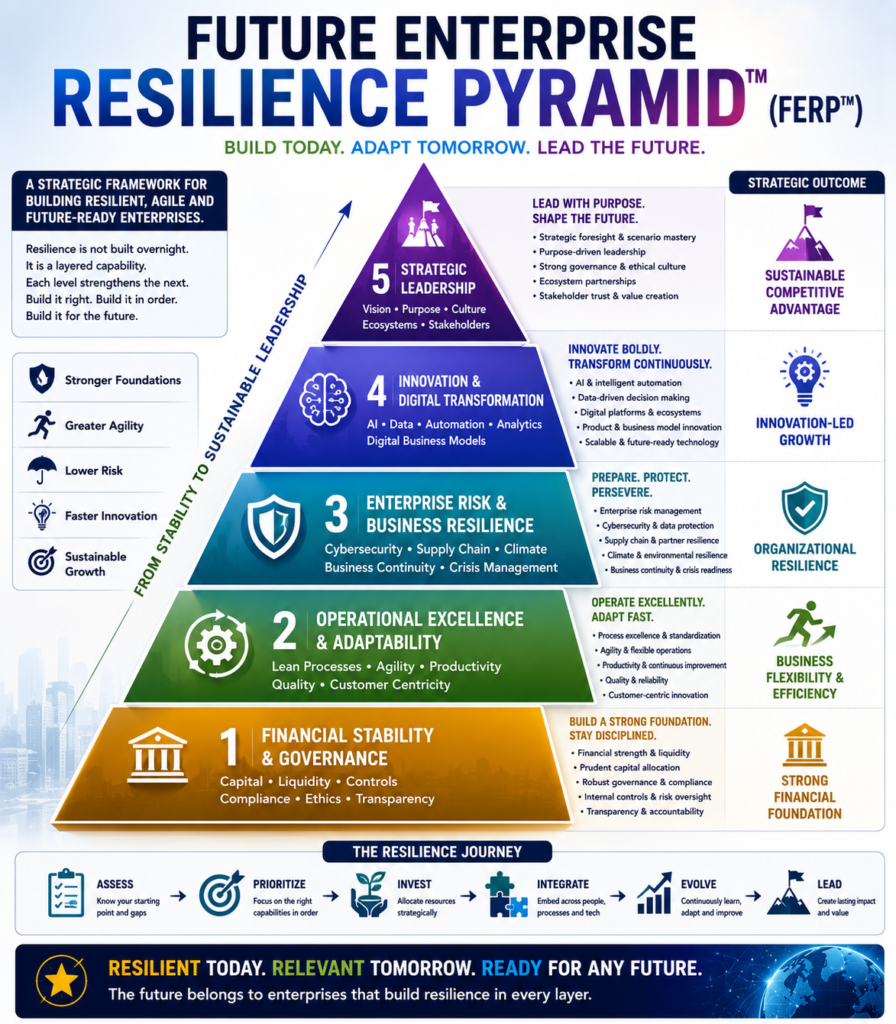
Together, GPSRM™, PBRF™, and FERP™ form a comprehensive strategic architecture that links external risk assessment, Board governance, and enterprise capability development into a unified management framework for navigating the emerging era of global polycrisis.
Conclusion
The global economy has entered an era fundamentally different from anything experienced during the previous half century.
The defining characteristic of this new environment is not the existence of individual risks but the increasing interaction among multiple structural forces. Geopolitical competition influences supply chains, supply chain disruptions contribute to inflation, inflation shapes monetary policy, higher interest rates increase debt burdens, technological disruption transforms labour markets, climate change affects food production, and cybersecurity threats challenge the digital foundations of modern economies.
These interconnected risks collectively define the emerging polycrisis.
Traditional forecasting models based primarily upon economic cycles are becoming progressively less effective because structural transformation rather than cyclical fluctuation now represents the dominant driver of global change.
The winners of the coming decade will not necessarily be the largest economies, the wealthiest corporations, or the fastest-growing markets.
Instead, leadership will belong to those capable of anticipating disruption, adapting rapidly, investing strategically, strengthening institutional resilience, embracing responsible innovation, and continuously developing human capital.
Resilience is replacing efficiency as the defining measure of competitive advantage.
Strategic foresight is replacing short-term optimization as the principal determinant of sustainable success.
The next decade will therefore be remembered not simply as another phase of economic uncertainty, but as the period during which the architecture of the global economy was fundamentally redesigned.
References
- International Monetary Fund. (2025). World Economic Outlook. https://www.imf.org/en/Publications/WEO
- World Bank. (2025). Global Economic Prospects. https://www.worldbank.org/en/publication/global-economic-prospects
- Organisation for Economic Co-operation and Development. (2025). OECD Economic Outlook. https://www.oecd.org/economic-outlook
- World Economic Forum. (2025). Global Risks Report 2025. https://www.weforum.org/reports/global-risks-report-2025
- United Nations Conference on Trade and Development. (2025). Trade and Development Report. https://unctad.org
- Bank for International Settlements. (2025). Annual Economic Report. https://www.bis.org
- International Energy Agency. (2025). World Energy Outlook. https://www.iea.org/reports/world-energy-outlook
- Intergovernmental Panel on Climate Change. (2023). Sixth Assessment Report. https://www.ipcc.ch
- McKinsey Global Institute. (2024). The Economic Potential of Generative AI. https://www.mckinsey.com/mgi
- International Labour Organization. (2025). World Employment and Social Outlook. https://www.ilo.org
- United Nations. (2024). World Population Prospects. https://population.un.org/wpp
- World Trade Organization. (2025). World Trade Statistical Review. https://www.wto.org
- International Monetary Fund. (2025). Global Financial Stability Report. https://www.imf.org/en/Publications/GFSR
- World Economic Forum. (2025). Future of Jobs Report. https://www.weforum.org/reports/the-future-of-jobs-report-2025
- International Renewable Energy Agency. (2025). Global Energy Transition Outlook. https://www.irena.org
Disclaimer
This article has been prepared exclusively for educational, strategic research, policy discussion, and knowledge-sharing purposes. The analysis reflects the author’s interpretation of publicly available economic research, institutional publications, and global macroeconomic trends as of the time of writing. Economic conditions, geopolitical developments, technological advancements, monetary policies, and regulatory environments evolve continuously and may alter the conclusions presented herein. The views expressed should not be construed as investment advice, financial advice, legal advice, policy recommendations, or guarantees of future economic outcomes. Readers are encouraged to consult official publications, qualified professionals, and updated research before making strategic, financial, or policy decisions based on the information contained in this article.