Introduction
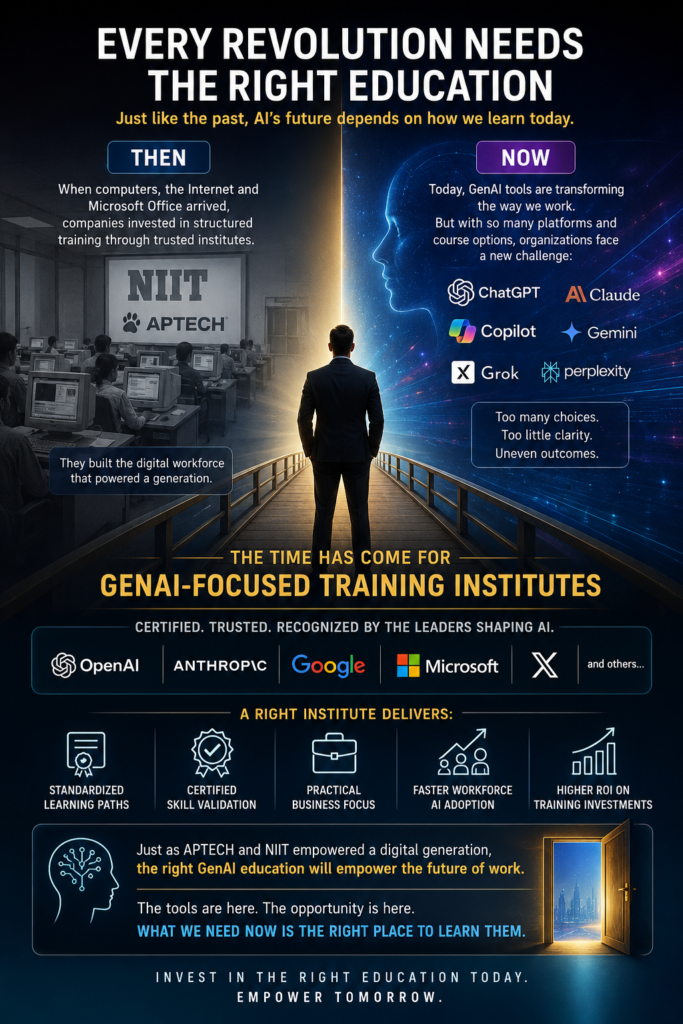
Artificial Intelligence is no longer a futuristic concept. It has become a powerful business tool that is transforming how individuals work, communicate, learn, innovate and make decisions. The emergence of Generative AI technologies such as ChatGPT, Claude, Copilot, Gemini, Grok and Perplexity represents one of the most significant technological shifts since the introduction of personal computers and the Internet.
Organizations across industries are rapidly adopting AI-powered tools to improve productivity, accelerate innovation, enhance customer experiences and gain competitive advantages. However, despite the growing enthusiasm surrounding AI, a major challenge continues to hinder large-scale adoption: workforce readiness.
While millions of professionals are experimenting with AI tools, many organizations struggle to determine how employees should be trained, what skills should be developed and which learning platforms can deliver measurable business outcomes. The challenge is not the availability of AI tools. The challenge is the lack of a structured and standardized AI education ecosystem.
The world has faced a similar situation before. During the computer revolution and the rise of the Internet, organizations relied heavily on specialized training institutions such as APTECH and NIIT to build workforce capabilities. Today, the Generative AI revolution requires a similar educational infrastructure, specifically designed to develop AI-ready professionals and AI-enabled organizations.
Learning from the Computer Revolution
The introduction of computers fundamentally changed business operations. Organizations invested heavily in hardware, software and digital infrastructure. However, technology investments alone could not create value. Employees needed training to effectively use operating systems, office productivity tools, programming languages and networking technologies.
Recognizing this requirement, specialized institutions emerged to provide structured training and certification programs. APTECH and NIIT became household names because they created standardized learning pathways that employers trusted and learners valued.
These institutions played a crucial role in accelerating digital transformation by reducing skill gaps and increasing workforce confidence. Companies could send employees for training knowing that they would acquire practical skills aligned with industry requirements.
Today, Generative AI presents a remarkably similar opportunity. Organizations are investing in AI technologies, but many employees lack the knowledge and confidence needed to utilize these tools effectively.
Table 1: Comparison Between the Computer Revolution and the Generative AI Revolution
| Parameter | Computer Revolution | Generative AI Revolution |
|---|---|---|
| Primary Technology | Computers and Internet | Generative AI Platforms |
| Learning Challenge | Digital Literacy | AI Literacy |
| Training Providers | APTECH, NIIT and others | Fragmented Online Platforms |
| Certification Standards | Widely Accepted | Limited Standardization |
| Employer Confidence | High | Moderate |
| Skill Validation | Structured | Inconsistent |
| Workforce Transformation | Digital Workforce | AI-Augmented Workforce |
The Current State of AI Education
Unlike the early days of computer education, modern learners have access to thousands of online resources. AI courses, webinars, tutorials, podcasts and videos are available across countless platforms.
While this abundance of content appears beneficial, it has created a new challenge. Learners often struggle to identify credible sources, relevant learning pathways and practical training programs. Organizations face even greater difficulties when attempting to train large workforces.
Many employees consume random AI content from different sources without following a structured curriculum. As a result, learning outcomes vary significantly. Some individuals become highly productive AI users while others remain confused about where to begin.
This fragmented learning environment creates uncertainty for both employers and employees. Organizations cannot easily determine whether employees possess practical AI competencies, and learners cannot accurately assess the value of various certifications.
The problem is not a lack of learning resources. The problem is a lack of standardization.
Why Organizations Need Structured AI Training
Generative AI is fundamentally different from traditional software applications. It is not simply another productivity tool that employees can learn through trial and error. AI is changing workflows, decision-making processes, communication methods and business models.
Effective AI adoption requires employees to understand prompt engineering, workflow integration, automation opportunities, AI governance, data privacy considerations and responsible AI practices.
Without structured training, organizations risk inconsistent adoption, reduced productivity gains and wasted technology investments. Employees may use AI tools inefficiently or fail to recognize opportunities where AI can create value.
Structured training programs help organizations establish consistent competencies across departments. They ensure that employees understand not only how AI tools work but also how they can be applied to solve real business challenges.
Table 2: Challenges of Unstructured AI Learning
| Challenge | Business Impact |
|---|---|
| Inconsistent Knowledge | Uneven Workforce Capabilities |
| Poor Tool Selection | Reduced Productivity |
| Lack of Practical Skills | Limited Business Value |
| Absence of Standards | Difficult Skill Assessment |
| Low Confidence | Slower AI Adoption |
| Information Overload | Learning Fatigue |
| Weak Governance Awareness | Increased Risk Exposure |
The Case for Dedicated Generative AI Institutes
The rapid growth of AI technologies has created a compelling need for specialized educational institutions focused entirely on Generative AI.
These institutes would not merely teach individual AI tools. Instead, they would provide comprehensive education covering AI fundamentals, prompt engineering, workflow automation, business transformation, AI ethics, governance and implementation strategies.
Dedicated AI institutes would offer structured learning pathways for professionals at different career stages and functional roles. They would also continuously update curricula to reflect technological advancements and evolving business requirements.
Such institutions could become the AI-era equivalent of APTECH and NIIT, helping millions of professionals acquire practical AI skills while supporting organizations in their transformation journeys.
The objective should be to move beyond tool training and focus on capability development.
The Need for Industry-Recognized Certifications
One of the most important aspects of successful technology education is certification credibility. During the computer revolution, certifications provided employers with confidence that candidates possessed specific competencies.
The AI industry currently lacks a universally recognized certification framework. Numerous providers offer certificates, but many employers remain uncertain about their practical value.
The next generation of AI institutes should collaborate directly with leading technology companies such as OpenAI, Anthropic, Google, Microsoft, xAI and other AI innovators. Such partnerships would ensure curriculum relevance, certification credibility and industry alignment.
Employer confidence would increase significantly if certifications were developed in collaboration with the organizations creating the underlying technologies.
Table 3: Benefits of Industry-Endorsed AI Certifications
| Benefit | Impact |
|---|---|
| Standardized Skills | Consistent Competency Levels |
| Employer Confidence | Better Hiring Decisions |
| Career Growth | Increased Employability |
| Learning Credibility | Higher Trust |
| Industry Alignment | Relevant Skill Development |
| Workforce Mobility | Global Recognition |
Role-Based AI Learning: A Strategic Requirement
Not every employee needs the same AI education. Different roles require different competencies and learning objectives.
Executives need to understand AI strategy, investment opportunities, governance frameworks and competitive implications.
Managers need to learn workflow redesign, productivity enhancement, performance measurement and change management.
Knowledge workers require practical expertise in content creation, research, communication, analysis and task automation.
Technical professionals must focus on AI integration, customization, security and enterprise deployment.
A one-size-fits-all approach to AI education is unlikely to produce optimal results. Dedicated AI institutes should offer specialized learning tracks tailored to different organizational roles and responsibilities.
Table 4: AI Learning Requirements by Role
| Role | Primary Learning Focus |
|---|---|
| CEO and Executives | Strategy and Governance |
| Business Leaders | Transformation and Innovation |
| Managers | Productivity and Change Management |
| Sales Teams | Customer Engagement and Prospecting |
| Marketing Teams | Content and Campaign Optimization |
| HR Professionals | Talent and Workforce Development |
| Finance Teams | Analysis and Forecasting |
| Technical Teams | Integration and Deployment |
Building an Enterprise AI Workforce
Organizations increasingly recognize that AI adoption is not solely a technology initiative. It is a workforce transformation initiative.
Successful AI implementation requires employees who can identify opportunities, redesign workflows and integrate AI into daily activities. This demands continuous learning and structured capability development.
Companies that invest in workforce AI education are likely to achieve faster adoption rates, higher productivity improvements and stronger innovation outcomes. They will also be better positioned to respond to future technological changes.
AI-ready workforces will become a critical source of competitive advantage.
Economic and Societal Impact of AI Education
The impact of AI education extends beyond individual organizations. Countries that develop AI-capable workforces will strengthen their economic competitiveness, innovation capacity and productivity growth.
Governments around the world are already investing in AI strategies and digital transformation initiatives. However, infrastructure investments alone are insufficient. Human capital development must become an equally important priority.
Educational institutions, governments, technology companies and employers must collaborate to build sustainable AI education ecosystems capable of serving millions of learners.
The nations that successfully bridge the AI skills gap will be better positioned to lead the next phase of global economic growth.
Table 5: Long-Term Benefits of AI Workforce Development
| Level | Benefit |
|---|---|
| Individual | Better Career Opportunities |
| Organization | Increased Productivity |
| Industry | Faster Innovation |
| Economy | Stronger Competitiveness |
| Society | Greater Digital Inclusion |
| Government | Improved Workforce Readiness |
Challenges in Creating Dedicated AI Institutes
Although the opportunity is significant, establishing dedicated AI institutes will require addressing several challenges.
The rapid pace of AI innovation means that curricula must be updated continuously. Training programs that remain static risk becoming obsolete within months.
Faculty development is another critical requirement. Instructors must possess both technical expertise and practical business experience to effectively teach AI applications.
Maintaining neutrality is equally important. Educational institutions should focus on principles, frameworks and use cases rather than promoting individual platforms exclusively.
Certification standards must also be rigorous enough to ensure meaningful skill validation and employer trust.
Despite these challenges, the need for structured AI education continues to grow and presents a significant opportunity for educational innovators.
The Future of AI Education
Over the next decade, AI literacy is likely to become as important as computer literacy. Organizations may increasingly expect employees to possess AI competencies regardless of role or industry.
Universities may incorporate AI education into mainstream curricula. Professional certification programs may become common requirements for career advancement. Governments may launch large-scale reskilling initiatives to prepare citizens for AI-driven economies.
Dedicated Generative AI institutes will play a crucial role in supporting this transition by providing structured, scalable and industry-aligned education.
The institutions that establish themselves as trusted providers of AI education today could become the global leaders of tomorrow’s workforce transformation ecosystem.
Conclusion
The Generative AI revolution is transforming industries at an unprecedented pace. Organizations are investing heavily in AI technologies, yet workforce readiness remains one of the biggest barriers to successful implementation.
The current AI learning ecosystem is fragmented, inconsistent and often overwhelming for both individuals and organizations. While countless learning resources exist, there remains a significant need for structured training, standardized curricula and industry-recognized certifications.
History demonstrates that technological revolutions succeed when education evolves alongside innovation. The computer revolution benefited from institutions such as APTECH and NIIT that provided trusted pathways for skill development. The AI revolution now requires a new generation of specialized institutions dedicated entirely to Generative AI education.
Organizations, governments, technology providers and educational institutions must work together to create a comprehensive AI education ecosystem that prepares workforces for the future. Those who invest in AI education today will be best positioned to lead tomorrow.
Recommendations
| Recommendation | Expected Outcome |
|---|---|
| Establish dedicated Generative AI institutes | Structured workforce development |
| Create industry-recognized certification programs | Trusted skill validation |
| Partner with OpenAI, Anthropic, Google, Microsoft and xAI | Improved curriculum relevance |
| Develop role-based learning pathways | Higher training effectiveness |
| Focus on practical business applications | Greater organizational ROI |
| Implement competency-based assessments | Better skill measurement |
| Encourage government participation | Large-scale workforce readiness |
| Continuously update curricula | Alignment with technological advances |
| Promote enterprise-wide AI literacy | Faster adoption and transformation |
| Build global AI education partnerships | Standardization and knowledge sharing |
The question is no longer whether AI will transform the workplace. The transformation is already underway. The real question is whether the world can build the educational infrastructure required to prepare people for the opportunities and challenges of the AI era.