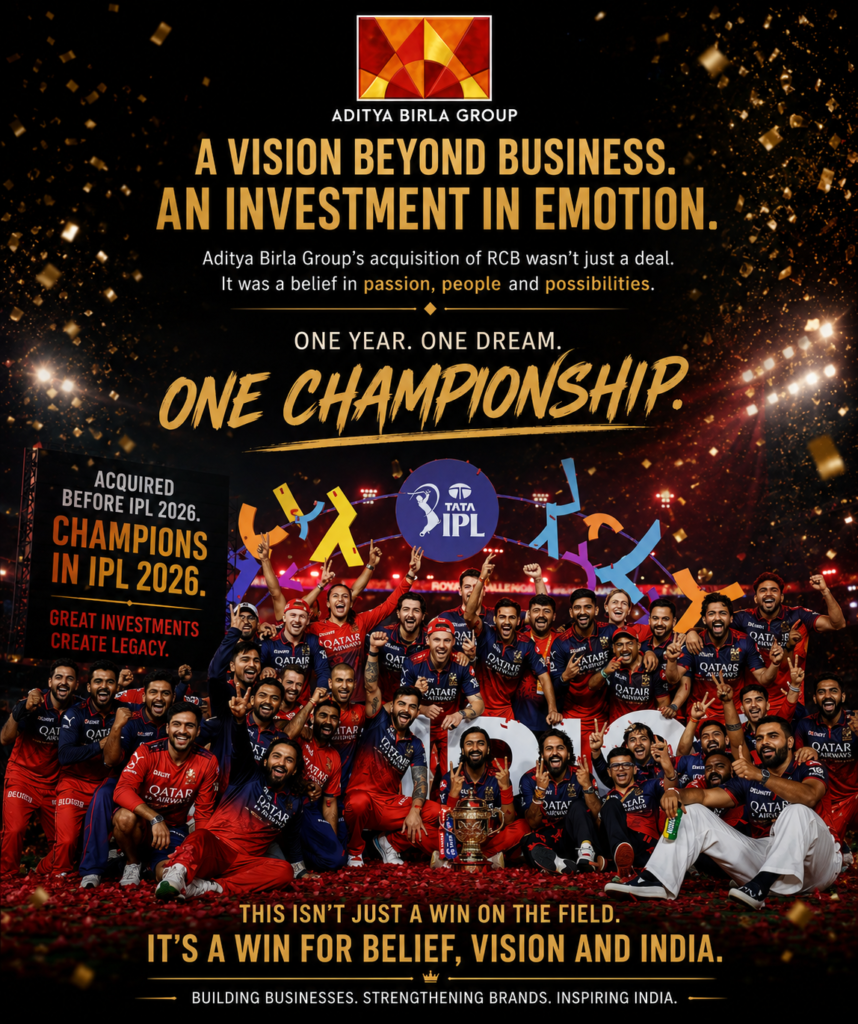
In the world of business, there are investments that generate profits and there are investments that create history.
The acquisition of Royal Challengers Bengaluru by the Aditya Birla Group before IPL 2026 has the potential to become far more than a sports transaction. It could eventually be studied as one of the boldest examples of emotional brand strategy in modern corporate India.
For decades, conglomerates built empires through factories, mines, ports, telecom networks, retail chains and manufacturing strength. Scale was measured through assets, production capacity and market capitalization.
But the global economy is changing rapidly.
Today, influence matters as much as infrastructure.
Attention matters as much as assets.
Emotion matters as much as economics.
And this is exactly where sports franchises have become strategic goldmines.
When Aditya Birla Group entered the IPL ecosystem through the acquisition of Royal Challengers Bengaluru, many observers initially viewed it as an expensive prestige move. After all, sports team valuations across the world have reached unprecedented levels.
But when RCB lifted the IPL trophy in 2026, the narrative changed completely.
Suddenly the acquisition looked visionary.
Suddenly the investment looked transformational.
Suddenly the conversation was no longer about cricket alone.
It became about branding, culture, consumer influence and the future of corporate storytelling.
The biggest lesson from this moment is simple.
The most valuable businesses of the future may not only own products.
They may own emotions.
And emotions create communities.
Communities create loyalty.
Loyalty creates long term economic power.
This is where the RCB acquisition becomes strategically fascinating.
Why IPL Is Much Bigger Than Cricket
To understand the brilliance of this move, one must first understand what the IPL has become.
The Indian Premier League is no longer just a sporting event.
It is a global entertainment ecosystem.
It combines:
• Sports
• Media
• Digital engagement
• Celebrity culture
• Advertising
• Youth influence
• Brand storytelling
• Consumer psychology
• Data monetization
• Merchandise commerce
Every IPL team today functions like a modern media company.
A successful franchise commands:
• Massive television visibility
• Billions of digital impressions
• Global fan engagement
• Social media dominance
• Brand partnerships
• Sponsorship revenues
• Licensing opportunities
• Merchandise sales
• Community influence
In many ways, IPL franchises today are emotional technology platforms.
Fans do not merely watch teams.
They emotionally invest in them.
That emotional connection is incredibly powerful in business.
A consumer may forget an advertisement within minutes.
But they remember how a brand made them feel during moments of joy, victory and celebration.
Sports create those moments naturally.
This is why sports ownership has become increasingly attractive for global business houses.
Why RCB Was More Than a Team
Royal Challengers Bengaluru has always been one of the IPL’s most emotionally charged franchises.
Even during seasons without trophies, RCB remained among the league’s most discussed and commercially attractive teams.
That itself is extraordinary.
Most brands lose attention when they fail to win.
RCB managed to grow despite not consistently winning championships.
Why?
Because RCB built emotional resonance.
The franchise represented:
• Passion
• Loyalty
• Hope
• Aggression
• Entertainment
• Star power
• Fan identity
The emotional intensity surrounding RCB was unlike most sports brands in India.
Fans supported the team not only because of victories but because they emotionally identified with the journey.
That emotional capital is extremely difficult to create artificially.
Companies spend billions globally trying to build loyal communities around products.
RCB already had one.
This is what makes the acquisition strategically brilliant.
Aditya Birla Group did not simply buy a cricket team.
It bought:
• A cultural symbol
• A passionate fan ecosystem
• A digital attention engine
• A globally recognized sports identity
• A high engagement youth platform
• A future ready brand asset
And most importantly, it bought relevance.
In the modern economy, relevance is priceless.
The New Era of Corporate Branding
Traditional branding focused heavily on visibility.
Modern branding focuses on participation.
Consumers no longer want to simply watch brands.
They want to engage with them.
This is especially true for younger demographics.
Millennials and Gen Z consumers prefer:
• Experiences over advertisements
• Communities over corporations
• Storytelling over promotion
• Authenticity over scripted marketing
• Interaction over interruption
Sports franchises naturally fulfill all these requirements.
Every match becomes a storytelling opportunity.
Every season becomes a brand narrative.
Every player becomes a marketing ambassador.
Every fan interaction becomes data.
Every victory becomes a cultural moment.
This creates an emotional ecosystem that traditional advertising simply cannot replicate.
For Aditya Birla Group, this acquisition opens multiple strategic possibilities.
The company can integrate:
• Consumer brands
• Fashion businesses
• Retail ventures
• Financial services
• Telecom offerings
• Lifestyle products
• Digital ecosystems
into the RCB platform.
The cross branding potential is enormous.
Imagine the power of integrating sports engagement with:
• Loyalty programs
• Digital payments
• Fashion merchandising
• Content creation
• Influencer marketing
• Experiential events
• Youth engagement campaigns
This is not simply sponsorship.
This is ecosystem building.
Winning Changed Everything
The IPL 2026 victory transformed the emotional and commercial value of the acquisition instantly.
Winning matters in sports because championships accelerate brand equity.
A trophy validates belief.
It amplifies fan loyalty.
It creates emotional memory.
And emotional memory drives long term monetization.
The victory gave Aditya Birla Group something extremely valuable:
a legendary opening chapter.
Instead of beginning ownership with uncertainty, the group began with triumph.
That matters enormously in branding.
People remember beginnings.
The first year became historic.
The emotional energy surrounding the victory generated:
• Massive media coverage
• Social media virality
• Increased merchandise demand
• Higher fan engagement
• Stronger sponsorship attractiveness
• Global recognition
Most importantly, it created a winning association between the Aditya Birla Group and RCB.
That emotional association can continue compounding for years.
The Economics of Emotion
Many business leaders still underestimate emotional economics.
But the world’s most valuable brands are built on emotion.
Apple sells aspiration.
Nike sells motivation.
Ferrari sells identity.
Disney sells imagination.
Sports teams sell belonging.
And belonging is one of the strongest emotional forces in human psychology.
Fans celebrate victories together.
Suffer defeats together.
Defend teams passionately.
Pass loyalty across generations.
This creates extraordinary brand stickiness.
Unlike transactional businesses, emotional brands become deeply embedded in culture.
That creates long term resilience.
Even during economic slowdowns, emotionally connected consumers remain loyal.
This is why global sports franchises command staggering valuations.
Their value lies not only in revenue but in emotional influence.
Aditya Birla Group recognized this shift early.
The acquisition signals that Indian conglomerates are beginning to understand the next frontier of corporate growth:
attention economies.
Attention Is the New Oil
For decades, industries fought for distribution.
Today, they fight for attention.
Consumers are flooded with content every second.
Traditional advertising is losing effectiveness because audiences increasingly ignore interruption based marketing.
But sports remain one of the few forms of live content people still actively engage with.
Fans willingly spend hours watching matches.
They discuss teams constantly online.
They create memes, videos, debates and fan communities.
This organic engagement is marketing gold.
A sports franchise essentially becomes a permanent attention engine.
This gives business groups enormous strategic leverage.
Because once you own attention, monetization opportunities multiply.
Sports franchises today are capable of generating value through:
• Streaming rights
• Advertising
• Digital subscriptions
• Brand partnerships
• E commerce
• Fan experiences
• Gaming integrations
• NFTs and collectibles
• International expansion
• Licensing
The future commercial possibilities are massive.
RCB is no longer merely a cricket team.
It is intellectual property.
And strong intellectual property compounds in value over time.
The Rise of Sports as Strategic Infrastructure
One of the most important shifts happening globally is the transformation of sports into strategic infrastructure.
Governments use sports for diplomacy.
Cities use sports for tourism.
Corporations use sports for branding.
Sports now influence:
• Consumer behavior
• Global perception
• Digital culture
• Youth aspirations
• International visibility
This is why sovereign wealth funds, billionaires and multinational corporations are aggressively investing in sports properties worldwide.
They understand that sports ownership creates influence beyond balance sheets.
It creates cultural power.
Aditya Birla Group entering this space indicates a deeper strategic vision.
The move positions the conglomerate not just as an industrial powerhouse but as a modern consumer facing cultural force.
That distinction matters greatly in the future economy.
Why This Matters for Indian Business
India is entering a new economic era.
The country is witnessing:
• Rapid digital adoption
• Youth driven consumption
• Rising disposable incomes
• Massive smartphone penetration
• Explosive creator economies
• Growing sports commercialization
Businesses that capture emotional engagement early will dominate future consumer markets.
This is why the RCB acquisition is important beyond cricket.
It signals a broader evolution in Indian corporate strategy.
Future business leaders may increasingly invest in:
• Sports franchises
• Media platforms
• Creator ecosystems
• Entertainment properties
• Gaming communities
• Digital fan engagement models
Because future growth will not only come from production.
It will come from participation.
Consumers want to belong to stories.
And sports provide some of the most powerful stories in the world.
The Virat Kohli Factor and Legacy Building
No discussion about RCB can be complete without acknowledging the emotional impact of Virat Kohli on the franchise.
For years, Kohli became synonymous with RCB’s identity.
His passion, intensity and loyalty shaped the emotional DNA of the brand.
This matters because iconic personalities elevate franchise value exponentially.
Fans emotionally connect with athletes in ways traditional celebrities often cannot replicate.
That emotional relationship becomes transferable to the franchise itself.
RCB benefited enormously from this effect.
The franchise became emotionally humanized through its stars.
Aditya Birla Group inherited not just a team but a legacy ecosystem built over years of emotional storytelling.
That legacy creates continuity.
And continuity strengthens brand durability.
The Future Commercial Potential
The future monetization possibilities for RCB under strategic ownership are enormous.
Potential growth areas include:
• International academies
• Digital fan clubs
• Global merchandise expansion
• Youth training ecosystems
• Sports technology partnerships
• OTT content creation
• Documentary series
• Experiential tourism
• Gaming collaborations
• AI driven fan engagement
• Premium membership ecosystems
Sports franchises today can evolve into full scale entertainment businesses.
The line between sports, media and technology is disappearing rapidly.
This convergence creates extraordinary commercial opportunities.
Aditya Birla Group now has the opportunity to build one of India’s strongest sports entertainment ecosystems.
Lessons for Business Leaders
There are several powerful lessons emerging from this acquisition.
1. Emotional Capital Matters
Financial capital alone is no longer enough.
Brands must build emotional capital to sustain long term relevance.
2. Communities Are the Future
Businesses that create passionate communities will outperform businesses that merely sell products.
3. Attention Is a Strategic Asset
The ability to command attention consistently is becoming one of the most valuable advantages in the modern economy.
4. Cultural Relevance Drives Growth
Brands connected to culture grow faster than brands disconnected from consumer emotion.
5. Vision Requires Courage
Large transformative opportunities often appear irrational initially.
Visionary investments frequently look expensive before they look brilliant.
Beyond Cricket: A Defining Strategic Statement
The acquisition of RCB represents something bigger than sports.
It represents a shift in how Indian conglomerates may approach growth in the coming decades.
The future economy will increasingly reward businesses that can combine:
• Infrastructure
• Technology
• Storytelling
• Emotion
• Community
• Digital influence
into integrated ecosystems.
This is precisely why sports franchises are becoming strategically important assets.
They sit at the intersection of entertainment, media, technology and consumer engagement.
RCB gives Aditya Birla Group access to all four simultaneously.
That is extraordinarily powerful.
Final Thoughts
Years from now, people may not remember the exact acquisition valuation.
But they may remember the vision behind it.
Because great investments are not only about buying assets.
They are about understanding where the world is moving before everyone else sees it.
The Aditya Birla Group’s acquisition of RCB before IPL 2026 and the team’s championship victory in the very first season under new ownership may eventually become one of the defining examples of emotional brand strategy in Indian business history.
This was not merely a purchase.
It was a statement.
A statement that the future of business is not only about manufacturing products.
It is about manufacturing emotion, aspiration, belonging and cultural influence.
And in a world driven increasingly by attention and engagement, those who own emotional ecosystems may ultimately become the most powerful businesses of all.
RCB’s victory was celebrated on the cricket field.
But strategically, the bigger victory may have happened in the boardroom.