How Immigration Became One of the Greatest Competitive Advantages of the United States
The modern American economy was not built by geography alone. It was built by ambition, opportunity, innovation and the ability to attract talent from every corner of the world.
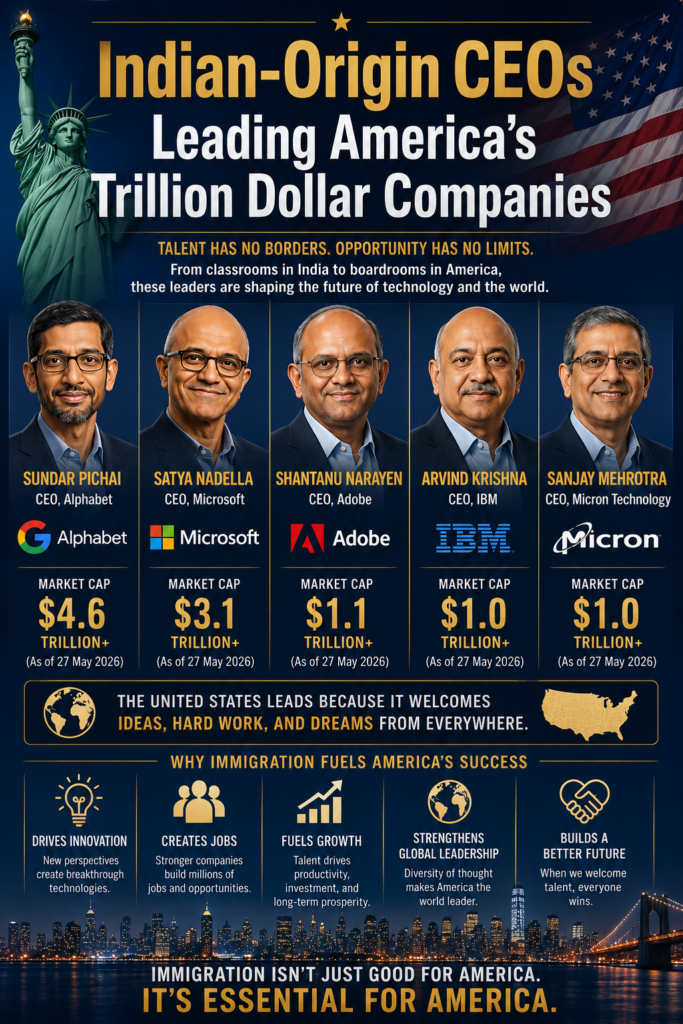
Today, some of the most influential technology companies in the United States are being led by Indian-origin CEOs. These are not small businesses or regional enterprises. These are companies valued in trillions of dollars that shape the global economy, influence technological progress and define the future of artificial intelligence, cloud computing, semiconductors and digital transformation.
From Google to Microsoft, from Adobe to IBM and Micron Technology, Indian-origin leaders are helping drive the next era of innovation in America.
This is not just a story about successful individuals. It is a story about the power of immigration, global talent and inclusive opportunity.
It is also one of the strongest examples of why the United States continues to remain a global innovation leader.
The Rise of Indian-Origin CEOs in America
Over the last two decades, the presence of Indian-origin leaders in global corporations has grown rapidly. What makes this trend extraordinary is not just representation but the scale of influence these leaders now command.
Sundar Pichai and Google
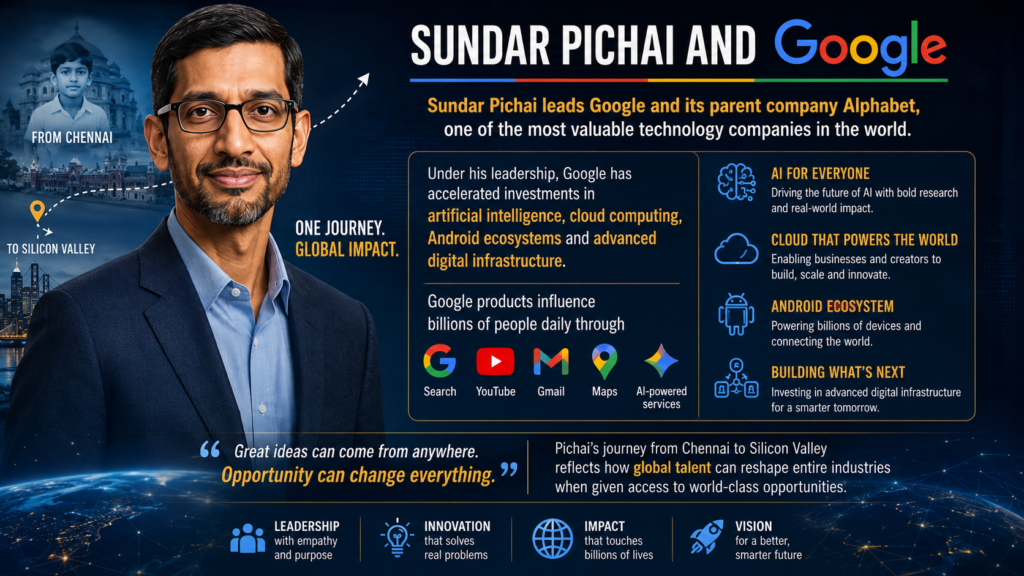
Sundar Pichai leads Google and its parent company Alphabet, one of the most valuable technology companies in the world.
Under his leadership, Google has accelerated investments in artificial intelligence, cloud computing, Android ecosystems and advanced digital infrastructure. Google products influence billions of people daily through search, YouTube, Gmail, Maps and AI-powered services.
Pichai’s journey from Chennai to Silicon Valley reflects how global talent can reshape entire industries when given access to world-class opportunities.
Satya Nadella and Microsoft
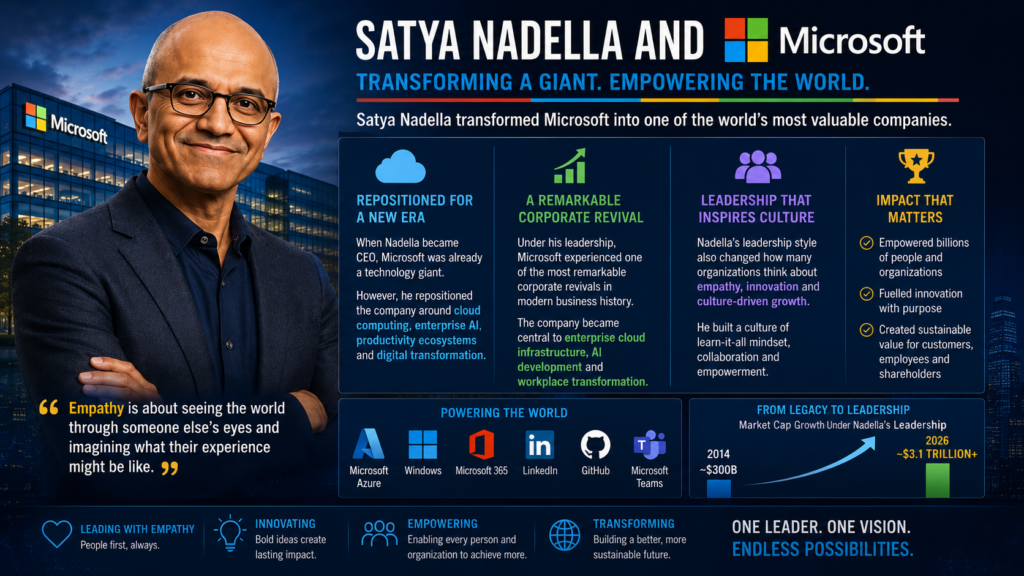
Satya Nadella transformed Microsoft into one of the world’s most valuable companies.
When Nadella became CEO, Microsoft was already a technology giant. However, he repositioned the company around cloud computing, enterprise AI, productivity ecosystems and digital transformation.
Under his leadership, Microsoft experienced one of the most remarkable corporate revivals in modern business history. The company became central to enterprise cloud infrastructure, AI development and workplace transformation.
Nadella’s leadership style also changed how many organizations think about empathy, innovation and culture-driven growth.
Shantanu Narayen and Adobe
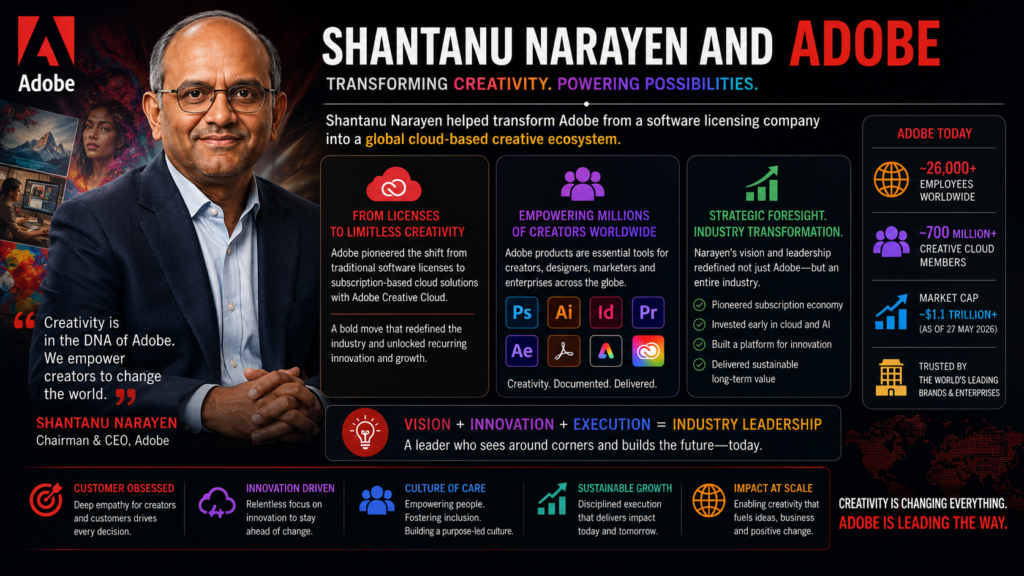
Shantanu Narayen helped transform Adobe from a software licensing company into a global cloud-based creative ecosystem.
Adobe products became essential tools for creators, designers, marketers and enterprises worldwide. The company successfully pioneered subscription-based digital models long before many competitors adapted.
Narayen demonstrated how strategic foresight and innovation can redefine entire industries.
Arvind Krishna and IBM
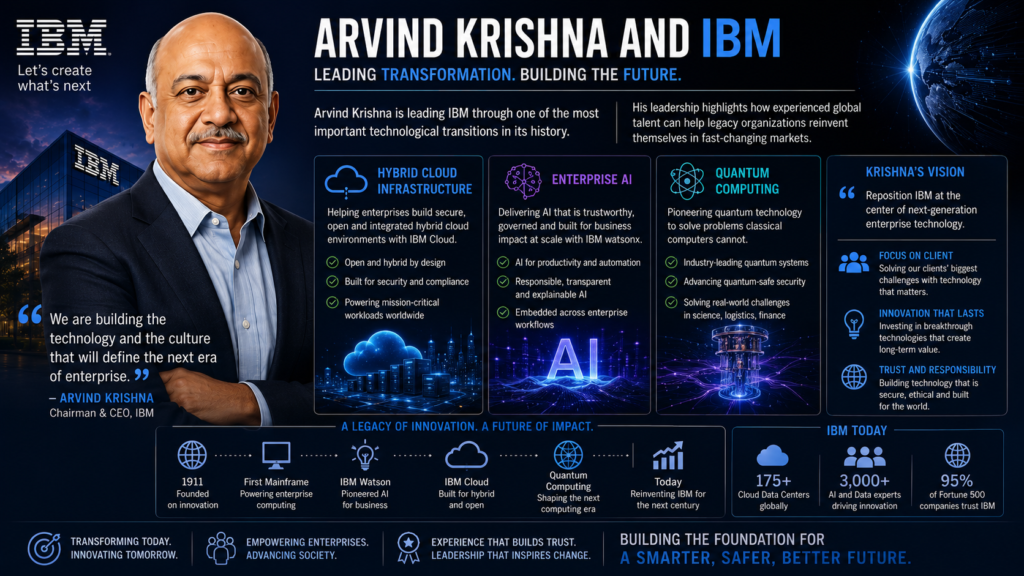
Arvind Krishna is leading IBM through one of the most important technological transitions in its history.
IBM is now focusing aggressively on hybrid cloud infrastructure, enterprise AI and quantum computing. Krishna’s vision aims to reposition IBM at the center of next-generation enterprise technology.
His leadership highlights how experienced global talent can help legacy organizations reinvent themselves in fast-changing markets.
Sanjay Mehrotra and Micron Technology
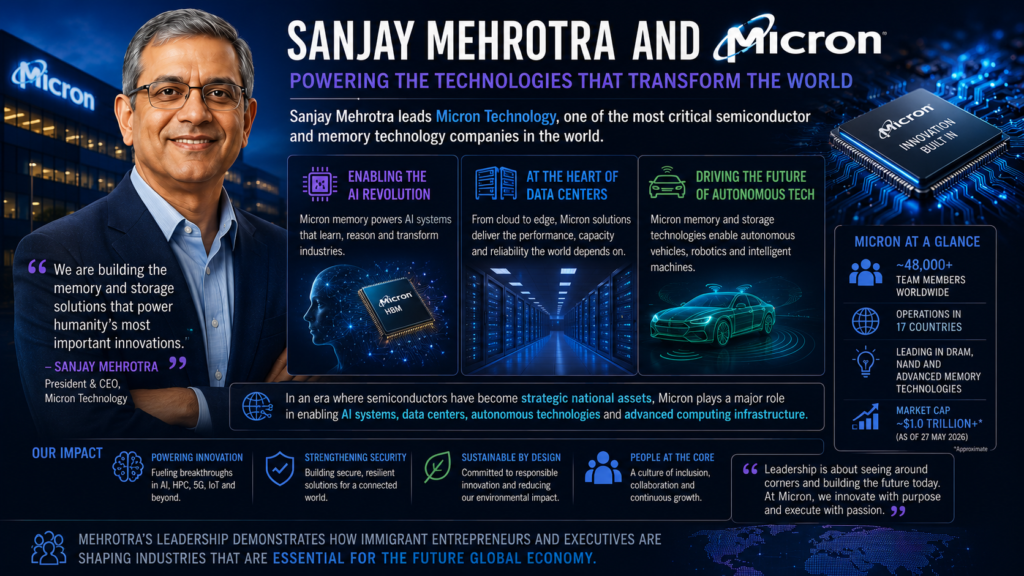
Sanjay Mehrotra leads Micron Technology, one of the most critical semiconductor and memory technology companies in the world.
In an era where semiconductors have become strategic national assets, Micron plays a major role in enabling AI systems, data centers, autonomous technologies and advanced computing infrastructure.
Mehrotra’s leadership demonstrates how immigrant entrepreneurs and executives are shaping industries that are essential for the future global economy.
Why Immigration Strengthens America
The success of Indian-origin CEOs is not accidental. It reflects a broader economic reality.
The United States became a global innovation powerhouse because it consistently attracted highly skilled people from across the world.
Immigration has contributed to America’s strength in multiple ways.
Immigration Expands the Talent Pool
Innovation depends on talent.
Countries that attract the best engineers, scientists, entrepreneurs and business leaders gain a competitive advantage. America’s universities, technology ecosystems and startup culture became magnets for global talent because they offered opportunities for growth and merit-based success.
Highly skilled immigrants have helped strengthen industries such as:
- Artificial intelligence
- Cloud computing
- Healthcare technology
- Semiconductors
- Aerospace
- Cybersecurity
- Financial technology
- Biotechnology
- Advanced manufacturing
Without global talent, many American industries would face severe shortages in critical expertise.
Immigration Drives Innovation
Immigrants are disproportionately represented among founders, researchers and innovators in the United States.
Many immigrant professionals bring unique problem-solving perspectives shaped by diverse educational systems, economic environments and cultural experiences.
Diversity of thought often leads to stronger innovation.
When people from different backgrounds collaborate, they challenge assumptions, generate new ideas and build more adaptable organizations.
This diversity advantage is one reason Silicon Valley became one of the world’s greatest innovation ecosystems.
Immigration Creates Jobs
One of the biggest misconceptions about immigration is that it reduces opportunities for local workers.
In reality, high-skilled immigration often creates entirely new industries and employment ecosystems.
Technology companies led by immigrant executives employ hundreds of thousands of workers directly and millions indirectly through suppliers, partners, developers, logistics providers and digital ecosystems.
Large technology companies also stimulate growth in:
- Infrastructure
- Real estate
- Education
- Digital services
- Manufacturing
- Consulting
- Advertising
- Transportation
- Retail
Immigration does not simply move people across borders. It expands economic activity.
Immigration Strengthens Global Competitiveness
The future global economy will increasingly depend on knowledge, innovation and advanced technologies.
Countries that fail to attract global talent may struggle to remain competitive in AI, semiconductor development, robotics and digital infrastructure.
The United States continues to maintain leadership partly because it remains attractive to ambitious individuals worldwide.
In a highly connected world, talent mobility has become a strategic economic advantage.
The Indian Education and Work Ethic Advantage
Indian-origin professionals have gained strong global recognition for technical capability, adaptability and resilience.
Several factors contributed to this rise.
Strong Focus on STEM Education
India produces a large number of engineers, software professionals and technical graduates every year.
Institutions such as the Indian Institutes of Technology and other engineering universities developed strong reputations for technical excellence and analytical thinking.
This educational foundation enabled many Indian professionals to succeed in global technology industries.
Adaptability and Problem Solving
Professionals from emerging economies often learn to operate under constraints, uncertainty and limited resources.
This develops adaptability, creative problem solving and operational resilience.
Many Indian-origin leaders successfully combine technical depth with strategic thinking and execution capability.
Long-Term Orientation
Many immigrant professionals pursue long-term educational and professional growth with exceptional discipline and persistence.
Their journeys often involve major sacrifices, cultural adaptation and continuous learning.
This resilience becomes a leadership advantage in high-pressure global environments.
America’s Real Competitive Weapon Is Opportunity
Natural resources alone no longer determine economic leadership.
In the modern world, the most valuable resource is human intelligence.
The countries that win the future will not necessarily be those with the largest populations or biggest territories. They will be the nations that successfully attract, retain and empower global talent.
America’s greatest strength has always been its ability to convert talent into opportunity.
That is why so many immigrants continue to contribute disproportionately to innovation, entrepreneurship and economic growth.
The American dream became globally powerful because it created belief.
Belief that talent matters more than background.
Belief that innovation matters more than geography.
Belief that ideas can change the world.
The Strategic Importance of Immigration in the AI Era
The importance of immigration will increase even further during the AI revolution.
Artificial intelligence is expected to reshape industries, economies and labor markets over the next decade.
The countries leading AI development will likely dominate future economic growth.
This requires extraordinary concentrations of:
- Engineers
- Data scientists
- Researchers
- Semiconductor experts
- Cloud architects
- Cybersecurity specialists
- AI strategists
Global competition for these professionals is intensifying rapidly.
The United States, Canada, the United Kingdom, Singapore and several European nations are already competing aggressively for skilled immigrants.
Talent attraction is becoming a national economic strategy.
Beyond Economics: Immigration and Cultural Strength
Immigration also contributes to cultural dynamism.
Global talent brings new perspectives, ideas, cuisines, art, entrepreneurship models and business philosophies.
Cities such as New York, San Francisco, Chicago and Seattle became innovation hubs partly because they attracted diverse populations.
Diversity strengthens creativity.
Organizations with multicultural leadership teams often understand global markets better and adapt more effectively to international opportunities.
In a globalized economy, cultural intelligence is increasingly becoming a competitive advantage.
Lessons for the World
The rise of Indian-origin CEOs in America offers important lessons for governments, businesses and societies.
Meritocracy Matters
People perform best when systems reward talent, capability and execution.
Nations and organizations that create merit-driven ecosystems tend to attract stronger talent.
Education Is a Long-Term Strategic Investment
Strong educational ecosystems can create global influence for decades.
Investment in technical education, research and innovation capabilities directly shapes economic competitiveness.
Openness Drives Growth
Countries that isolate themselves from global talent risk slowing innovation and competitiveness.
Open economies generally adapt faster to technological change.
Diversity Is an Innovation Multiplier
Homogeneous thinking limits creativity.
Diverse teams often generate stronger ideas, better problem-solving and improved decision-making.
Immigration Is About More Than Movement of People
Immigration is fundamentally about the movement of ambition, knowledge and ideas.
Every skilled immigrant carries more than qualifications. They carry aspirations, resilience, perspective and the willingness to build something meaningful.
The success of Indian-origin CEOs in America demonstrates what becomes possible when talent meets opportunity.
These leaders are not only running trillion-dollar companies. They are influencing the future of artificial intelligence, enterprise technology, digital infrastructure and global innovation.
Their journeys remind the world that great talent can emerge from anywhere.
The future will belong to countries that understand this reality and build systems that welcome, empower and elevate global talent.
Because in the modern economy, innovation has no borders.
And neither does ambition.