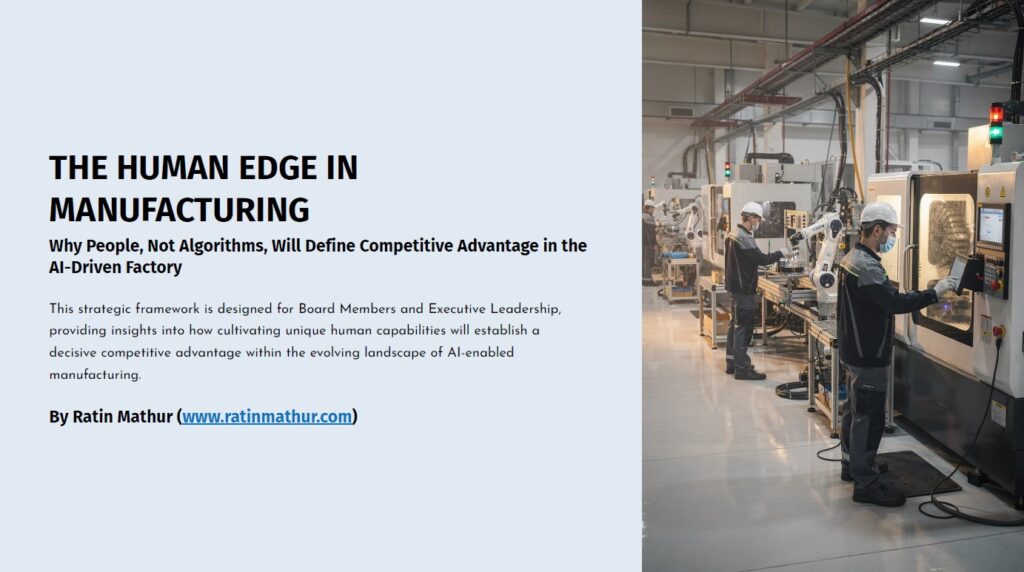
How Human Judgment, Craftsmanship, Leadership, and Ethics Will Define Industrial Work in the Age of AI
Contents
- Executive Summary
- Introduction: AI in Manufacturing – Promise and Limits
- Understanding “Non-Automatable” Work in Manufacturing
- Core Categories of Manufacturing Work AI Cannot Replace
4.1 Human Judgment & Accountability in Production Decisions
4.2 Skilled Craftsmanship and Tacit Knowledge
4.3 Complex Problem Solving & Improvisation on the Shop Floor
4.4 Leadership, Workforce Management & Industrial Culture
4.5 Ethics, Safety, and Regulatory Responsibility
4.6 Innovation, Process Design & Industrial Creativity
4.7 Customer Collaboration & Custom Manufacturing
4.8 Crisis Management & High-Risk Industrial Operations - Deep-Dive Analysis by Manufacturing Function
5.1 Production & Assembly
5.2 Quality & Inspection
5.3 Maintenance & Reliability
5.4 Process Engineering & Continuous Improvement
5.5 Supply Chain & Vendor Development
5.6 Industrial Safety & Compliance
5.7 R&D and Product Development
5.8 Plant Leadership & Operations Management - Why AI Will Augment, Not Replace, These Roles
- Strategic Implications for Manufacturing Companies
- Recommendations for Leaders, Policymakers & Workforce Development
- Conclusion: The Human-Centered Factory of the Future
- References (APA Format)
1. Executive Summary
Artificial Intelligence, robotics, and advanced automation are rapidly transforming manufacturing. Smart factories, predictive maintenance, AI-driven quality inspection, and autonomous material handling are becoming standard. Yet despite these advances, a critical truth remains:
Manufacturing will never be fully automated because production is not only technical — it is human, ethical, contextual, and creative.
This report identifies and analyzes the categories of manufacturing work that AI cannot fully replace and where humans will always be required, even in the most advanced factories. These roles persist because they rely on:
- Human judgment under uncertainty
- Tacit knowledge and craftsmanship
- Ethical responsibility and legal accountability
- Leadership, motivation, and culture-building
- Creative problem-solving and innovation
- Real-time improvisation in complex environments
Rather than eliminating humans, AI will amplify the importance of human roles in manufacturing — shifting workers from repetitive execution to decision-making, orchestration, problem solving, and innovation.
2. Introduction: AI in Manufacturing – Promise and Limits
Manufacturing has always been at the forefront of automation:
- Mechanization (Industrial Revolution)
- Electrification and mass production
- CNC machines and robotics
- Industry 4.0 and smart factories
- AI-driven analytics and digital twins
Today, AI can:
- Optimize production schedules
- Predict equipment failures
- Inspect parts using computer vision
- Simulate production lines
- Recommend process improvements
However, manufacturing is not a closed mathematical system. It is embedded in:
- Human behavior
- Organizational politics
- Regulatory environments
- Cultural practices
- Market uncertainty
- Physical variability
This creates structural limits to what AI can do.
3. Understanding “Non-Automatable” Work in Manufacturing
A manufacturing task is fundamentally human when it requires:
- Moral or legal responsibility
- Interpretation of ambiguous physical reality
- Contextual judgment beyond data
- Embodied skill and sensory feedback
- Creative recombination of experience
- Social leadership and trust
- Accountability for risk and failure
These are not technical gaps. They are ontological limits of machines.
4. Core Categories of Manufacturing Work AI Cannot Replace
4.1 Human Judgment & Accountability in Production Decisions
Why AI fails here:
AI can recommend. It cannot own consequences.
In manufacturing, decisions often involve:
- Safety trade-offs
- Cost vs quality trade-offs
- Delivery commitments under uncertainty
- Environmental compliance risks
Only humans can:
- Accept liability
- Defend decisions to regulators
- Face workers and unions
- Bear moral responsibility
Examples:
- A plant manager deciding to shut down a line due to a suspected defect
- A production head choosing to delay shipment rather than compromise safety
- A quality leader authorizing a deviation under extreme circumstances
AI may advise — humans decide and answer.
4.2 Skilled Craftsmanship and Tacit Knowledge
Not all manufacturing is robotic. Much of high-value manufacturing depends on craft skill:
- Tool & die making
- Mold making
- Precision welding
- Hand finishing and polishing
- Complex assembly
These rely on:
- Touch
- Sound
- Visual micro-cues
- Experience-based intuition
Tacit knowledge cannot be fully digitized.
Example:
An experienced machinist hears a subtle change in spindle sound and stops the machine before a catastrophic failure — something sensors may miss.
4.3 Complex Problem Solving & Improvisation on the Shop Floor
Real factories are messy:
- Raw material variability
- Machine wear
- Operator differences
- Environmental changes
AI assumes stable patterns. Reality is chaotic.
Humans excel at:
- Improvising workarounds
- Re-sequencing tasks
- Jugaad engineering
- Combining partial solutions
Example:
A line supervisor redesigns a temporary fixture using scrap material to keep production running during a tooling delay.
No algorithm was trained for that.
4.4 Leadership, Workforce Management & Industrial Culture
Factories are social systems.
Humans are required to:
- Motivate teams
- Resolve conflicts
- Build discipline and pride
- Handle unions and grievances
- Mentor apprentices
AI cannot:
- Inspire
- Build loyalty
- Sense morale shifts
- Manage egos and emotions
Example:
During a downturn, a plant head keeps workforce morale intact through transparent communication and personal presence — preventing attrition.
4.5 Ethics, Safety, and Regulatory Responsibility
Manufacturing involves:
- Worker safety
- Environmental impact
- Community responsibility
- Regulatory compliance
These are ethical domains, not computational ones.
Only humans can:
- Be jailed
- Be fined personally
- Be morally blamed
- Be socially shamed
Example:
A safety officer shuts down a line despite cost pressure because a guard is missing — an ethical decision, not an algorithmic one.
4.6 Innovation, Process Design & Industrial Creativity
AI can optimize existing processes.
Humans invent new ones.
Manufacturing innovation requires:
- Conceptual thinking
- Cross-domain analogy
- Business understanding
- Risk appetite
Examples:
- Toyota Production System
- Lean manufacturing
- Six Sigma
- Cellular manufacturing
These were human inventions, not algorithmic outputs.
4.7 Customer Collaboration & Custom Manufacturing
In B2B manufacturing:
- Requirements are vague
- Needs evolve
- Politics intervene
Humans are needed to:
- Interpret unstated needs
- Negotiate trade-offs
- Build trust
Example:
An application engineer modifies a design after reading between the lines of a customer’s operational challenge.
4.8 Crisis Management & High-Risk Industrial Operations
Crises include:
- Plant fires
- Explosions
- Major quality escapes
- Environmental leaks
- Labor unrest
In these moments:
- Data is incomplete
- Time is limited
- Emotions are high
Only humans can:
- Command authority
- Reassure stakeholders
- Make morally weighted decisions
AI cannot lead in chaos.
5. Deep-Dive Analysis by Manufacturing Function
5.1 Production & Assembly
AI can:
- Control robots
- Optimize sequences
- Balance lines
Humans will always:
- Handle exceptions
- Adjust for variability
- Train new operators
- Resolve conflicts
Why irreplaceable: Production is socio-technical, not purely technical.
5.2 Quality & Inspection
AI can:
- Detect surface defects
- Flag anomalies
Humans will always:
- Interpret root cause
- Decide acceptability
- Interface with customers
- Own recalls and warranties
Why irreplaceable: Quality is contextual, commercial, and reputational.
5.3 Maintenance & Reliability
AI can:
- Predict failures
- Recommend schedules
Humans will always:
- Diagnose ambiguous issues
- Perform complex repairs
- Improvise in breakdowns
Why irreplaceable: Machines fail in unpredictable ways.
5.4 Process Engineering & Continuous Improvement
AI can:
- Simulate flows
- Suggest optimizations
Humans will always:
- Design new layouts
- Challenge assumptions
- Lead Kaizen
- Balance cost, safety, and ergonomics
Why irreplaceable: Improvement is cultural as much as analytical.
5.5 Supply Chain & Vendor Development
AI can:
- Forecast demand
- Optimize inventory
Humans will always:
- Build supplier relationships
- Negotiate contracts
- Handle geopolitical risk
- Manage trust failures
Why irreplaceable: Supply chains are political systems, not equations.
5.6 Industrial Safety & Compliance
AI can:
- Monitor conditions
- Detect anomalies
Humans will always:
- Enforce discipline
- Conduct investigations
- Train behavior
- Make ethical calls
Why irreplaceable: Safety is moral leadership.
5.7 R&D and Product Development
AI can:
- Generate design options
- Run simulations
Humans will always:
- Define product vision
- Understand customer pain
- Make aesthetic and functional trade-offs
Why irreplaceable: Innovation is intention-driven.
5.8 Plant Leadership & Operations Management
AI can:
- Provide dashboards
- Highlight risks
Humans will always:
- Lead people
- Own results
- Take blame
- Build culture
Why irreplaceable: Factories are communities.
6. Why AI Will Augment, Not Replace, These Roles
6.1 Technical Limits
- Lack of true understanding
- Poor handling of novelty
- Limited embodiment
- Weak causal reasoning
6.2 Social Limits
- No legitimacy
- No moral authority
- No accountability
6.3 Business Reality
- Customers want human assurance
- Regulators demand human sign-off
- Workers need human leaders
7. Strategic Implications for Manufacturing Companies
- Human skills become more valuable, not less
- Leadership quality will outperform automation alone
- Factories will compete on culture, not just technology
- Training becomes strategic, not HR
- Ethics and safety become brand differentiators
8. Recommendations
For Manufacturing Leaders
- Invest in human capability, not just machines
- Redesign roles toward judgment, not execution
- Protect craft skills and apprenticeships
For Policymakers
- Support vocational education
- Incentivize human-centric manufacturing
- Regulate AI accountability clearly
For Workforce Development
- Focus on problem-solving, not button-pressing
- Teach systems thinking
- Develop leadership at shop-floor level
9. Conclusion: The Human-Centered Factory of the Future
The factory of the future will not be:
Dark, empty, and fully automated
It will be:
Intelligent, connected, and deeply human
AI will run machines.
Humans will run meaning, judgment, ethics, creativity, and leadership.
In manufacturing, technology scales production — humans define purpose.
Those companies that understand this will dominate the next industrial era.
10. References (APA Format)
- Autor, D. H. (2015). Why Are There Still So Many Jobs? The History and Future of Workplace Automation. Journal of Economic Perspectives, 29(3), 3–30.
- Brynjolfsson, E., & McAfee, A. (2014). The Second Machine Age. W. W. Norton.
- Susskind, R., & Susskind, D. (2015). The Future of the Professions. Oxford University Press.
- West, D. M. (2018). The Future of Work. Brookings Institution Press.
- Dreyfus, H. L. (1972). What Computers Can’t Do. Harper & Row.
- Floridi, L. (2014). The Fourth Revolution. Oxford University Press.
- Womack, J. P., & Jones, D. T. (1996). Lean Thinking. Simon & Schuster.
- Liker, J. K. (2004). The Toyota Way. McGraw-Hill.
- Kagermann, H., Wahlster, W., & Helbig, J. (2013). Recommendations for Implementing the Strategic Initiative Industrie 4.0.
- Porter, M. E., & Heppelmann, J. E. (2015). How Smart, Connected Products Are Transforming Companies. Harvard Business Review.