Why Globalization, Not Localization, Is the Sustainable Path Forward
Executive Summary
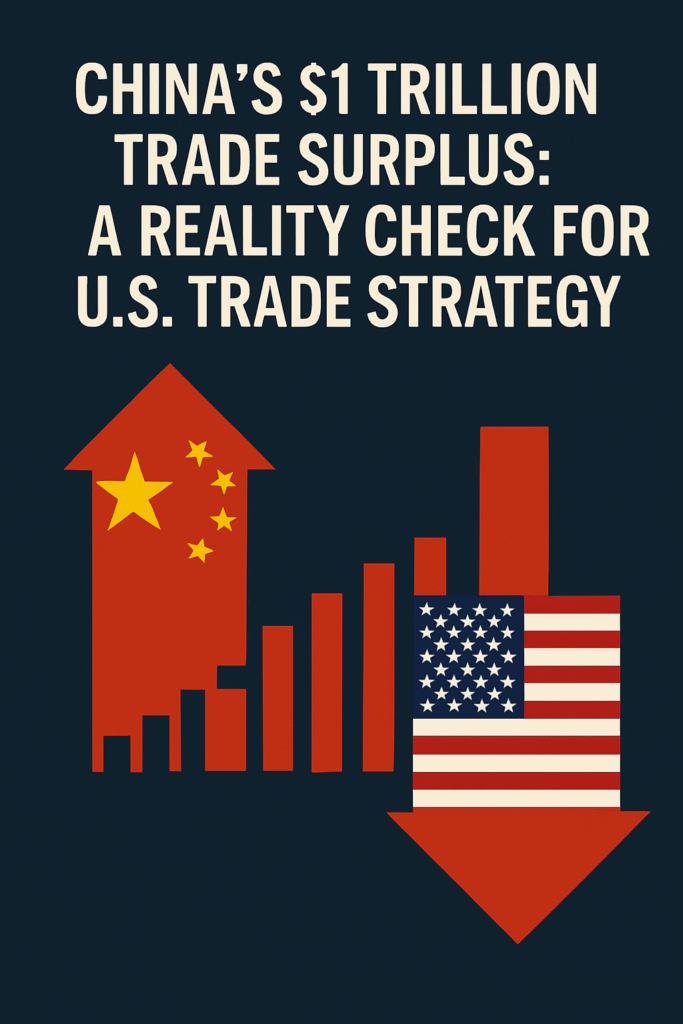
In 2025, China crossed a historic milestone: its trade surplus exceeded $1 trillion for the first time in 11 months. This occurred despite years of elevated U.S. tariffs, intensified trade restrictions, and a broader political narrative centered on economic nationalism, localization, and reshoring of manufacturing.
For policymakers, business leaders, and global strategists, this development raises a critical question:
If tariffs on China are among the highest in modern U.S. history, why does the U.S. still run a large trade deficit with China—and why has China’s global surplus continued to grow?
This report examines the structural, economic, and strategic realities behind this outcome. It argues that tariffs, when used as a primary tool, are ineffective against deeply embedded global manufacturing systems and often produce unintended consequences for the imposing country. Most importantly, it concludes that globalization—not isolation—is the more realistic and economically sound path for the United States, given its cost structure, labor economics, and comparative advantages.
1. Understanding the Trade Surplus Milestone
China’s trade surplus surpassing $1 trillion is not an isolated or short-term anomaly. It reflects several long-standing structural strengths:
- Deep and integrated manufacturing ecosystems
- High productivity at scale
- Extensive supplier networks
- Strong logistics and port infrastructure
- A diversified global export base
While exports to the U.S. have declined in recent years, China has successfully redirected trade flows to Europe, Southeast Asia, the Middle East, Latin America, and Africa. In other words, tariffs changed where Chinese goods were sold—but not whether they were sold.
This distinction is crucial.
2. The U.S.–China Trade Deficit: A Persistent Reality
Despite high tariffs, the U.S. trade deficit with China remains substantial. While the absolute size of the deficit has fluctuated year to year, it remains one of the largest bilateral trade imbalances in the world.
Why the deficit persists:
- U.S. consumption remains strong
The U.S. economy is consumption-driven. American households and businesses demand affordable goods at scale—electronics, consumer products, industrial inputs—that China is uniquely positioned to supply. - Tariffs raise prices, not alternatives
Tariffs increase the cost of imports but do not automatically create competitive domestic substitutes. In many categories, U.S. manufacturing capacity either does not exist or cannot compete on price. - Supply chains are global, not bilateral
Even when imports from China decline, many goods re-enter the U.S. supply chain through third countries after partial processing or assembly elsewhere. - Trade balances reflect savings and investment patterns
Trade deficits are not purely trade phenomena; they are macroeconomic outcomes shaped by consumption, investment, and capital flows.
3. Why Tariffs Do Not Fix Structural Trade Imbalances
Tariffs are often framed as a corrective tool—meant to protect domestic industry, reduce dependence on foreign suppliers, and rebalance trade. In practice, their effectiveness is limited when structural realities are ignored.
3.1 Tariffs Address Price, Not Capability
Tariffs make imported goods more expensive, but they do not create:
- Skilled labor
- Manufacturing ecosystems
- Supplier density
- Cost competitiveness
Without these, domestic production does not automatically replace imports.
3.2 Retaliation and Trade Diversion
Tariffs invite retaliation. They also cause trade diversion, where supply chains shift geographically rather than return home. This means:
- China exports less to the U.S. but more elsewhere
- U.S. imports shift to other low-cost countries, not domestic producers
3.3 Inflationary Pressure
Tariffs function as a tax on imports. In a high-consumption economy, this often leads to:
- Higher consumer prices
- Higher input costs for domestic manufacturers
- Reduced competitiveness of U.S. exports
4. The Labor Cost Reality: Why the U.S. Cannot Compete on Low-Cost Manufacturing
One of the most critical—and often overlooked—factors in the tariff debate is labor economics.
4.1 Structural Cost Disadvantage
The U.S. has one of the highest labor cost structures globally when wages, benefits, compliance, and productivity-adjusted costs are considered. By contrast:
- China, Vietnam, India, Mexico, and others offer significantly lower manufacturing labor costs
- These countries have invested heavily in industrial clusters designed for scale manufacturing
This gap cannot be closed through tariffs alone.
4.2 Automation Is Not a Universal Solution
While automation can offset labor costs in certain industries, it is:
- Capital-intensive
- Best suited for high-value or precision manufacturing
- Not a replacement for labor-intensive, low-margin production
Attempting to fully reshore low-cost manufacturing through automation often results in higher prices with limited employment gains.
5. The Risk of Misinterpreting Economic Strength
Political narratives such as “Make America Great Again” or claims that the U.S. is the “hottest economy in the world” often conflate macroeconomic strength with manufacturing competitiveness.
These are not the same.
- The U.S. is strong in services, technology, finance, innovation, and capital markets
- It is not structurally positioned to dominate low-cost mass manufacturing
Confusing these domains leads to policy misalignment.
6. Globalization vs Localization: A Strategic Comparison
Localization (Tariff-Driven Strategy)
Pros:
- Political appeal
- Short-term protection for select industries
- Perceived control over supply chains
Cons:
- Higher consumer prices
- Limited job creation
- Supply-chain inefficiency
- Reduced export competitiveness
- Risk of retaliation
Globalization (Strategic Integration)
Pros:
- Cost efficiency
- Supply-chain resilience through diversification
- Access to global innovation and talent
- Stronger export competitiveness
- Lower inflationary pressure
Cons:
- Requires coordination and diplomacy
- Demands strong domestic policy alignment
7. What a Smarter U.S. Trade Strategy Looks Like
A sustainable U.S. trade strategy does not attempt to replicate China’s manufacturing model. Instead, it plays to America’s strengths.
7.1 Compete Where the U.S. Has Advantage
- Advanced technology
- Intellectual property
- Software and digital services
- High-value manufacturing (semiconductors, aerospace, medical devices)
- Financial and professional services
7.2 Use Global Supply Chains Strategically
Rather than breaking globalization, the U.S. should:
- Diversify sourcing
- Reduce over-dependence on single geographies
- Strengthen alliances and trade partnerships
7.3 Invest Domestically Without Isolation
Domestic investment should focus on:
- Skills and workforce development
- Infrastructure and logistics
- R&D and innovation ecosystems
Not on trying to recreate low-cost manufacturing economics that no longer fit the U.S. cost structure.
8. Lessons from China’s $1 Trillion Surplus
China’s surplus is not simply a reflection of tariffs “failing.” It reflects:
- Long-term industrial planning
- Global market integration
- Cost discipline and scale
- Supply-chain depth
It also highlights a broader truth: global trade is adaptive. When pressure is applied in one direction, flows adjust rather than disappear.
9. Implications for Businesses
For global companies, this environment reinforces several imperatives:
- Design supply chains for flexibility, not nationalism
- Hedge geopolitical risk through diversification
- Focus on cost, resilience, and speed—not just origin
- Separate political narratives from operational reality
Companies that align strategy with economic fundamentals—not slogans—will outperform.
10. Strategic Perspective
The persistence of China’s trade surplus and the U.S. trade deficit despite high tariffs underscores a fundamental lesson:
You cannot tariff away structural economic realities.
The U.S. cannot—and does not need to—out-manufacture low-cost economies to remain globally competitive. Its strength lies in innovation, capital efficiency, services, and high-value industries. Attempting to reverse globalization through tariffs risks higher costs, weaker competitiveness, and strategic isolation.
The smarter path forward is strategic globalization:
leveraging global supply chains, strengthening partnerships, investing in domestic capabilities where they matter most, and accepting that economic leadership in the 21st century is built through integration—not insulation.