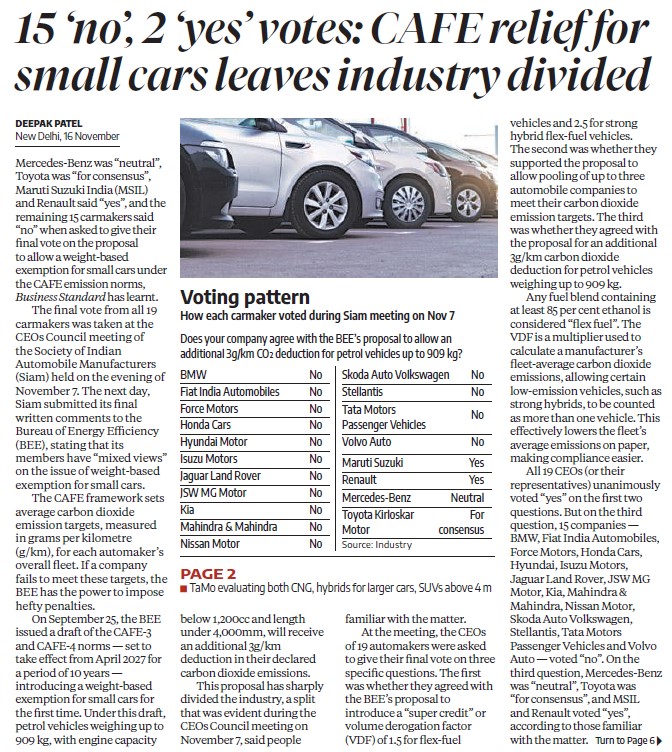
Business Standard’s latest report on the CAFE vote highlights a deeper strategic tension shaping India’s auto industry. Why did 15 OEMs vote ‘No’ to CO₂ relief for small cars?
Key Strategic Reasons Behind the Pushback:
• Margins Don’t Support Compliance Costs – Small cars operate on wafer-thin profitability. Adding hybridisation, lighter materials, or tech credits significantly erodes margins.
• Unbalanced Investment Economics – R&D for low-emission tech pays off faster in SUVs and premium models where pricing power is higher.
• Regulatory Ambiguity – One-time exemptions risk creating inconsistent compliance pathways, making long-term planning harder.
• Portfolio Realignment Already Underway – OEMs are shifting capital to SUVs/EVs where demand is strong and returns are compelling.
What This Means for the Market:
• Small cars may face slower tech upgrades and limited new launches.
• Potential price hikes could push entry buyers toward used cars or compact SUVs.
• The industry risks a structural imbalance, with India drifting toward an SUV-heavy market while the need for affordable, low-emission mobility remains unmet.
The Strategic Imperative:
If India wants small cars to remain viable, compliant, and affordable, policy design must align economic incentives with emission goals. Without this balance, manufacturers will naturally follow the margin—and that path leads away from the mass-market segment.