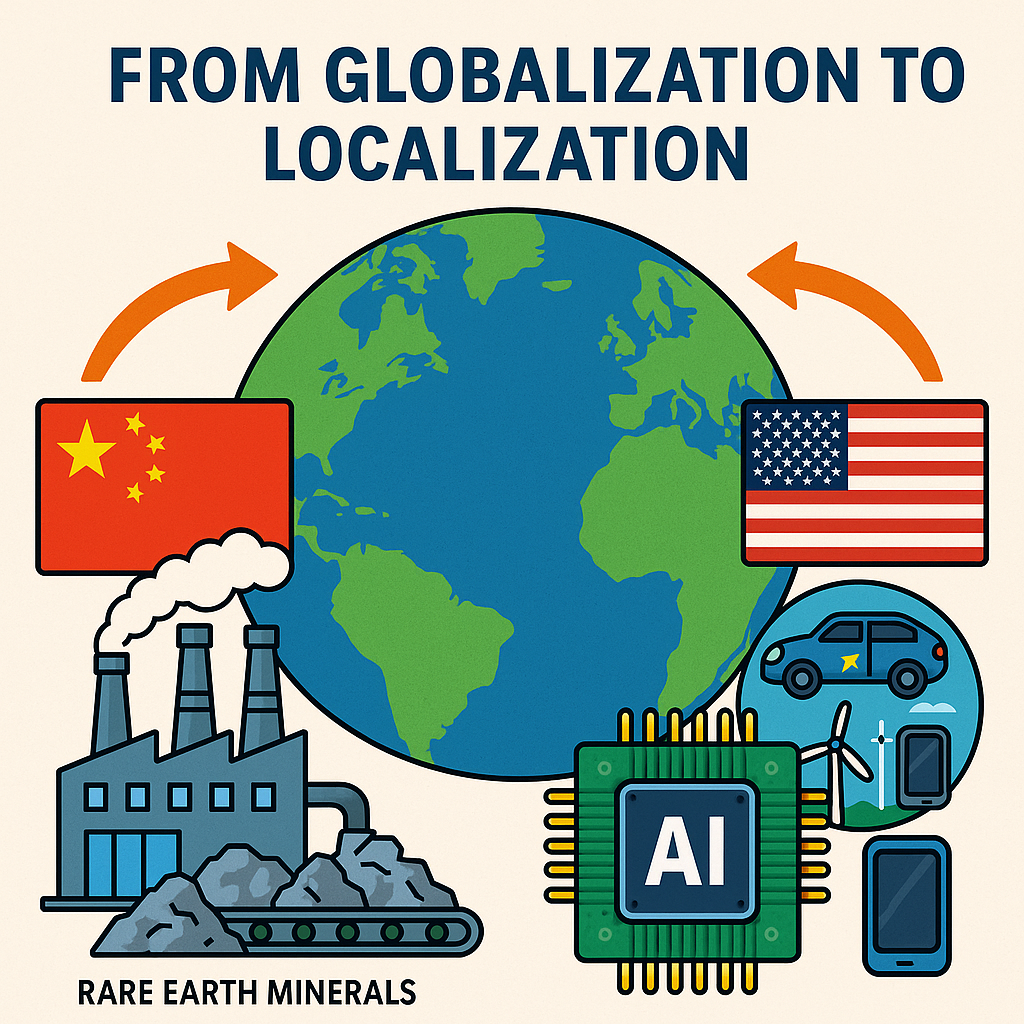
For over three decades, globalization — the free flow of goods, services, and ideas across borders — powered unprecedented growth. Countries specialized in what they did best, and global supply chains connected the world like never before.
But today, we are witnessing a strategic shift from globalization to localization — a move driven by rising risks, geopolitical tensions, and the lessons learned from supply chain disruptions during the pandemic and beyond.
So, why is this happening?
✅ 1️⃣ Geopolitical Rivalries:
Tensions between major powers like the United States of America (USA) and China have divided the global technology and trade landscape. Export bans, sanctions, and restrictions on artificial intelligence (AI) chips and rare earth minerals are forcing countries to rethink their dependencies.
✅ 2️⃣ Supply Chain Vulnerabilities:
Events such as the blockage of the Suez Canal, the drought in Panama Canal, and conflicts affecting shipping routes through the Red Sea have shown how fragile global logistics can be. Companies now prefer to produce closer to home — a concept known as nearshoring or friendshoring — to reduce risks and delays.
✅ 3️⃣ Technological and Environmental Factors:
Automation, digital manufacturing, and carbon-neutral policies are reducing the advantage of cheap labor abroad. Countries are investing heavily in green technology, recycling, and local innovation ecosystems.
✅ 4️⃣ Rise of Industrial Policies:
Governments are no longer leaving industrial growth entirely to markets. Initiatives like the United States CHIPS and Science Act and the European Union Critical Raw Materials Act aim to build domestic capacity and reduce reliance on single-country suppliers.
📉 The China Factor:
China remains the world’s manufacturing hub, producing and processing the majority of rare earth elements — crucial for electric vehicles, wind turbines, and smartphones. Meanwhile, the USA leads in semiconductor and AI chip technology through companies like NVIDIA.
Both nations are now leveraging their dominance to influence global trade — creating new challenges for every other economy.
🧭 The Way Forward:
It’s not about choosing localization over globalization — it’s about balancing efficiency with resilience.
- Globalize where it is safe and economical.
- Localize where it is strategic and essential.
- Diversify suppliers to avoid dependency on one nation or one region.
🏁 In conclusion:
The world is entering a new era — not of de-globalization, but of “re-globalization” — where smarter, diversified, and technology-driven partnerships will define the next phase of growth.