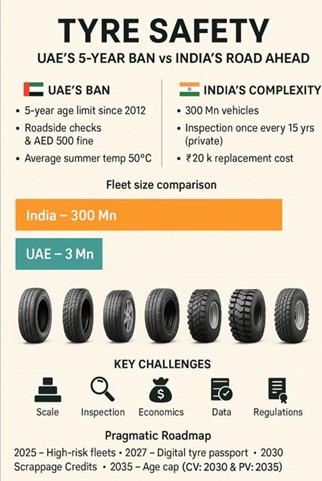
Dubai’s Roads & Transport Authority (RTA) issued its annual Summer Without Accidents advisory, reminding drivers that tires older than five years are outright banned on UAE roads—a rule enforced with roadside checks and heavy penalties to prevent blow-outs at 50 °C summer temperatures.
But could India replicate this seemingly simple safety intervention?
Short answer: not any time soon.. Here’s why 👇
1️⃣ Scale & diversity
> 260 million two-wheelers and 50 million cars traverse 6.6 million km of roads—orders of magnitude above the UAE’s entire vehicle parc. Policing tire age across 36 states/UTs, thousands of district roads and countless rural tracks would overwhelm existing RTO capacity.
2️⃣ Inspection gap
Only commercial vehicles undergo an annual fitness test; private owners see an inspector once every 15 years (registration renewal). No nationwide MOT-style network exists to read side-wall dates or flag expired rubber.
3️⃣ Economics & the informal market
A full replacement can exceed ₹20k for a hatchback and ₹3k for a scooter—well above median monthly spending, pushing owners toward second-hand imports, part-worn swaps or roadside retreads.
An unorganized retreading sector (₹7,000 cr+) would need a parallel overhaul to stop “resetting” the ageing clock.
4️⃣ Data signals vs policy urgency
Tire-burst crashes are deadly but relatively small—≈10k cases and 3k deaths a year, dwarfed by speeding and driver error that together cause 70 %+ of fatalities. Policymakers tend to chase bigger numbers first.
5️⃣ Regulatory complexity
BIS & CMVR amendments already mandate wet-grip and noise standards but stop short of an age limit; aligning 1400 tire models, multiple IS codes and state enforcement rules would take years.
A pragmatic roadmap instead of an outright ban
• Start with inter-state buses, school vans, haz-chem tankers (AIS-140 GPS).
• Digital tire passports: DOT code in VAHAN/FASTag for touch-less checks.
• Scrappage credits/GST relief for rural 2-wheelers & fleets.
• Star-labels at POS + OEM/e-commerce fitment drives.
• 5-yr cap by 2030 (commercial) & 2035 (private), phased state-wise as infra matures.
𝗕𝗼𝘁𝘁𝗼𝗺 𝗹𝗶𝗻𝗲
India can pursue the spirit of the UAE’s five-year rule, but an immediate blanket ban would be unenforceable and economically disruptive. A phased, data-driven approach—pairing regulation with affordability and tech-enabled enforcement—offers a far safer, more realistic path.
What’s your take? Should we priorities inspection capacity before age caps, or leapfrog straight to digital enforcement? 🛞💭